
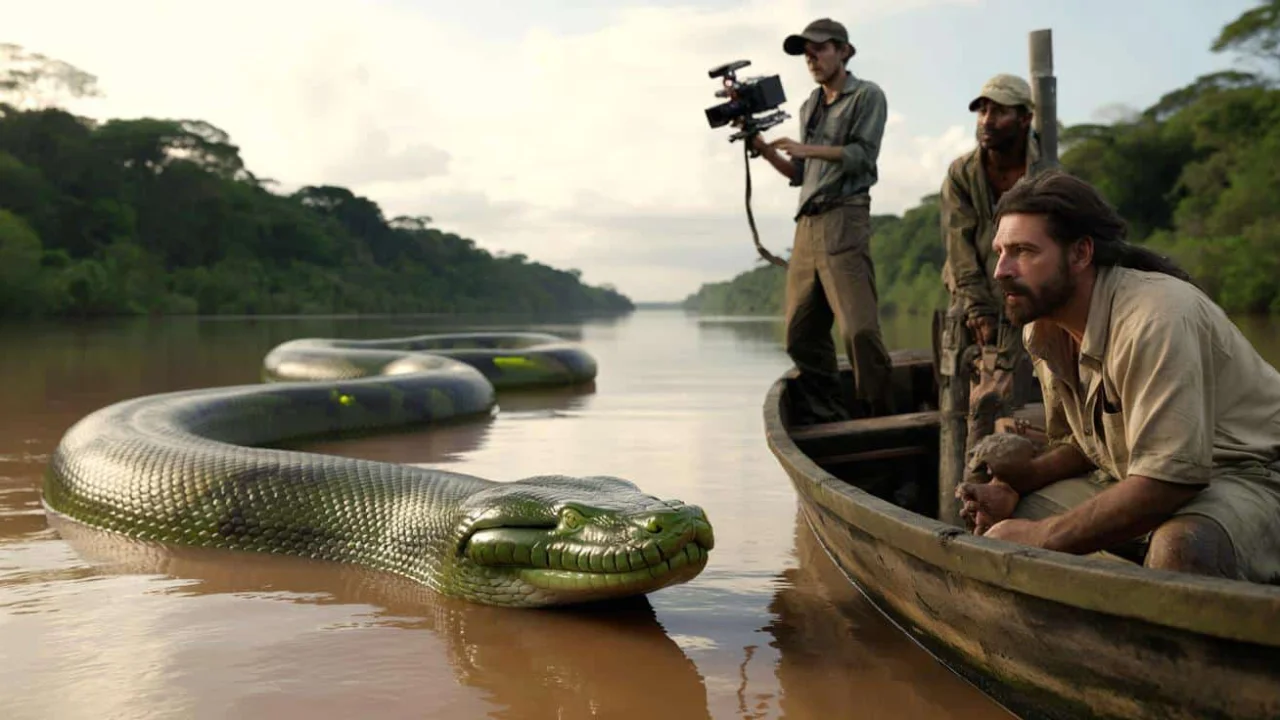
Picture yourself on a small boat, deep in the Amazon rainforest. The air is so thick you can almost chew it, and every sound seems muffled by the green canopy above. You’re scanning the murky water for wildlife when suddenly, your guide goes completely silent. He’s pointing at something just beneath the surface—something that makes your brain struggle to process what you’re seeing.
This exact scenario unfolded during a recent documentary shoot featuring Will Smith. What they captured on camera wasn’t just another Amazonian creature. It was an amazon river monster that has scientists questioning everything they thought they knew about the world’s largest snakes.
The massive anaconda measured an estimated 7.5 meters—potentially breaking records and rewriting wildlife biology textbooks in the process.
When Hollywood Cameras Captured Scientific History
The snake didn’t announce itself with fanfare. Instead, it revealed itself piece by piece, like a slow-motion magic trick that nobody wanted to believe. First, a thick, muscular section appeared—as wide as a truck tire. Then came the unmistakable head, broad and ancient-looking, with eyes that seemed completely indifferent to the boat full of humans above.
“We’ve been studying anacondas for decades, but nothing prepares you for seeing something this massive in the wild,” explains Dr. Maria Santos, a herpetologist who reviewed the footage. “The sheer scale challenges our understanding of what these animals can achieve.”
The documentary crew used laser rangefinders and reference measurements to estimate the snake’s size. Every calculation came back larger than expected. This wasn’t just a big anaconda—this was potentially a record-breaking amazon river monster that exists at the very edge of what science considers possible.
Local guides have whispered stories about giant river serpents for generations. Tales of 30-meter snakes that swallow cattle whole or drag canoes underwater with a single twist. Most scientists dismiss these stories as folklore mixed with fear and exaggeration.
But this time was different. Multiple cameras captured the encounter from various angles, providing the kind of documentation that transforms legend into scientific evidence.
Breaking Down the Numbers Behind This Amazon Giant
Understanding why this discovery matters requires looking at the science behind anaconda size limits. Here’s what makes this amazon river monster so extraordinary:
| Measurement | Typical Anaconda | Large Anaconda | This Discovery |
|---|---|---|---|
| Length | 4-5 meters | 6-6.5 meters | 7.5+ meters |
| Weight | 30-70 kg | 100-200 kg | 250+ kg (estimated) |
| Body Diameter | 20-30 cm | 30-40 cm | 40+ cm |
The size difference isn’t just impressive—it’s scientifically significant. Female green anacondas are typically larger than males, and the biggest verified specimens barely reach 6.5 meters. This amazon river monster pushes well beyond those boundaries.
“When you’re dealing with an animal this size, you’re looking at a completely different ecological role,” notes wildlife biologist Dr. James Rodriguez. “A 7.5-meter anaconda can take prey that smaller snakes simply cannot handle.”
Key factors that make this discovery remarkable:
- Exceeds previous size records by over a meter
- Captured on high-definition camera equipment
- Documented by professional film crew and biologists
- Measured using scientific rangefinding equipment
- Represents potential new upper size limit for the species
What This Discovery Means for Amazon Conservation
Finding an amazon river monster of this size raises important questions about habitat preservation and ecosystem health. Large anacondas like this one require extensive territories and abundant prey populations to survive.
The discovery suggests that some areas of the Amazon remain pristine enough to support apex predators at their maximum potential size. This is encouraging news for conservationists who worry about habitat fragmentation and wildlife population decline.
“Large predators are indicators of ecosystem health,” explains conservation biologist Dr. Ana Gutierrez. “When you see animals reaching these extreme sizes, it tells you the environment is still functioning properly.”
However, the rarity of such encounters also highlights how much we still don’t know about Amazon wildlife. If snakes this large exist, how many other undocumented giants are swimming through the murky waters of the world’s largest river system?
The implications extend beyond scientific curiosity:
- Supports arguments for expanded protected areas
- Demonstrates importance of intact river ecosystems
- Provides new data for anaconda conservation efforts
- Highlights gaps in our understanding of Amazon biodiversity
Climate change and deforestation threaten the delicate balance that allows such massive predators to thrive. Protecting the habitats where these amazon river monsters can reach their full potential becomes increasingly critical as human development expands into previously untouched areas.
The Bigger Picture for Amazon Research
This discovery represents more than just a really big snake. It demonstrates how much we still have to learn about one of Earth’s most biodiverse ecosystems. The Amazon continues to surprise scientists with new species discoveries and record-breaking specimens that push the boundaries of what we thought possible.
“Every time we think we understand the Amazon’s limits, nature proves us wrong,” says Dr. Rodriguez. “This anaconda reminds us that there are still mysteries waiting in those dark waters.”
The encounter also showcases how modern technology can capture and verify extraordinary wildlife encounters. High-definition cameras, drones, and precision measurement tools transform anecdotal sightings into scientific documentation.
For local communities who have shared stories about giant river serpents for generations, this discovery validates traditional knowledge that scientists sometimes dismiss. The intersection between indigenous wisdom and modern research continues to yield important insights about Amazon ecology.
FAQs
How big was the amazon river monster found during the Will Smith documentary?
The anaconda measured approximately 7.5 meters in length, potentially making it one of the largest ever documented on camera.
Are there really snakes this big living in the Amazon?
While extremely rare, giant anacondas of this size can exist in pristine Amazon habitats with abundant prey and minimal human disturbance.
How do scientists measure such large snakes in the wild?
Researchers use laser rangefinders, reference objects, and high-resolution camera analysis to estimate size without capturing or disturbing the animal.
What do amazon river monsters this large eat?
Giant anacondas can consume large fish, caimans, capybaras, and even small deer or pigs that come to the water’s edge.
Is this the largest snake ever found?
While potentially record-breaking for anacondas, some reticulated pythons in Southeast Asia may reach similar or greater lengths.
How often do people encounter snakes this size in the Amazon?
Encounters with amazon river monsters of this magnitude are extremely rare, which makes this documented sighting particularly significant for science.


