
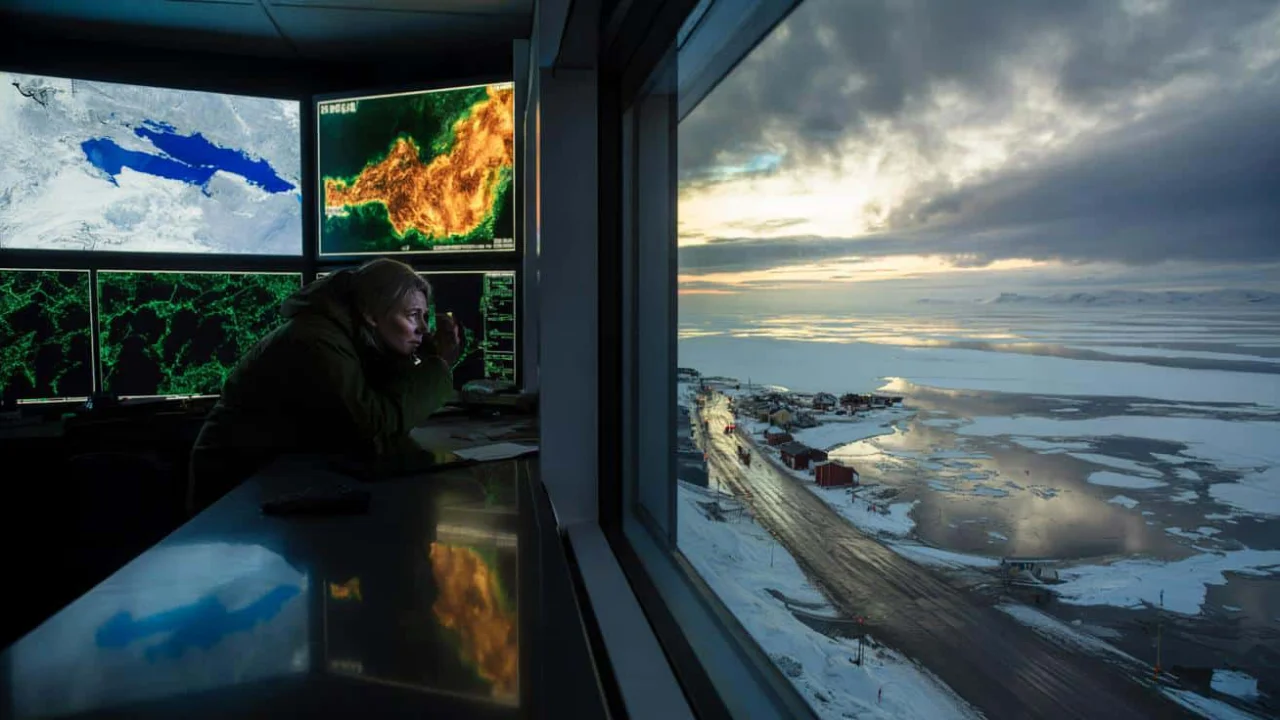
Maria pulls her truck over on the remote Alaska highway, stepping out into what should be bitter February air. Instead, she feels something almost like spring—wet snow hitting her face, temperatures hovering just below freezing when they should be plunging to -30°F. She’s been driving this route for fifteen years, delivering supplies to isolated villages. This year feels different.
The ice road she planned to take next week might not even form. Local elders are shaking their heads, saying they’ve never seen a February like this. What Maria doesn’t know is that thousands of miles away, meteorologists are staring at their screens with the same worried expression.
They’re watching arctic conditions deteriorating in real time, weeks ahead of schedule.
When Winter Loses Its Grip
Across the Arctic, something fundamental is shifting. Meteorologists aren’t just tracking another warm spell—they’re witnessing a breakdown in the seasonal patterns that have defined northern winters for millennia.
The numbers tell a stark story. Air temperatures across vast Arctic regions are running 6 to 10°C above historical averages. Sea ice that should be steadily thickening through February is instead stalling, and in some areas, actually retreating.
“We’re seeing February behave like March used to,” explains Dr. James Mitchell, a climatologist who has monitored Arctic conditions for over two decades. “The calendar says deep winter, but the ice is already thinking spring.”
February has traditionally been the Arctic’s strongest month—the time when sea ice reaches maximum thickness and the polar cold recharges for another year. That reliability is crumbling.
Researchers at the Danish Meteorological Institute recently published ice extent maps that looked more appropriate for mid-March. The Bering Sea shows gaping blue patches where solid white ice should dominate. The Barents Sea tells the same troubling story.
The Numbers Behind the Crisis
The scale of this early deterioration becomes clearer when you look at the data side by side:
| Arctic Region | Temperature Anomaly | Ice Loss Timeline |
|---|---|---|
| Bering Sea | +8°C above average | 4 weeks early |
| Barents Sea | +6°C above average | 3 weeks early |
| Canadian Arctic | +10°C above average | 2-3 weeks early |
| Greenland Coast | +7°C above average | 3-4 weeks early |
The warning signs are appearing everywhere:
- Sea ice thickness measurements show 20-30% less growth than normal for this time of year
- Coastal Alaska communities report ice roads becoming impassable weeks ahead of schedule
- Northern Scandinavia recorded rain-on-snow events during what should be the coldest period
- Siberian weather stations logged temperatures that typically don’t occur until late March
- Greenland’s ice sheet shows surface melting activity in areas that usually remain frozen until May
“The Arctic is warming roughly four times faster than the global average,” notes Dr. Sarah Chen, an Arctic specialist at the National Weather Service. “When your baseline keeps climbing, the traditional winter window keeps shrinking.”
Indigenous communities across the north are adapting to changes their ancestors never faced. Inuit hunters describe sea ice that “feels different”—thinner, more unpredictable, breaking up earlier each year.
What This Means for Everyone
Arctic conditions deteriorating this early doesn’t just affect polar bears and research stations. The impacts ripple outward in ways that touch lives across the globe.
When the Arctic loses its winter grip, weather patterns everywhere start shifting. The polar vortex becomes less stable, potentially sending more extreme cold snaps south while leaving the north unusually warm. This creates the paradox of Arctic heat waves coinciding with southern blizzards.
Shipping companies are already adjusting routes as Arctic passages open earlier and stay open longer. While this creates new economic opportunities, it also accelerates ice loss by bringing more warm water north.
Coastal communities face the most immediate challenges. In Alaska, villages that depend on ice roads for supplies are scrambling to find alternatives. Some are considering expensive airlifts for essential goods that trucks normally carry across frozen ground.
“My grandfather could predict ice conditions weeks in advance,” shares Thomas Kanguq, a community leader from northern Alaska. “Now we’re making it up day by day.”
The economic ripples extend far beyond the Arctic. Insurance companies are reassessing flood risks for coastal areas worldwide as accelerated ice loss contributes to sea level rise. Agricultural regions are watching weather pattern shifts that could affect everything from crop timing to water availability.
Wildlife populations are struggling to adapt. Polar bears, seals, and Arctic foxes depend on predictable sea ice formation for hunting and breeding. When that ice forms late and breaks up early, entire ecosystems feel the pressure.
The most concerning aspect might be the feedback loops. Less ice means more dark ocean water absorbing heat instead of white ice reflecting it back to space. This accelerates warming, which reduces ice further, creating a cycle that’s increasingly difficult to break.
Climate scientists emphasize that this isn’t a distant future scenario—it’s happening now, measurably faster than most models predicted even a decade ago.
“We’re not just losing individual winters,” explains Dr. Mitchell. “We’re watching the entire concept of Arctic winter change before our eyes.”
The question facing researchers isn’t whether arctic conditions will continue deteriorating, but how quickly the changes will compound and what that means for weather patterns worldwide. February used to be the month when the Arctic recharged its climate influence. Now it’s becoming just another step in an accelerating retreat.
FAQs
Why are arctic conditions deteriorating so much faster than expected?
The Arctic is warming about four times faster than the global average due to feedback loops where melting ice exposes dark water that absorbs more heat, accelerating the warming process.
How does early Arctic ice loss affect weather in other parts of the world?
When Arctic ice melts early, it destabilizes the polar vortex, potentially causing more extreme weather events both north and south, including unexpected cold snaps in typically warmer regions.
Will February still have winter conditions in the future?
Climate models suggest that February will continue to warm, with some Arctic regions potentially experiencing above-freezing temperatures during what traditionally was the coldest month.
What can communities do to adapt to these changes?
Northern communities are developing alternative transportation routes, adjusting hunting and fishing schedules, and investing in infrastructure that can handle more variable weather patterns.
How accurate are predictions about Arctic ice loss?
Recent observations show that Arctic ice loss is actually happening faster than most scientific models predicted, suggesting that future changes could be more dramatic than current projections indicate.
Does this affect global sea levels immediately?
While sea ice melting doesn’t directly raise sea levels, the early warming contributes to faster melting of land-based ice in Greenland and other areas, which does contribute to rising seas over time.


