
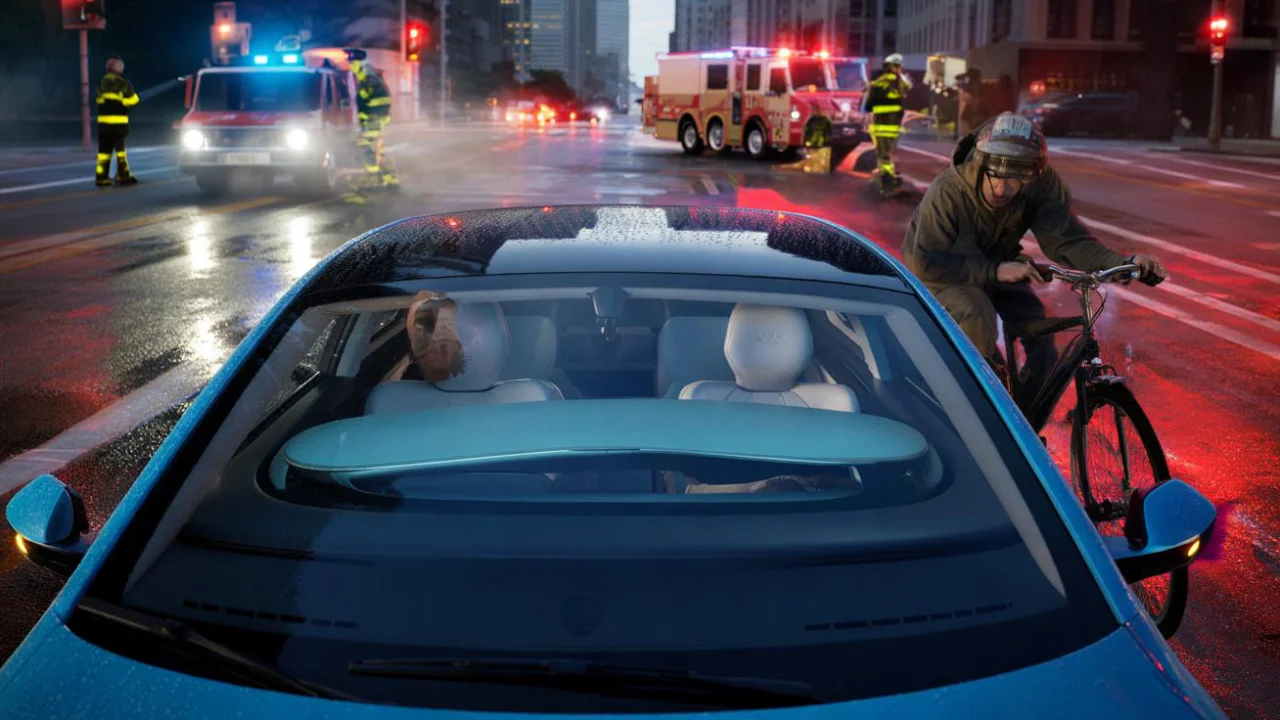
Sarah Chen was running late for her job interview when she hailed what looked like a regular rideshare car in downtown San Francisco. But as the sleek electric vehicle pulled up, something felt off. Through the windshield, she could see… nothing. No driver behind the wheel. Actually, no wheel at all.
“I stood there for a solid thirty seconds just staring,” Sarah recalls. “My brain couldn’t process it. There was just this empty space where a person should be, and these two seats facing forward like a tiny living room.”
What Sarah didn’t realize was that she was about to become part of history. She was looking at one of the first fully autonomous electric cars legally approved to operate on American roads without any human controls whatsoever. No steering wheel, no brake pedal, no backup driver ready to take over.
When Silicon Valley Decided to Delete the Driver
This isn’t your typical autonomous electric car story. Most self-driving vehicles still have steering wheels tucked away, just in case. This one was designed from day one to never need human intervention. The tech billionaire behind it – who also happens to control one of the world’s most powerful AI companies – made a bold bet that software could completely replace human control.
The regulatory approval came quietly, almost sneakily. While everyone was debating whether AI could safely assist drivers, this company skipped ahead to asking whether AI could replace them entirely. The National Highway Traffic Safety Administration said yes.
“This is the moment we crossed the Rubicon,” explains Dr. Marcus Rodriguez, a transportation policy expert at Stanford University. “We went from ‘maybe someday’ to ‘it’s happening right now, whether you’re ready or not.'”
The decision has triggered what industry insiders are calling the “control wars” – a brutal fight over who gets to determine how our roads evolve. On one side: tech companies pushing for rapid autonomous adoption. On the other: unions, traditional automakers, and cities that feel they’re being steamrolled by Silicon Valley.
What Makes This Autonomous Electric Car Different
Here’s what sets this vehicle apart from every other autonomous electric car on the road:
- Zero human controls: No steering wheel, pedals, or override buttons
- Living room layout: Seats face forward with a shared screen and cup holders
- AI-first design: Built around software, not adapted from traditional cars
- Legal exemption: First car approved to operate without backup human controls
- Limited deployment: Currently restricted to specific urban zones
| Feature | Traditional Self-Driving Car | This Autonomous Electric Car |
|---|---|---|
| Steering Wheel | Present (hidden or removable) | Completely absent |
| Human Override | Always available | Not possible |
| Interior Design | Traditional car layout | Lounge-style seating |
| Regulatory Status | Requires safety driver backup | Fully autonomous approval |
| Deployment Area | Testing phases | Live commercial service |
The vehicle’s sensor array is impressive – 40+ cameras, radar, and lidar systems that create a 360-degree view extending several city blocks. The AI processes this information 100 times per second, making split-second decisions that would challenge even experienced drivers.
“The technology is genuinely remarkable,” admits Janet Liu, a former Detroit automaker executive. “But remarkable technology doesn’t automatically mean we should hand over our roads to it.”
The Battle Lines Are Already Drawn
Cities are scrambling to figure out how to regulate something they never anticipated. San Francisco has seen protests outside the company’s headquarters, with taxi drivers and delivery workers holding signs reading “Our Jobs, Our Roads.”
The concerns go beyond employment. Emergency responders worry about vehicles they can’t manually control during crises. Insurance companies are rewriting policies for accidents involving cars with no human operator. Urban planners are questioning whether infrastructure designed for human drivers can handle AI decision-making.
“We’re essentially conducting a massive public experiment,” says Maria Santos, a city councilwoman who’s been tracking the autonomous electric car rollout. “Except the test subjects are everyone who uses our streets.”
Traditional automakers are furious that a tech company leapfrogged decades of automotive safety culture. They argue that removing human oversight entirely is reckless, regardless of how sophisticated the AI becomes.
Meanwhile, disability rights advocates see potential liberation. For people who cannot operate traditional vehicles, an autonomous electric car without human controls could provide unprecedented mobility freedom.
What This Means for Your Daily Commute
If you live in a major city, you’ll probably encounter one of these vehicles within the next year. The company plans to expand beyond San Francisco to Los Angeles, Austin, and Phoenix by 2024.
The immediate changes are subtle but significant. Traffic patterns shift when some vehicles make perfectly predictable, rule-following decisions while others are driven by unpredictable humans. Some intersections flow more smoothly; others become confused bottlenecks.
Parking is becoming interesting too. These autonomous electric cars don’t need to park near their passengers – they can drop you off and drive themselves to cheaper spots miles away, then return when summoned.
“My neighborhood has gotten quieter,” notes Robert Kim, who lives near a popular drop-off zone. “These cars are whisper-quiet compared to regular traffic. But it’s also eerie seeing them glide around with no one inside.”
The psychological impact might be the biggest change. We’re hardwired to make eye contact with drivers, to predict their behavior, to feel some human connection in traffic. That’s vanishing, one autonomous electric car at a time.
The Questions Nobody Wants to Answer
As more of these vehicles hit the road, uncomfortable questions are multiplying faster than answers. What happens when an autonomous electric car needs to choose between hitting one person versus three? Who gets prosecuted when the AI makes a fatal mistake? How do we maintain driving skills in a world that’s rapidly automating them away?
The tech billionaire behind the project remains confident that AI will make better decisions than humans ever could. Critics worry that we’re sacrificing human agency for technological efficiency.
What’s certain is that this autonomous electric car represents more than just transportation innovation. It’s a preview of how AI companies plan to reshape society – quickly, quietly, and with or without public consensus.
The steering wheel may be gone, but the fight over who controls our future is just getting started.
FAQs
Is it legal to drive a car without a steering wheel?
Yes, but only for specific vehicles that receive federal exemptions. This autonomous electric car is among the first to get full approval for public road use without human controls.
What happens if the autonomous electric car breaks down?
The vehicles have multiple backup systems and can call for remote assistance or human technicians. They’re designed to safely pull over and stop if critical systems fail.
How much does it cost to ride in one?
Current pricing is similar to premium rideshare services, though costs may drop as the technology scales. The company hasn’t released specific pricing details.
Can I buy one of these autonomous electric cars?
Not yet. They’re only available through the company’s ride-hailing service. Personal ownership versions may come later, but no timeline has been announced.
Are these cars actually safer than human drivers?
The company claims their AI is statistically safer, but independent data is limited since deployment just began. Long-term safety comparisons will require years of real-world data.
What cities will get these autonomous electric cars next?
Los Angeles, Austin, and Phoenix are planned for 2024 expansion, with other major metropolitan areas likely to follow based on regulatory approval and local acceptance.


