
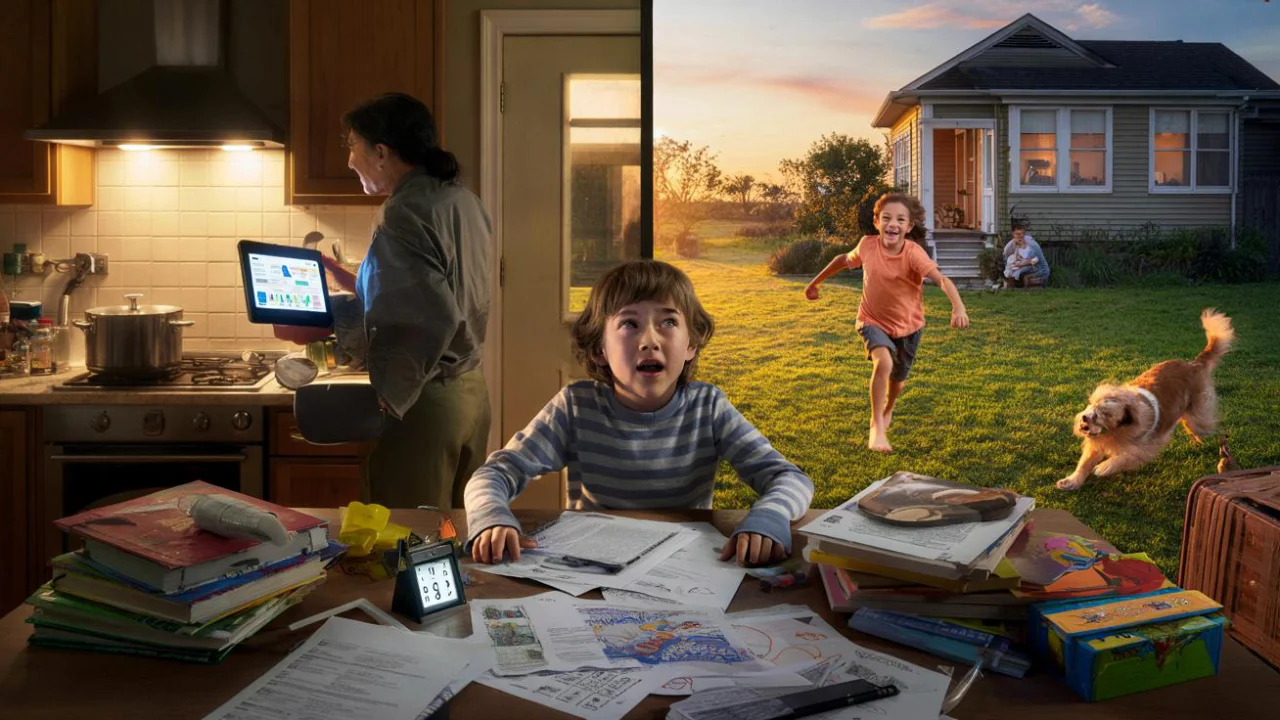
Sarah stares at the kitchen table where her 8-year-old daughter Emma sits hunched over a math worksheet, tears streaming down her face. It’s 7:30 PM. Dinner dishes sit unwashed. The laundry basket overflows in the corner. Emma’s supposed bedtime was thirty minutes ago, but she’s still wrestling with double-digit subtraction problems that make no sense to either of them.
“I hate this,” Emma whispers, erasing her answer for the fourth time. “I just want to play.”
Sarah feels her heart break a little. Outside, other kids are riding bikes in the fading daylight. Inside, her daughter is learning that childhood ends at 3 PM when the school bell rings and the real work begins. This scene plays out in millions of homes every night, and more parents are asking a radical question: what if we just stopped?
The homework debate reaches a breaking point
Banning homework sounds extreme until you look at what’s happening in American homes. Kids as young as kindergarten are bringing home worksheets. Middle schoolers carry backpacks that could double as gym equipment. High school students pull all-nighters to finish projects that teach them more about stress management than actual subjects.
Dr. Jennifer Martinez, an elementary school principal in Portland, sees the fallout daily. “Parents come to me exhausted, saying their 7-year-old is having meltdowns every night over homework. We’re creating anxiety disorders in second grade.”
The homework tradition runs deep in American culture. For generations, parents have viewed those after-school assignments as character building. But a growing movement of educators, parents, and child development experts are questioning whether we’re building character or just burning out kids before they hit puberty.
Some schools have already taken the leap. In 2017, a Vermont elementary school banned homework for students under 12. Test scores didn’t drop. Attendance improved. Parent satisfaction soared. Similar experiments in California, Texas, and New York have yielded surprising results that challenge everything we thought we knew about learning.
What the research actually shows about homework
When you dig into the data on homework effectiveness, the results might shock you. Here’s what decades of educational research have uncovered:
| Age Group | Homework Benefit | Optimal Amount | Common Reality |
|---|---|---|---|
| Elementary (K-5) | No measurable benefit | 10 minutes per grade level | 45-90 minutes nightly |
| Middle School | Slight improvement in standardized tests | 1-2 hours maximum | 2-4 hours common |
| High School | Moderate benefits up to 2 hours | 2 hours maximum | 3-5 hours typical |
The numbers tell a story that most parents and teachers never hear. For elementary school children, homework provides virtually no academic benefit. None. Yet millions of young kids spend their evenings hunched over worksheets instead of playing, exploring, or just being children.
“We’re essentially conducting a massive experiment on childhood,” says Dr. Michael Chen, a child psychologist who studies homework’s impact on family stress. “And the results aren’t good.”
Countries with the highest-performing students often assign less homework than American schools. Finnish students, who consistently rank among the world’s best in international assessments, rarely receive homework before age 16. South Korean students, despite their homework-heavy culture, are experiencing a mental health crisis that’s forcing educational reforms.
The hidden costs of homework culture
Banning homework would rescue more than just childhood bedtimes. It would address a cascade of problems that homework creates throughout family life:
- Sleep deprivation among children and teenagers
- Increased family conflict and stress
- Reduced time for physical activity and free play
- Widening achievement gaps between socioeconomic classes
- Parent burnout from serving as unpaid teaching assistants
- Loss of intrinsic motivation to learn
The socioeconomic impact hits hardest. Wealthy families hire tutors or have parents with college degrees to help with assignments. Working-class families often can’t provide the same support, turning homework into a tool that widens educational inequality rather than leveling the playing field.
Maria Rodriguez, a single mother working two jobs in Phoenix, knows this reality intimately. “I get home at 8 PM and my son’s homework isn’t done. I’m exhausted, he’s frustrated, and I can’t help him with math I don’t understand. How is this helping anyone?”
But eliminating homework also raises uncomfortable questions about discipline and preparation for adult responsibilities. Critics worry that banning homework would create a generation unprepared for college and careers that demand self-discipline and time management.
What schools would look like without homework
Schools experimenting with homework bans haven’t descended into chaos. Instead, they’ve discovered something interesting: when you remove the pressure of nightly assignments, both teaching and learning often improve.
Teachers report having more time to focus on interactive, engaging classroom activities instead of assigning worksheets that get rushed through at kitchen tables. Students arrive more rested and ready to learn. Parents can actually help their children with genuine learning experiences like cooking, reading together, or exploring nature.
Dr. Lisa Park, who eliminated homework at her Massachusetts elementary school, explains the transformation: “Without homework hanging over everyone’s heads, we could focus on making school time more effective. Kids were happier, parents were less stressed, and our academic results actually improved.”
The schools that have banned homework often replace it with more intentional family engagement. Instead of worksheets, children might be encouraged to cook with their parents, interview grandparents about family history, or simply read books they choose for pleasure.
This shift reveals what education could become if we stopped trying to extend the school day into family time. It forces schools to make every minute of classroom time count instead of relying on homework to cover material that should have been taught during school hours.
The discipline dilemma
The strongest argument against banning homework centers on discipline and work habits. Supporters argue that homework teaches children to manage time, complete tasks independently, and develop the persistence needed for success in college and careers.
But homework opponents counter that forced compliance isn’t the same as self-discipline. When children spend hours on assignments they find meaningless, they often learn to cut corners, rush through work, or simply go through the motions to get done.
“Real discipline comes from engaging in meaningful work,” argues Dr. Alfie Kohn, author of “The Homework Myth.” “Busy work disguised as homework teaches children that learning is a chore to be endured rather than a joy to be pursued.”
The challenge is finding ways to develop responsibility and work habits without turning childhood into an endless series of assignments and deadlines.
FAQs
Won’t kids fall behind academically without homework?
Research shows no academic benefit from homework in elementary school and diminishing returns in middle school. Countries with less homework often outperform the US academically.
How would children learn discipline without homework?
Discipline develops through meaningful activities, chores, sports, music, and pursuing personal interests. Forced compliance with busywork doesn’t build genuine self-discipline.
What would kids do with their free time instead?
Play, explore hobbies, spend time with family, get adequate sleep, exercise, and pursue interests that spark genuine curiosity and learning.
Are any schools successfully operating without homework?
Yes, schools across the US and internationally have eliminated homework with positive results including improved student wellbeing and maintained or improved academic performance.
How can parents support learning without homework?
Read together, encourage questions, visit museums, cook together, discuss current events, and model curiosity. Learning happens naturally through engaged family interaction.
What about preparing kids for college and career demands?
College readiness comes from critical thinking, creativity, and genuine engagement with learning, not from years of completing assignments. Many successful professionals never had heavy homework loads as children.


