
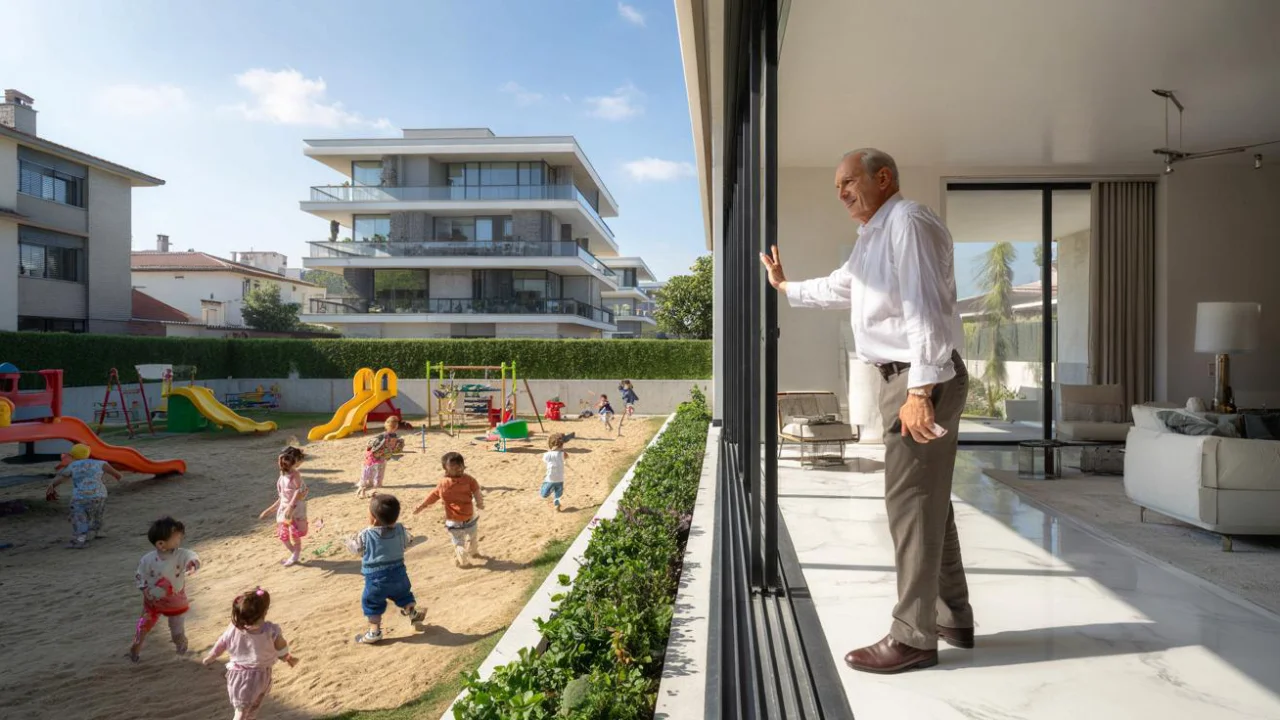
Maria clutches her four-year-old’s hand as they walk past the towering hedge that separates their neighborhood kindergarten from the glass mansion next door. Today, like every day for the past six months, the playground sits eerily quiet during what should be the busiest hour of the morning.
Her daughter Emma tugs at her sleeve, asking why they can’t use the swings anymore. Maria doesn’t know how to explain that the man living behind those pristine windows—a man whose wealth could fund their entire school district—has legally silenced the sound of children’s laughter.
The billionaire kindergarten noise case that started as a neighborly dispute has become a landmark ruling that’s dividing communities across the country.
When Children’s Laughter Becomes a Legal Problem
The case began innocuously enough. A tech billionaire, seeking refuge from urban stress, purchased a sprawling estate in a quiet residential neighborhood. The property happened to sit adjacent to Rainbow Meadows Kindergarten, a small community school that had operated peacefully for over two decades.
What followed reads like something from a legal thriller. The billionaire’s team documented every recess period, measuring decibel levels that regularly exceeded 65 dB—louder than normal conversation. They compiled evidence showing how children’s voices, with their naturally high pitch, penetrated even advanced sound insulation.
“The issue isn’t that children are inherently problematic,” explains Dr. Sarah Chen, an environmental acoustics specialist. “It’s that residential zoning laws weren’t designed to handle this kind of proximity conflict between private luxury living and community facilities.”
The kindergarten director, meanwhile, found herself defending something she never thought needed defending: a child’s right to play outdoors. The school had actually expanded its playground area just months before the billionaire’s arrival, adding new equipment that encouraged more active, vocal play.
The Court Battle That Shocked Everyone
When negotiations failed, the case landed in civil court with an unusual request: forced relocation of the kindergarten or significant operational restrictions during “quiet hours.”
The legal arguments revealed the complexity of modern neighborhood disputes:
- Property rights versus community needs
- Noise ordinance interpretations in mixed-use areas
- The legal definition of “reasonable enjoyment” of property
- Municipal responsibility for zoning compatibility
- Children’s developmental needs for outdoor play
The billionaire’s legal team presented a methodical case. They brought in acoustic engineers who testified that playground noise during peak hours created a “hostile living environment.” Sound recordings played in court captured moments of particularly intense play—tag games, playground disputes, and the general chaos of recess.
“Property owners have legitimate expectations of peaceful enjoyment,” argues real estate attorney Michael Torres. “When someone invests millions in a residential sanctuary, municipal planning should protect that investment from incompatible neighboring uses.”
The kindergarten’s defense centered on community precedence and children’s rights. Parents testified about the school’s 25-year history, long predating the billionaire’s arrival. Child development experts explained why outdoor play remains essential for healthy growth.
| Factor | Billionaire’s Position | Kindergarten’s Position |
|---|---|---|
| Noise Levels | 65-70 dB daily, exceeding residential standards | Normal childhood play, temporary and educational |
| Timeline | Playground expanded after property purchase | School operated 25 years before neighbor arrival |
| Solutions | Indoor play or relocation | Sound barriers or adjusted schedules |
| Investment | $50 million private residence | $2 million community facility serving 150 families |
The Surprising Ruling and Its Ripple Effects
Judge Patricia Williams delivered a split decision that satisfied nobody completely. The kindergarten could remain operational, but with strict limitations: no outdoor play before 9 AM or after 3 PM, mandatory “quiet time” during lunch hours, and installation of sound-dampening barriers along the shared property line.
The ruling acknowledged both parties’ legitimate interests while attempting practical compromise. However, the financial burden of compliance—estimated at $200,000 for sound barriers and schedule restructuring—falls entirely on the school.
“This case represents a broader tension in American neighborhoods,” observes urban planning professor Dr. James Mitchell. “As wealth inequality grows, we’re seeing more conflicts between individual luxury and community institutions.”
The kindergarten director admits the restrictions have changed everything. Children now play in shorter bursts, teachers constantly monitor noise levels, and some families have transferred to other schools rather than deal with the artificial constraints.
Meanwhile, the billionaire has reportedly installed additional soundproofing and continues monitoring compliance through a legal team that sends monthly noise violation reports to local authorities.
The Community Divide Nobody Expected
Perhaps most surprising is how the case has split the local community. While many initially supported the kindergarten, others have quietly sided with their wealthy neighbor.
Some residents appreciate the noise reduction during their work-from-home hours. Others worry about property values if the area becomes known for “unchecked noise pollution.” A few parents even admit relief that their own children’s outdoor time has become more “structured and civilized.”
The controversy has inspired similar legal challenges nationwide. At least twelve other cases involving playground noise restrictions have emerged in affluent suburbs, creating what legal experts call a “precedent cascade.”
“We’re essentially asking courts to referee between childhood and capital,” notes child advocacy lawyer Rachel Martinez. “The question isn’t just about noise—it’s about what kind of communities we want to live in.”
Real estate developers are now factoring “acoustic compatibility” into luxury residential planning. Some high-end neighborhoods are pre-emptively restricting or relocating community facilities to avoid future conflicts.
The kindergarten continues operating under its new restrictions, but enrollment has dropped 30%. Parents report children asking why they can’t play “like the big kids at other schools” and teachers struggling to maintain energy and engagement within the compressed schedule.
As for the billionaire, he’s achieved his quiet sanctuary—but at the cost of becoming the neighborhood’s most notorious resident. His name now appears on local social media groups not for charitable contributions, but as a cautionary tale about wealth, community, and the price of perfect silence.
FAQs
Can a neighbor really force a kindergarten to limit playground time?
Yes, if they can prove the noise violates local ordinances and affects their reasonable property enjoyment. However, courts typically seek compromise solutions rather than complete shutdowns.
What decibel level is considered too loud for residential areas?
Most municipalities set residential noise limits between 55-65 dB during daytime hours. Children’s playground activities often exceed this, especially during peak play periods.
Who pays for noise reduction measures in these cases?
Typically, the “noise-generating” party bears the cost, even if they were there first. This can create significant financial hardship for community institutions like schools.
Are similar cases becoming more common?
Yes, as wealth inequality increases and luxury developments expand into established neighborhoods, these conflicts are rising nationwide.
Can communities prevent these disputes?
Better zoning planning and acoustic impact studies during development approval can help, but existing neighborhoods face more complex challenges requiring case-by-case solutions.
What rights do children have to outdoor play?
While recognized as developmentally essential, children’s play rights aren’t explicitly protected from noise ordinance enforcement, creating legal gray areas courts must navigate.


