
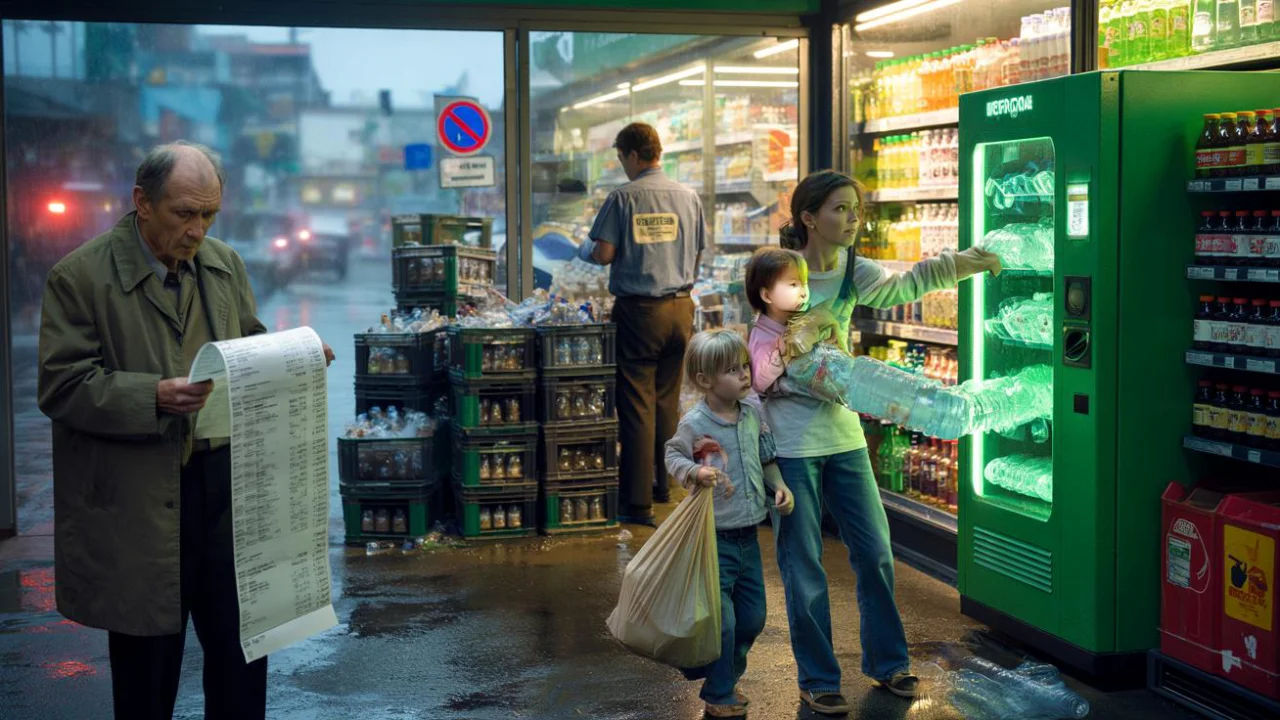
Sarah stares at the glowing reverse vending machine in her local supermarket, clutching a bag of empty bottles worth £3.20 in deposits. Her toddler tugs at her coat while the machine jams for the third time this week. Behind her, an impatient queue builds as families wait to reclaim their money. What started as a simple trip for milk has turned into a 20-minute ordeal that makes her question whether being eco-friendly should feel this exhausting.
This scene plays out thousands of times daily across cities where bottle deposits have become the latest weapon in the war against plastic waste. But as Sarah discovers, the reality of these schemes creates winners and losers in ways nobody anticipated.
The promise seemed straightforward: pay a small deposit when buying drinks, get your money back when you return the empties. Clean streets, higher recycling rates, and a circular economy where nothing gets wasted. Yet the system that looked perfect in policy papers has spawned an underground economy of bottle hunters, frustrated retailers, and families who feel punished for every drink they buy.
The hidden economics of every empty bottle
Bottle deposits work through a simple financial mechanism that creates complex social consequences. When you buy a drink, you pay an additional 10-25 cents that gets refunded when you return the empty container. Countries like Germany and Norway boast recycling rates above 90% for deposit containers, compared to roughly 30% in places without such systems.
“The environmental benefits are undeniable,” says Dr. Emma Richardson, a waste management researcher at Edinburgh University. “But we’re seeing unintended social impacts that policymakers didn’t anticipate when designing these programs.”
The deposits create what economists call a “reverse market” where discarded containers have immediate cash value. This transforms litter into currency, but also means every drink purchase requires upfront capital that some families simply don’t have.
For middle-class shoppers, deposits feel like an environmental tax they can afford. For low-income households, each bottle represents cash tied up until they can make the trip back to return it. When money is tight, that 20 cents per bottle can determine whether a family buys drinks at all.
Who pays the real price of plastic-free policies
The burden of bottle deposits falls unevenly across different groups, creating a complex web of winners and losers:
- Low-income families: Face effective price increases and must store empties until they can afford return trips
- Small retailers: Struggle with storage space, machine maintenance, and customer complaints about jammed systems
- Bottle collectors: Develop informal income streams but work in legally gray areas
- Elderly shoppers: Often unable to physically manage large bags of returns or navigate complex machines
- Environmental advocates: Celebrate recycling statistics while grappling with social equity concerns
The data reveals stark differences in how deposit schemes affect communities:
| Income Level | Average Bottles Stored | Return Frequency | Unclaimed Deposits |
|---|---|---|---|
| High Income | 5-10 | Weekly | 2-3% |
| Middle Income | 15-25 | Bi-weekly | 5-8% |
| Low Income | 30-50 | Monthly | 15-22% |
“We’re essentially asking the poorest families to loan money to the beverage industry,” explains Marcus Thompson, a community organizer in South London. “They pay deposits they can’t immediately reclaim, while wealthier shoppers treat it like pocket change.”
When retailers become reluctant recycling centers
Small shop owners face their own challenges with deposit schemes. Storage space disappears under mountains of sticky, smelly returns. Reverse vending machines break down regularly, leaving staff to manually process returns while queues of frustrated customers grow.
Independent retailers report spending 3-5 hours weekly managing returns, time they’d prefer to spend serving customers or restocking shelves. The machines themselves cost thousands to install and maintain, often requiring daily cleaning and frequent repairs.
“Some days I feel more like a recycling plant than a corner shop,” says Ahmed Hassan, who runs a convenience store in Manchester. “The machine breaks, customers get angry, and I’m stuck in the middle of someone else’s environmental policy.”
Large supermarket chains can absorb these costs more easily, giving them another competitive advantage over independent retailers who already struggle with thin margins and rising rents.
The bottle hunters creating an invisible economy
Perhaps the most unexpected consequence of deposit schemes is the emergence of informal bottle collecting networks. In cities across Germany, Denmark, and now Scotland, people supplement their income by gathering discarded containers from bins, parks, and public spaces.
These collectors range from students earning beer money to pensioners stretching limited incomes. Some operate alone, while others work in informal teams, dividing territories and sharing information about profitable locations.
“It’s not glamorous work, but it helps pay my rent,” admits Lisa, a university student in Berlin who collects bottles three evenings a week. “I can make €20-30 if I’m systematic about it, but you have to know where and when to look.”
This shadow economy raises questions about dignity, fairness, and whether environmental policies should create systems where people scavenge for survival. Critics argue that deposit schemes essentially subsidize corporate responsibility by making individuals bear the cost and effort of recycling.
Environmental success stories with social side effects
Despite these challenges, bottle deposits deliver measurable environmental benefits. Germany’s system prevents an estimated 2 billion containers from entering landfills annually. Norway achieves a 97% return rate for plastic bottles, making it one of the world’s most effective recycling programs.
The question isn’t whether deposits work environmentally – they clearly do. The question is whether societies can design systems that achieve green goals without creating new forms of inequality or burden-shifting.
“We need to be honest about trade-offs,” says Dr. Richardson. “Deposit schemes are environmentally effective but socially regressive. The challenge is redesigning them to be fairer while maintaining their environmental benefits.”
Some regions are experimenting with modifications: digital deposits linked to bank accounts, social support for low-income returns, or graduated deposit amounts based on household income. These innovations remain small-scale pilot projects rather than widespread solutions.
FAQs
How much money do people lose from unreturned deposits?
Studies suggest 5-20% of deposits go unclaimed, with higher rates among low-income households who struggle to make return trips.
Are bottle deposits legal everywhere?
Deposit schemes operate under different legal frameworks globally, with some mandatory and others voluntary industry programs.
Do deposits really increase recycling rates?
Yes significantly – countries with deposit systems typically see 80-95% container return rates compared to 30-50% without deposits.
Can you make a living collecting bottles?
While some people earn meaningful supplementary income, full-time bottle collecting rarely provides a living wage in most cities.
What happens to unclaimed deposit money?
Policies vary, but unclaimed deposits often go to beverage companies, government environmental funds, or recycling program administration.
Are there alternatives to individual bottle deposits?
Some regions use producer responsibility schemes where manufacturers fund recycling directly, rather than requiring individual consumer deposits.


