
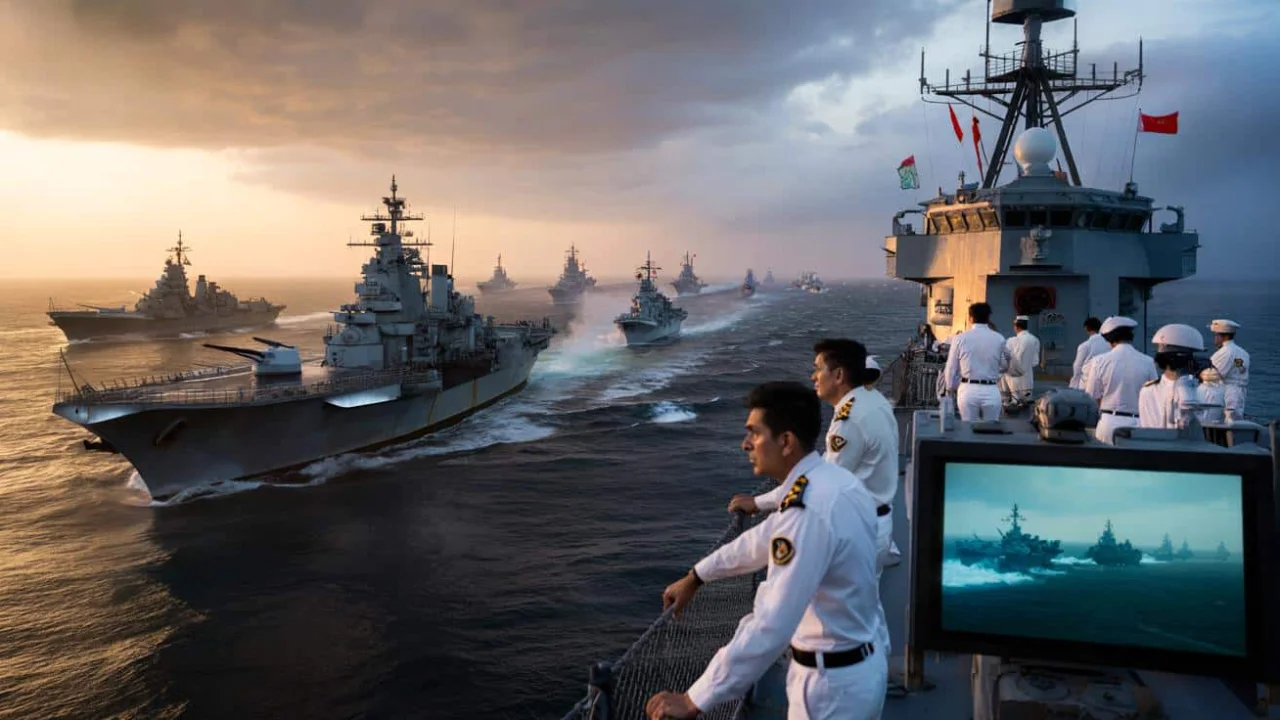
Captain Rajesh Kumar stands on the bridge of INS Kolkata, watching the sun rise over the Arabian Sea. His phone buzzes with a message from his teenage daughter back in Mumbai: “Dad, my friend’s father works at the shipyard. He says China is building warships like we build cars on an assembly line. Is that true?”
Kumar stares at the horizon for a long moment. Twenty years ago, when he first joined the Navy, questions like this didn’t exist. China was building roads and factories, not fleets that could challenge India’s dominance in its own backyard.
Today, that world feels like ancient history.
The Numbers Game That’s Keeping Delhi Awake
Chinese naval expansion has become India’s most pressing security concern, and the statistics are sobering. Beijing plans to acquire 50 new warships in the coming years, adding to what’s already the world’s largest navy by hull count. For a nation like India, which depends on ocean trade routes for 95% of its commerce, this isn’t just military posturing – it’s an existential challenge.
The shift represents a fundamental change in how regional powers view the Indian Ocean. What was once considered India’s strategic backyard is rapidly becoming a contested space where multiple navies compete for influence.
“We’re witnessing the most significant naval buildup in Asia since World War II,” explains Admiral Arun Prakash, former Chief of Naval Staff. “China’s maritime ambitions extend far beyond their traditional coastal waters.”
The Chinese naval expansion comes at a time when India is struggling to modernize its own fleet. While China launches new destroyers and frigates at an unprecedented pace, India’s naval procurement remains bogged down by bureaucratic delays and budget constraints.
Breaking Down China’s Naval Ambitions
The scope of Chinese naval expansion becomes clearer when you examine the details. Here’s what India is watching with growing concern:
| Ship Type | Current Chinese Fleet | Planned Additions | Strategic Impact |
|---|---|---|---|
| Aircraft Carriers | 2 operational | 2-3 more planned | Power projection capability |
| Destroyers | 32 active | 15-20 new builds | Air defense umbrella |
| Frigates | 42 operational | 20-25 additions | Anti-submarine warfare |
| Submarines | 60+ hulls | 12-15 nuclear subs | Stealth operations |
Key factors driving this expansion include:
- Protection of sea lanes vital to China’s energy imports
- Securing trade routes worth over $3 trillion annually
- Establishing naval bases from Djibouti to Pakistan
- Countering U.S. naval presence in the Pacific
- Supporting the Belt and Road Initiative maritime component
The pace of construction is what truly alarms Indian strategists. Chinese shipyards can complete a frigate in 18 months, while Indian naval projects often stretch beyond five years.
“They’ve industrialized naval construction in ways we’re still trying to understand,” notes Rear Admiral Sudarshan Shrikhande, a maritime strategy expert. “It’s not just about building ships – it’s about building them fast and in large numbers.”
Where This Naval Race Hits Home
The impact of Chinese naval expansion extends far beyond military circles. Consider Visakhapatnam, India’s primary naval base on the east coast. Local fishermen report seeing unfamiliar warships on the horizon more frequently. Port workers notice increased activity as Indian Navy vessels spend more time at sea, monitoring regional waters.
For India’s 1.4 billion people, the implications are deeply practical:
- Trade Vulnerability: Over 90% of India’s oil imports pass through sea lanes China could potentially control
- Economic Security: Disruption of maritime trade could cost India billions in GDP growth
- Food Security: Essential imports like fertilizers and pulses depend on secure shipping lanes
- Energy Independence: Offshore gas fields need naval protection from potential threats
The human cost appears in unexpected places. Naval families report longer deployments as ships patrol extended areas. Coastal communities see increased military exercises. Young Indians considering naval careers face the reality of a more dangerous and competitive maritime environment.
“My son asks if there will be a war,” says Priya Nair, whose husband serves on an Indian frigate. “I don’t know what to tell him anymore.”
The Response India Can’t Avoid
Indian policymakers understand they’re facing a moment of truth. The traditional approach of gradual naval modernization won’t match the speed of Chinese naval expansion. New strategies are emerging:
Indigenous Shipbuilding Push: India is investing heavily in domestic shipyards, hoping to reduce construction times and costs. Projects like the Indigenous Aircraft Carrier and advanced submarine programs represent this shift.
Strategic Partnerships: Closer cooperation with the United States, Japan, and Australia through initiatives like the Quad represents a multilateral response to Chinese naval power.
Technology Focus: Rather than matching China ship-for-ship, India is investing in force multipliers like advanced missiles, surveillance systems, and underwater sensors.
“We can’t build 400 ships, but we can make sure our 200 ships are technologically superior,” explains Captain Abhishek Sharma, a naval strategy analyst.
The challenge remains formidable. China’s naval budget exceeds India’s entire defense spending. Their shipbuilding capacity dwarfs anything India can currently achieve. Most concerning for Indian planners, the gap is widening rather than narrowing.
Yet this naval competition will ultimately reshape the entire Indo-Pacific region. Countries from Indonesia to Japan are watching how India responds to Chinese naval expansion, knowing their own security depends partly on this balance of power.
As Captain Kumar finally responds to his daughter’s text message, he writes simply: “Yes, it’s true. And it’s why your dad’s job just got a lot more important.”
FAQs
How many warships does China currently have compared to India?
China operates over 350 naval vessels while India has approximately 150 ships, though the gap in advanced vessels is even wider.
Why is Chinese naval expansion particularly concerning for India?
India depends heavily on sea lanes for trade and energy imports, making Chinese control over these routes an existential threat to Indian economic security.
Can India match China’s naval expansion?
India lacks China’s shipbuilding capacity and defense budget, so it’s focusing on technological superiority and strategic partnerships rather than matching numbers.
Where is China building its new naval bases?
China has established bases in Djibouti, Pakistan’s Gwadar Port, and is developing facilities in Myanmar and Sri Lanka, effectively surrounding India.
How does this naval competition affect ordinary Indians?
It impacts everything from fuel prices and trade costs to national security, potentially affecting economic growth and regional stability.
What is India doing to counter Chinese naval expansion?
India is accelerating indigenous shipbuilding, strengthening partnerships with like-minded nations, and investing in advanced maritime surveillance and missile systems.


