
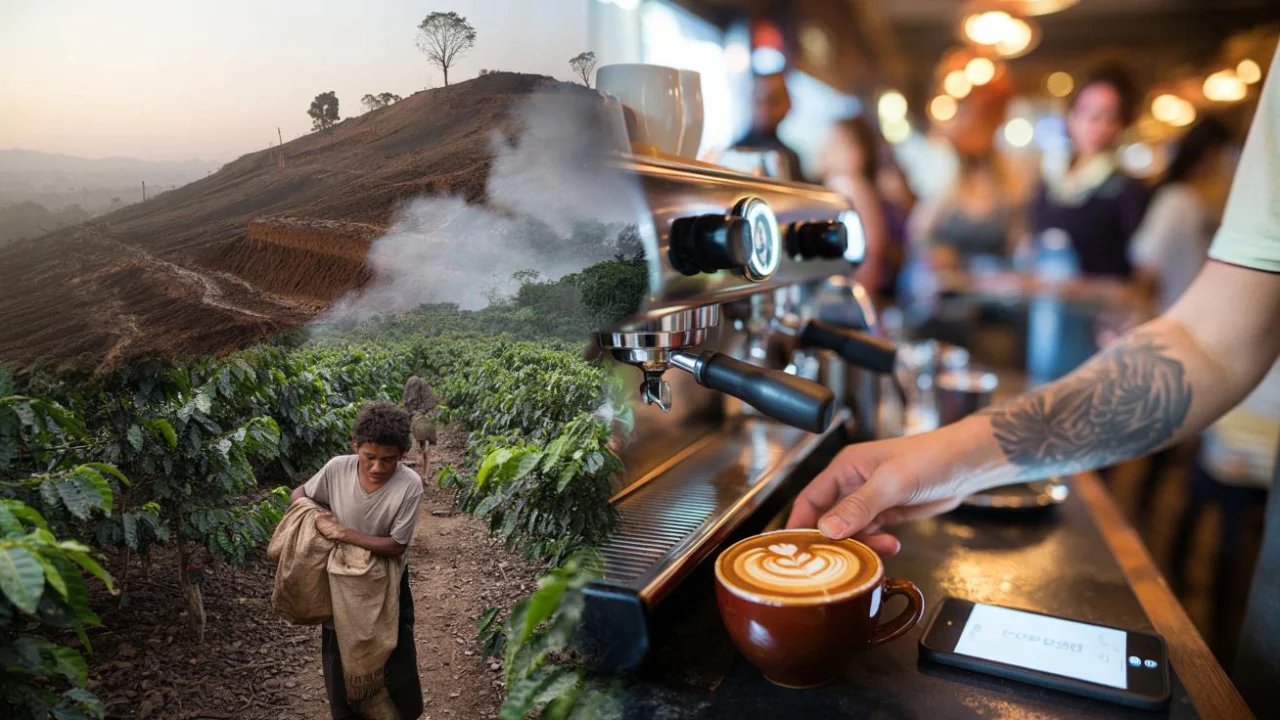
Maria sets her alarm for 4 AM every morning, not because she’s an early riser by choice, but because the coffee cherries won’t wait. By the time most of us are hitting snooze, she’s already deep in the Colombian mountains, her weathered hands moving methodically through rows of coffee plants. She earns about $2 for every pound of cherries she picks—enough to buy maybe half of what you paid for your latte yesterday.
Meanwhile, 3,000 miles north, you’re scrolling through Instagram while waiting for your order. Double shot oat milk macchiato, extra hot, light foam. The barista calls your name, and you grab that familiar cup without thinking about Maria’s bleeding fingertips or the fact that her village’s water source now runs muddy brown.
Same coffee beans. Completely different worlds.
Why your coffee habit is feeding a global disaster
The coffee industry crisis isn’t some distant problem happening “somewhere else.” It’s happening right now, and every morning ritual connects you directly to it. That comforting routine of yours—the one that makes you feel human before 9 AM—sits at the center of environmental destruction, labor exploitation, and economic inequality that spans continents.
Here’s what most coffee shops won’t tell you: your daily cup is part of a supply chain that destroys roughly 2.5 million acres of forest every year. The industry has convinced us that coffee is about community, comfort, and culture. But strip away the marketing, and you’ll find an operation that prioritizes profit over people and planet.
“We’ve turned coffee into this Instagram-worthy experience while completely ignoring the fact that it’s one of the most environmentally destructive crops on Earth,” says Dr. Sarah Chen, an agricultural economist who studies global food systems. “The cognitive dissonance is staggering.”
Coffee plants naturally grow under forest canopies, but industrial farming clear-cuts those forests to create massive plantations. When you multiply that across Brazil, Colombia, Vietnam, and Ethiopia—the world’s biggest coffee producers—you get an ecological disaster hiding behind your morning buzz.
The real cost breakdown of your daily coffee
Let’s talk numbers, because the coffee industry crisis becomes crystal clear when you see who actually profits from your $5 latte:
| Your $5 Latte Goes To: | Amount | Percentage |
|---|---|---|
| Coffee farmer | $0.10 | 2% |
| Processing & export | $0.40 | 8% |
| Shipping & import | $0.25 | 5% |
| Roasting company | $0.75 | 15% |
| Coffee shop profit | $2.00 | 40% |
| Labor & overhead | $1.50 | 30% |
Look at that first line again. The person who actually grew your coffee gets 10 cents. Meanwhile, you’re paying more for the cup and the experience than the farmer sees for an entire day’s work.
The environmental costs are even more brutal:
- One cup of coffee requires 140 liters of water to produce
- Coffee production generates 15 billion pounds of waste annually
- Conventional coffee farming uses more pesticides per acre than almost any other crop
- Coffee plantations are responsible for 70% of deforestation in key biodiversity hotspots
- Climate change will eliminate 50% of current coffee-growing land by 2050
“The industry has mastered the art of making consumers feel good about a product that’s destroying the communities where it’s grown,” explains environmental journalist Marcus Rodriguez, who spent two years documenting coffee farming in Central America. “They sell you sustainability theater while the actual system gets worse.”
How farmers pay the real price for your caffeine addiction
While you debate oat milk versus almond milk, coffee farmers are dealing with something much more serious: survival. The coffee industry crisis hits hardest at the source, where families have been growing coffee for generations but can barely afford to feed their children.
Climate change is pushing coffee-growing regions higher up mountains, forcing farmers to either abandon their land or cut down forests to plant at higher altitudes. Meanwhile, global coffee prices have actually dropped over the past decade, even as your local coffee shop prices keep climbing.
In Guatemala, farmers now earn less per pound of coffee than they did in the 1980s, despite inflation and rising production costs. Many families send their children to work the plantations instead of school, because they need every hand to survive economically.
“I’ve watched three generations of the same family go from sustainable mixed farming to coffee monoculture to debt and migration,” says Dr. Elena Vasquez, who researches rural development in Latin America. “The market demands more coffee at lower prices, and farmers pay with their land, their health, and their future.”
The pesticide problem is particularly devastating. Conventional coffee farming relies heavily on chemicals that contaminate water sources and cause serious health problems in farming communities. Children in coffee-growing regions show higher rates of birth defects and developmental issues linked to chemical exposure.
But here’s the part that might hit closest to home: this system is unsustainable even for coffee lovers. Climate change and environmental degradation are rapidly shrinking the areas where coffee can grow. By 2050, many experts predict a global coffee shortage that will make your current prices look like a bargain.
Why you’ll keep buying lattes anyway (and what that says about us)
Despite knowing all this, most people will still hit their usual coffee shop tomorrow morning. Why? Because the coffee industry has spent decades building something more powerful than addiction—it’s built identity.
Coffee isn’t just a drink anymore. It’s how you signal that you’re cultured (single-origin beans), environmentally conscious (that “sustainable” label), or simply adult enough to function in society. The industry has made questioning your coffee habit feel like questioning who you are as a person.
That’s brilliant marketing and terrible ethics. The coffee industry crisis continues because companies have successfully shifted responsibility to consumers while maintaining systems that make ethical choices nearly impossible.
Even “fair trade” and “organic” labels often represent minimal improvements rather than real solutions. Fair trade farmers still earn poverty wages, and organic certification doesn’t address deforestation or labor conditions.
“The coffee industry has created a perfect storm of consumer guilt and limited options,” notes sustainable agriculture expert Dr. James Morrison. “They’ve made it feel like individual coffee choices can solve systemic problems, which conveniently takes pressure off companies to change their fundamental practices.”
The truth is, there are no perfect coffee choices within the current system. The most ethical option might be drinking less coffee, but that’s exactly what the industry doesn’t want you to consider.
FAQs
Is fair trade coffee actually better for farmers?
Fair trade does guarantee slightly higher prices, but many farmers still earn below living wages, and the certification process can be expensive and bureaucratic.
Will coffee really become unavailable due to climate change?
Climate change will significantly reduce coffee-growing areas, but the crop won’t disappear entirely—it will just become much more expensive and lower quality.
Are there coffee companies that actually treat farmers fairly?
A few small-scale roasters work directly with farmers and pay living wages, but they represent a tiny fraction of the global coffee market.
Does organic coffee solve the environmental problems?
Organic coffee eliminates pesticides but doesn’t address deforestation, water usage, or labor conditions—it’s just one piece of a much larger puzzle.
What would happen if everyone stopped drinking coffee?
Millions of farmers would lose their primary income source overnight, creating a humanitarian crisis—the solution requires changing the industry, not eliminating it.
Why don’t coffee shops charge more to pay farmers better?
Most coffee shops already have high profit margins and could pay farmers more without raising prices, but there’s no market pressure forcing them to do so.


