
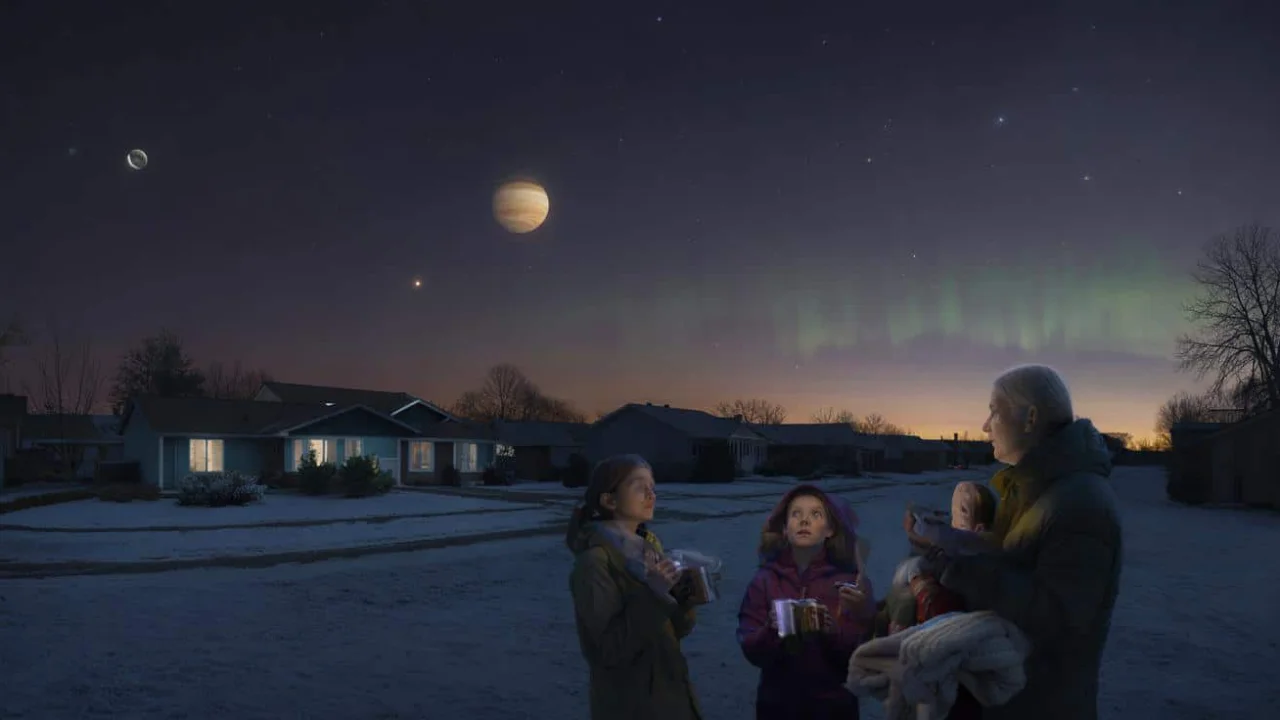
Sarah Martinez was rushing through her Tuesday evening routine when her phone buzzed with an astronomy app notification. “Major celestial event approaching December 4,” it read. She almost swiped it away—who had time to stargaze between kids’ homework and tomorrow’s presentation? But something made her pause. Her grandfather used to wake her up at dawn to watch meteor showers, claiming the sky held better stories than any book.
That notification would change how Sarah saw the next few weeks. Because what’s coming on December 4 isn’t just another space event that only scientists care about. It’s the kind of cosmic alignment that happens maybe once every few years, visible to anyone willing to step outside and look up.
Astronomers worldwide are calling it one of the most accessible and beautiful celestial shows of 2024. And unlike so many astronomical events that require special equipment or perfect timing, this December 4 celestial event is designed for regular people living regular lives.
What Makes December 4 So Special in Space
Think of December 4 as nature’s own planetarium show, happening right above your neighborhood. Multiple cosmic events are lining up in a way that creates something truly spectacular for naked-eye observers.
The centerpiece is a rare planetary alignment featuring Jupiter, Saturn, and the Moon clustering together in the southwestern sky just after sunset. But that’s not all. Solar activity is peaking right around the same time, increasing our chances of seeing aurora displays much further south than usual.
“We’re looking at a perfect storm of visibility conditions,” explains Dr. Maria Gonzales, a planetary scientist at the National Observatory. “Clear skies, bright planets, and solar activity all combining on the same night. It’s like the universe scheduled itself around our dinner plans.”
The December 4 celestial event also coincides with optimal viewing conditions across most of North America and Europe. The Moon will be in a favorable phase, providing just enough light to help guide your eyes to the planets without washing out the dimmer details.
What makes this different from typical stargazing? Usually, you need to know exactly where to look and when. This time, the show will be obvious enough that even casual observers will notice something special happening overhead.
Your Complete Viewing Guide for December 4
Preparing for the December 4 celestial event doesn’t require expensive equipment or advanced planning. Here’s everything you need to know to make the most of this cosmic opportunity:
| Time | What to Look For | Direction |
|---|---|---|
| 6:00-7:00 PM | Jupiter-Moon conjunction | Southwest horizon |
| 7:00-8:00 PM | Saturn visibility peak | South-southwest |
| 8:00-10:00 PM | Full planetary alignment | Western sky |
| 10:00 PM-Dawn | Potential aurora activity | Northern horizon |
The essential preparation items you’ll actually need:
- Warm clothing (December nights are cold, even in mild climates)
- A comfortable chair or blanket for extended viewing
- Red flashlight to preserve night vision
- Smartphone astronomy app to help identify what you’re seeing
- Hot beverage in a thermos (seriously, this makes all the difference)
“The biggest mistake people make is stepping outside for thirty seconds and expecting magic,” notes amateur astronomer James Chen, who runs stargazing workshops in Colorado. “Give your eyes fifteen minutes to adjust, and suddenly you’ll see details you never noticed before.”
Location matters, but not as much as you might think. Even urban observers should be able to see the brightest elements of this December 4 celestial event. Rural locations will offer more detail, but city dwellers won’t be completely left out.
Why Scientists Are Particularly Excited About This Date
Beyond the visual spectacle, December 4 represents something deeper for the astronomical community. We’re witnessing multiple cycles of cosmic activity converging at once—planetary orbits, solar cycles, and seasonal positioning all aligning in ways that won’t repeat for several years.
The solar activity component adds an unpredictable element that has researchers genuinely curious about what might happen. Enhanced solar wind interactions with Earth’s magnetic field could produce aurora displays visible as far south as the northern United States, possibly even into states like Montana, North Dakota, and Minnesota.
“This isn’t just about pretty pictures,” explains Dr. Robert Kim, a space weather specialist. “These conditions help us understand how solar activity affects our technology, our communications, and even our power grids. Plus, they remind us that we’re part of a much larger cosmic system.”
The December 4 celestial event also offers researchers a chance to study planetary positions and their gravitational effects with enhanced visibility. While these influences are subtle, they contribute to our understanding of long-term orbital mechanics and space navigation.
Photography enthusiasts are already marking their calendars. The bright planetary grouping will be ideal for both smartphone cameras and professional equipment, offering chances for stunning images without requiring specialized astrophotography skills.
What This Means for Regular People
You don’t need to be a space enthusiast to appreciate what’s happening on December 4. This celestial event offers something increasingly rare in our screen-dominated world: a reason to disconnect from digital distractions and reconnect with the natural world around us.
Families are already planning viewing parties. Schools are organizing after-hours sky-watching sessions. Even retirement communities are setting up group observations, recognizing that shared experiences like this create lasting memories.
The timing works well for most people’s schedules. The main show happens during typical evening hours, not at 3 AM like many astronomical events. Kids can participate without disrupting school schedules. Working adults can catch the spectacle after dinner.
“There’s something profound about standing under the same sky that humans have watched for thousands of years and seeing the same planets our ancestors saw,” reflects astronomy educator Lisa Wong. “It puts our daily concerns in perspective and connects us to something much larger than ourselves.”
Weather will obviously play a role in visibility, but meteorologists are already tracking cloud patterns for early December. Current long-range forecasts suggest favorable conditions across much of the viewing area, though local variations will always apply.
The December 4 celestial event also provides an excellent introduction to astronomy for anyone who’s been curious but never knew where to start. The bright, obvious nature of this alignment makes it perfect for beginners who might feel overwhelmed by typical stargazing guides.
FAQs
Do I need any special equipment to see the December 4 celestial event?
No telescope or binoculars required. The planetary alignment and lunar position will be bright enough to see with just your eyes, though binoculars can enhance the details.
What if it’s cloudy on December 4 in my area?
The alignment will be visible for several days before and after December 4, so you’ll have multiple chances to catch the show even if weather doesn’t cooperate on the exact date.
Will this celestial event affect Earth in any dangerous ways?
Absolutely not. This is purely a visual spectacle with no harmful effects on Earth, technology, or human health. The increased solar activity might enhance aurora displays but poses no threat.
How often do events like this December 4 alignment happen?
Planetary alignments this visible and well-positioned occur roughly every 3-5 years, but the combination with peak solar activity makes this particular event more rare.
Can I photograph the December 4 celestial event with my phone?
Yes! Modern smartphones handle bright celestial objects quite well. Use night mode if available, and consider a tripod or stable surface for the clearest shots.
What time zone should I use for the viewing schedule?
All times should be adjusted to your local time zone. The planetary positions will be visible globally, but peak viewing times will shift based on your geographic location.


