
Sarah Martinez remembers the exact moment she realized her 16-year-old daughter might not make it to 17. It was a Tuesday morning, and Emma was sitting at the breakfast table, staring at untouched cereal. “Mom,” she whispered, “I don’t think I can do this anymore.” Those words haunted Sarah for months as they cycled through therapists, medications, and treatment centers. Nothing worked. Emma’s depression had become a fortress that no conventional treatment could breach.
Stories like Emma’s are why a recent depression treatment breakthrough is sending shockwaves through the medical world. After decades of limited options for treatment-resistant depression, researchers have developed what some are calling a “happiness switch” – a brain implant that can literally flip severe depression into hope within minutes.
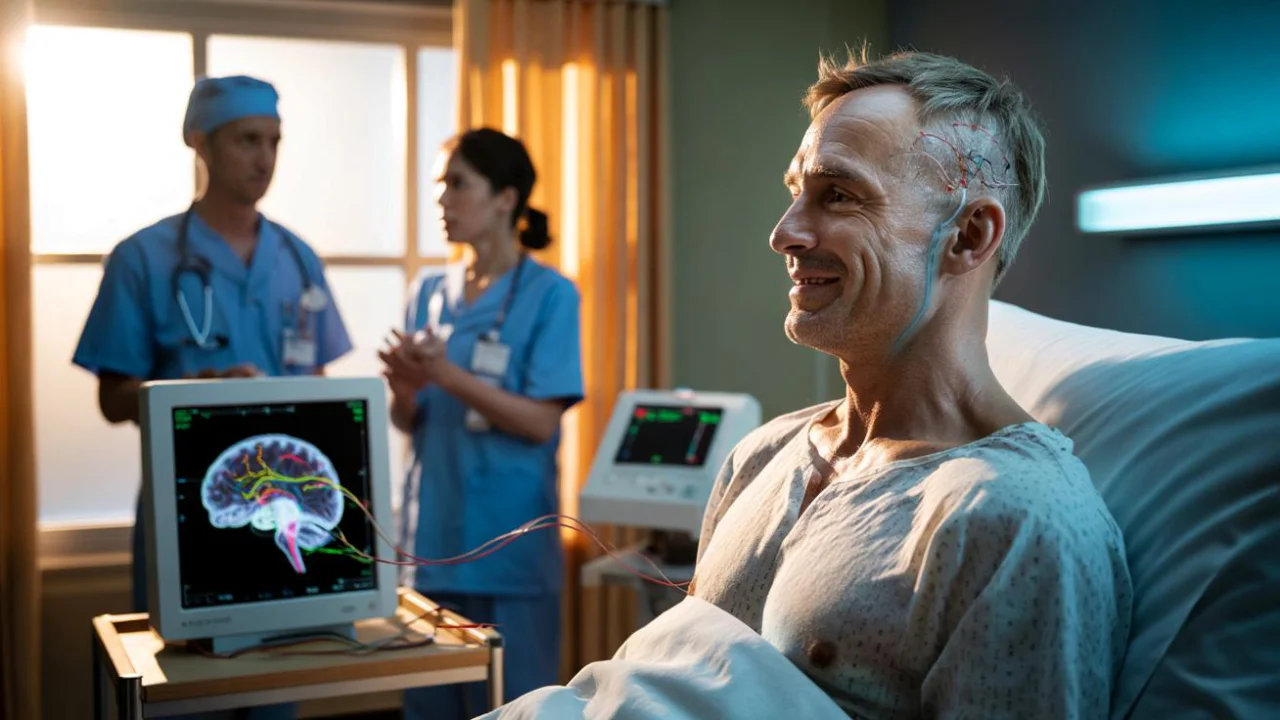
The story of Daniel, a 44-year-old man who lived with crushing depression for 27 years, shows just how revolutionary this technology could be. After every traditional treatment failed him, he became one of the first people to receive this experimental brain device. Fifteen minutes after activation, he was laughing for the first time in decades.
How This Depression Treatment Breakthrough Actually Works
The technology behind this depression treatment breakthrough sounds like something from a sci-fi movie, but it’s grounded in decades of brain research. Deep brain stimulation involves placing a coin-sized device directly into the brain’s “mood circuit” – specific neural pathways that control emotional regulation.
Dr. Helen Rodriguez, a neurosurgeon involved in the trials, explains it simply: “We’ve identified the exact brain signals that trigger depressive episodes. The device monitors these patterns 24/7 and sends tiny electrical pulses to interrupt them before they can take hold.”
The procedure itself takes about four hours. Surgeons drill a small hole in the skull and carefully position electrodes in the brain region that shows abnormal activity during depression. The device then learns each patient’s unique neural signature – the electrical patterns that predict when depression is about to strike.
What makes this different from previous treatments is the personalization. Unlike medications that affect the entire brain, this implant targets only the specific circuits causing problems in each individual patient.
The Numbers Behind This Medical Revolution
The results from early trials are staggering, especially for people who’ve exhausted all other options. Here’s what the data shows:
| Treatment Outcome | Success Rate | Timeline |
|---|---|---|
| Immediate mood improvement | 85% | Within 1 hour |
| Sustained remission at 6 months | 71% | 6 months post-surgery |
| Return to work/normal activities | 68% | 3-6 months |
| Complete elimination of suicidal thoughts | 89% | Within 2 weeks |
The speed of improvement is what shocks researchers most. Traditional antidepressants can take 6-8 weeks to show any effect, and many patients cycle through multiple medications before finding something that works. With brain stimulation, the changes can happen almost instantly.
Current treatment options for severe depression include:
- Multiple rounds of different antidepressant medications
- Electroconvulsive therapy (ECT)
- Transcranial magnetic stimulation
- Ketamine infusions
- Intensive psychotherapy programs
For the roughly 30% of depression patients who don’t respond to these treatments, this depression treatment breakthrough offers the first real hope in decades.
The Controversy That Has Everyone Talking
Not everyone is celebrating this medical advance. The ability to directly manipulate mood and emotions raises profound ethical questions that society isn’t prepared to answer.
Dr. Michael Chen, a bioethicist at Stanford, warns: “When we can flip a switch and change someone’s personality, we’re crossing into uncharted territory. Where does treatment end and enhancement begin?”
The concerns are real and varied:
- Insurance companies might pressure patients to get implants instead of covering ongoing therapy
- The long-term effects on personality and identity remain unknown
- Wealthy patients might use the technology for mood enhancement rather than medical necessity
- Questions about consent when someone is severely depressed and desperate
Religious groups have also raised objections, arguing that suffering can have spiritual value and that artificially eliminating it interferes with natural human experience.
But for families watching loved ones suffer, these philosophical debates feel abstract. Maria Santos, whose husband received the implant after three suicide attempts, puts it bluntly: “People who’ve never lived with treatment-resistant depression don’t understand. This isn’t about perfection – it’s about survival.”
What This Means for Millions of Suffering Families
The potential impact of this depression treatment breakthrough extends far beyond individual patients. Depression affects over 280 million people worldwide, with treatment-resistant cases representing roughly 100 million individuals who’ve found no relief from existing therapies.
The economic implications are staggering. Depression costs the U.S. economy over $200 billion annually in lost productivity, medical costs, and disability payments. A treatment that could restore function to previously untreatable patients could fundamentally change these numbers.
Dr. Lisa Park, who leads one of the research teams, believes we’re looking at a paradigm shift: “We’re moving from treating symptoms to directly addressing the neural circuits that create those symptoms. It’s like fixing a broken wire instead of just managing the flickering light.”
The technology is still in clinical trials, but early access programs are expanding. Currently, only patients who’ve failed at least four different treatment approaches qualify for consideration.
The FDA is fast-tracking approval based on the dramatic results, but full availability is still 2-3 years away. Cost remains a major barrier – the procedure currently runs about $100,000, though researchers expect prices to drop significantly with wider adoption.
For now, families like the Martinez family are watching and waiting. Emma, now 18, has stabilized somewhat with a new medication combination, but her mother Sarah keeps following the research closely. “If this could give my daughter her life back,” she says, “we’d find a way to afford it.”
The next phase of trials will include teenagers and expand to treat other conditions like severe anxiety and PTSD. What started as a last-resort treatment for the most desperate cases might become a first-line therapy for millions.
FAQs
How dangerous is the brain implant surgery?
The procedure carries similar risks to other brain surgeries, with serious complications occurring in less than 3% of cases. Most patients go home within 2-3 days.
Can the device be turned off or removed?
Yes, patients can turn the device off with an external controller, and it can be surgically removed if needed. The brain tissue returns to its previous state once the stimulation stops.
Does insurance cover this depression treatment breakthrough?
Currently, most insurance plans don’t cover the procedure since it’s still experimental. However, some companies are beginning to approve it for patients who meet specific criteria.
How long does the implant battery last?
The current devices have batteries that last 3-5 years. Replacement is a minor outpatient procedure that takes about 30 minutes.
Are there any side effects from the brain stimulation?
Most patients experience no side effects. Some report mild headaches in the first week or slight changes in taste or smell, but these typically resolve quickly.
Who qualifies for this experimental treatment?
Currently, only patients with severe, treatment-resistant depression who’ve failed at least four different therapies and are at high risk for suicide qualify for clinical trials.


