
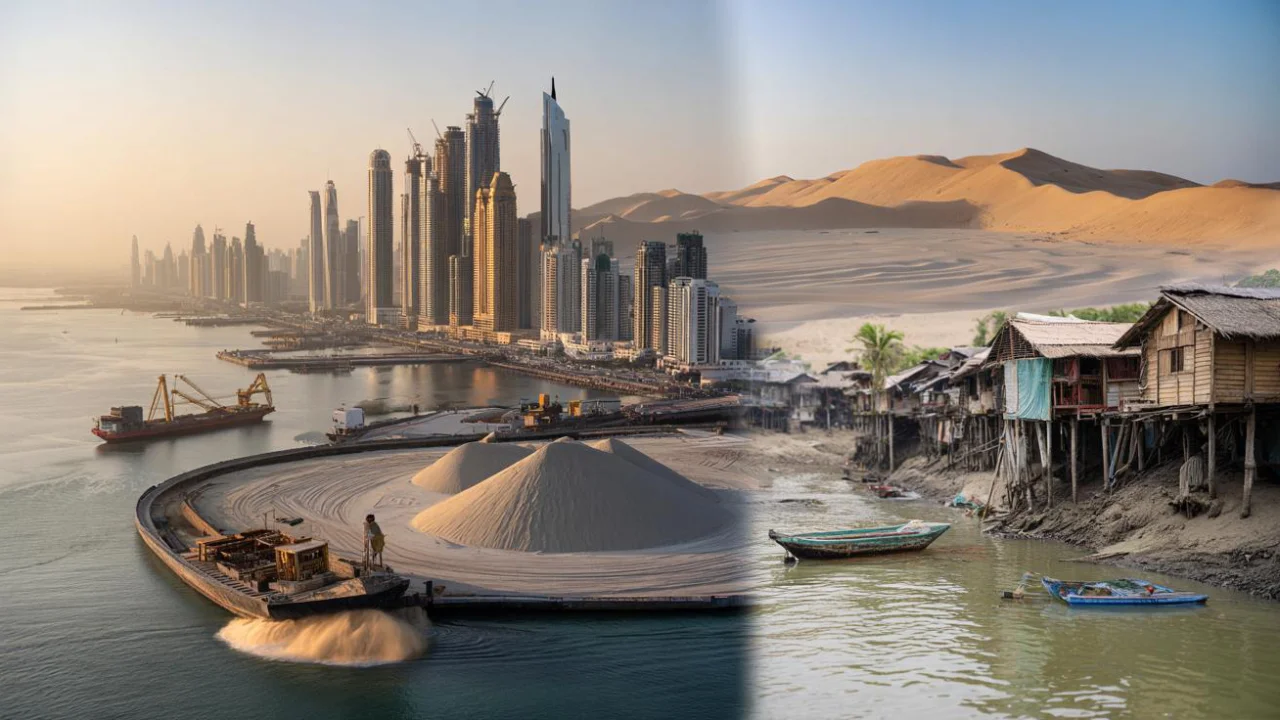
Ahmed runs a small construction company in Riyadh. Last month, he watched a convoy of trucks dump tons of imported sand at his worksite while golden dunes stretched endlessly beyond the city limits. “My grandfather would laugh,” he told his foreman. “We’re buying sand in the desert.”
Ahmed isn’t alone in this irony. Across the Gulf, from Dubai’s glittering towers to Qatar’s World Cup stadiums, one of the world’s most counter-intuitive trades quietly unfolds. Desert kingdoms surrounded by billions of tons of sand import millions more from distant shores, paying premium prices for what seems to lie free outside their doors.
The reason cuts straight to the heart of modern construction: not all sand is created equal. And the global scramble for the “right” kind is reshaping economies, destroying ecosystems, and sparking conflicts most people never hear about.
The Problem with Perfect Desert Sand
Walk onto any Arabian dune and let the grains slip through your fingers. They feel like silk, polished smooth by centuries of wind. Each particle is perfectly rounded, almost marble-like in its smoothness. To tourists, it’s Instagram gold. To engineers, it’s completely useless.
Concrete demands rough, angular sand particles that grip each other like puzzle pieces. Desert sand imports became essential because wind-polished grains won’t bond properly. They slip and slide, creating weak concrete that crumbles under pressure.
“Desert sand is like trying to build with ball bearings,” explains Dr. Sarah Mitchell, a materials engineer who has worked on Gulf construction projects for fifteen years. “You need jagged edges and irregular shapes to create strong concrete. Mother Nature spent millennia making desert sand too perfect for our purposes.”
The alternative comes from riverbeds, coastal areas, and quarries where water and geological pressure create the angular, rough-textured grains that construction requires. This explains why ships loaded with Australian river sand dock in Dubai ports while local dunes remain untouched.
The Massive Scale of Desert Sand Imports
The numbers behind global sand trade reveal an industry most people never think about. Here’s what the data shows:
| Country | Annual Sand Imports (Million Tons) | Primary Sources | Estimated Cost (USD Billions) |
|---|---|---|---|
| UAE | 45-60 | Australia, India, Pakistan | 3.2-4.1 |
| Saudi Arabia | 35-50 | Egypt, Jordan, Australia | 2.8-3.9 |
| Qatar | 25-35 | Australia, Philippines | 2.1-2.8 |
| Kuwait | 15-25 | India, Australia | 1.2-2.0 |
These imports serve specific purposes that local desert sand simply cannot fulfill:
- High-rise construction: Skyscrapers require precisely graded sand for structural concrete
- Land reclamation: Artificial islands need marine-grade sand that won’t shift underwater
- Infrastructure projects: Roads, bridges, and tunnels demand consistent sand quality
- Glass manufacturing: Certain industrial applications need ultra-pure sand varieties
“When you’re building the world’s tallest tower, you don’t compromise on materials,” notes construction industry veteran James Park. “Every grain of sand in that concrete has been tested and approved. Desert sand just doesn’t make the grade.”
Environmental and Human Costs Nobody Talks About
While Gulf cities rise from imported sand, the extraction zones pay a hidden price. River dredging in Southeast Asia has altered waterways, affecting millions who depend on fishing and agriculture. Coastal sand mining has accelerated beach erosion from India to Vietnam.
Local communities bear the brunt of this global demand. Vietnamese fishermen report shrinking catches as sand dredging destroys spawning grounds. Indian farmers watch their rivers change course after intensive sand extraction. Australian environmental groups document habitat destruction around major quarry sites.
The human element often gets forgotten in economic calculations. Small-scale miners in developing countries risk their lives diving for sand in dangerous conditions, earning minimal wages while feeding a multi-billion-dollar trade.
“We’re essentially strip-mining the developing world to build monuments in the desert,” argues environmental economist Dr. Rosa Martinez. “The real cost isn’t just financial – it’s measured in destroyed ecosystems and displaced communities.”
Transportation adds another layer of environmental impact. Cargo ships burn massive amounts of fuel hauling sand across oceans. The carbon footprint of importing construction materials to desert kingdoms rivals that of entire small nations.
Who Really Pays for Desert Development Dreams
The economics of desert sand imports create winners and losers across continents. Gulf states get their architectural marvels and diversified economies. International shipping companies profit from steady cargo demand. Sand exporters earn valuable foreign currency.
But the calculation isn’t simple. Environmental damage often becomes someone else’s problem, creating what economists call “externalized costs.” When a Dubai hotel uses imported sand, the environmental bill gets paid by Vietnamese fishing communities or Australian river systems.
Supply chain disruptions have revealed how dependent these desert kingdoms have become on imported sand. COVID-19 shipping delays stalled construction projects worth billions. Political tensions with supplier countries can instantly threaten infrastructure timelines.
“The irony is absolute,” observes urban planning expert Dr. Michael Chen. “Countries sitting on vast sand reserves have made themselves vulnerable to supply shocks from the other side of the planet. It’s like Saudi Arabia importing oil.”
Alternative technologies are emerging. Some companies now process desert sand through special treatments, though costs remain high. Others explore recycled concrete as a partial substitute for fresh sand. But these solutions haven’t scaled enough to change the fundamental equation.
The global sand trade continues expanding as emerging economies launch their own construction booms. Desert sand imports that once seemed uniquely Gulf phenomena now spread to other arid regions with development ambitions.
This creates a troubling feedback loop: more development drives more sand demand, more environmental damage, and greater dependency on increasingly scarce marine and river sand sources. The grains of sand slipping through Ahmed’s fingers in Riyadh represent choices with consequences rippling across the globe.
FAQs
Why can’t desert countries use their own sand for construction?
Desert sand grains are too smooth and rounded from wind erosion, making them unsuitable for concrete that requires angular, rough-textured particles for proper bonding.
How much does imported sand cost compared to local alternatives?
Imported construction sand typically costs 3-5 times more than local sand, but Gulf countries pay the premium for quality and consistency in major projects.
Which countries supply the most sand to desert kingdoms?
Australia, India, Pakistan, and Vietnam are major suppliers, with Australia providing the highest quality marine sand for premium construction projects.
Are there environmental consequences to large-scale sand imports?
Yes, extensive river and coastal sand mining damages ecosystems, affects fishing communities, accelerates erosion, and disrupts natural water flow patterns in supplier regions.
Could desert sand ever become usable for construction?
Scientists are developing treatments to make desert sand suitable for construction, but current methods remain expensive and haven’t reached commercial scale for major projects.
How much sand does the world consume annually?
Global sand consumption exceeds 50 billion tons per year, with construction accounting for the largest share, making it the second-most consumed natural resource after water.


