
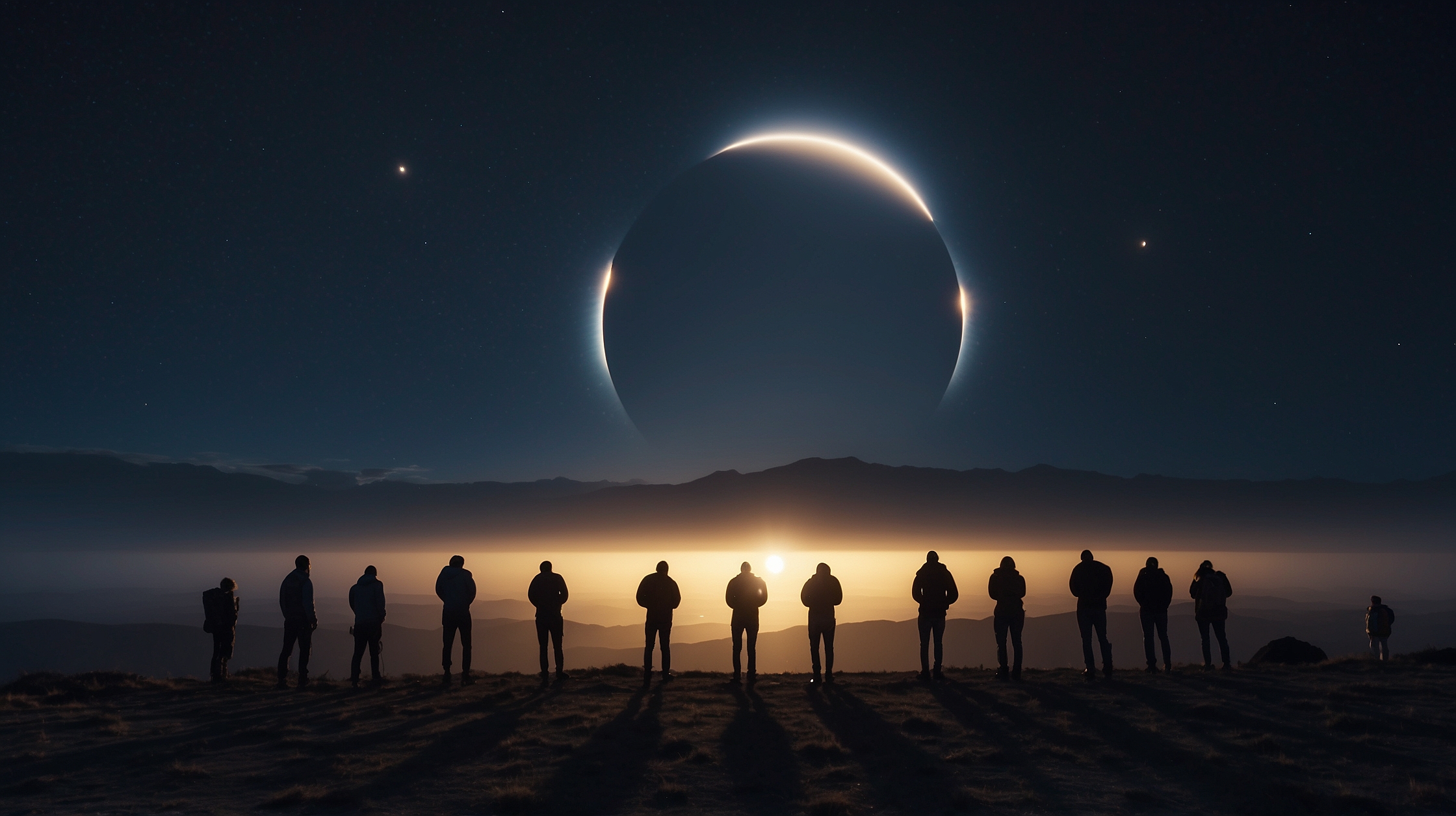
The long-awaited **’Eclipse of the Century’** is almost here—a rare celestial event that will transform day into night for several breathtaking minutes, captivating millions across continents. As the Moon casts its shadow over Earth, observers in its direct path will experience a **total solar eclipse** lasting up to a stunning six minutes, the longest such spectacle in over a century. This rare astronomical phenomenon promises not only an unforgettable visual experience but also the chance for scientists and skywatchers alike to gain valuable insights about our universe.
Unlike other eclipses that last only a matter of seconds or boast limited visibility, this exceptional event will grace significant portions of the Earth’s surface with an unparalleled duration of darkness in the middle of the day. As excitement builds in communities and news spreads worldwide, travelers are making plans, scientists are preparing studies, and locals are gearing up for what promises to be a once-in-a-lifetime experience. But where exactly can you catch it, and what makes this eclipse so special?
Key facts about the 2024 Total Solar Eclipse
| Feature | Details |
|---|---|
| Date of Eclipse | April 8, 2024 |
| Maximum Duration of Totality | 6 minutes and 12 seconds |
| Areas of Totality | Mexico, parts of the U.S., and Canada |
| Best Viewing Cities | Mazatlán (MX), Austin, Dallas, Little Rock, Indianapolis, Buffalo |
| Eclipse Type | Total Solar Eclipse |
| Moon’s Position | Closest (Perigee), making Moon appear bigger |
| Next Eclipse with Similar Duration | Not until 2316 |
Why this eclipse is so monumental
The April 8, 2024 eclipse isn’t merely another addition to astronomy calendars—it’s making history because of its **exceptional duration and path**. Most total solar eclipses last less than three minutes, but this one stands out with over six minutes of total darkness in some areas. This rare alignment occurs due to the Moon being at perigee—its closest orbit to Earth—making it appear large enough to completely obscure the Sun for a longer period than average.
The last total solar eclipse of similar magnitude occurred in 1973, and it was largely visible over the Atlantic and parts of Africa, out of reach for most observers. Considering that the next eclipse of similar length won’t occur until 2316, this 2024 opportunity is truly once-in-a-generation for those residing in or able to travel to its path.
Where the eclipse will be visible
The path of totality begins in the Pacific Ocean, sweeping across **Mazatlán, Mexico** before traversing the central United States and finally exiting through eastern **Canada**. Cities warmly welcomed into the path of totality include **Dallas, Austin, Little Rock, Indianapolis, Buffalo, and Montreal**. Major metropolitan areas that were left out of the 2017 eclipse will now be treated to a rare sight.
Observers just outside the direct path will still experience a **partial eclipse**, a fascinating event in its own right but without the breathtaking totality that plunges the sky into an eerie twilight. For the best experience, experts advise being in the centerline of the path where duration of totality is longest—it’s here that **six full minutes of darkness** can be enjoyed at the peak.
When and how to watch the eclipse safely
Depending on your geographic location, the timing of the eclipse will vary. In **Mazatlán, Mexico**, the eclipse is expected just after **11 a.m. local time**, with the U.S. seeing it in the early to mid-afternoon hours. As always, **safety is paramount**. Never look directly at the Sun without certified eclipse glasses or other proper viewing tools. Damaging UV rays can cause permanent retinal injuries in just seconds.
Local astronomy clubs and municipal observatories often organize **viewing parties** with telescopic equipment and guided narration during events like these, which can enhance the experience remarkably. Ensure any telescope or binoculars are fitted with **solar filters**, and avoid homemade filters unless verified by experts.
Scientific importance and preparation
Eclipses also provide scientists with a **rare opportunity to study the solar corona**, the outermost layer of the Sun, which becomes visible only during totality. NASA and independent researchers are already deploying high-speed cameras, solar spectrographs, and high-altitude balloons to collect data that’s normally unattainable due to the Sun’s overpowering brightness.
Unlike previous eclipses, this one occurs in an age of **advanced imaging, citizen science apps**, and near-instant global communication. Experts hope to better understand topics ranging from **heliophysics to solar wind behavior**, making this not just a visual spectacle, but a groundbreaking moment in research.
Winners and losers of the eclipse path
| Winners | Losers |
|---|---|
| People in Mazatlán, Dallas, and Buffalo—ideal visibility for 4–6 minutes | People in southern California, Florida, and northern Canada—outside totality path |
| Scientists with access to corona observation technology | Last-minute travelers struggling with high-demand accommodations |
| Tourism sectors along the eclipse path | Motorists affected by likely traffic congestion during peak times |
What travelers and locals should know
With eclipse tourism on the rise, hotel bookings have surged in places like Austin and Indianapolis. Experts strongly recommend **reserving accommodations early** and planning around weather forecasts, since clouds and rain could mar visibility. Communities are also preparing for infrastructure strain—expect crowded roads, emergency service alerts, and extended wait times in popular viewing areas.
Local governments, particularly in rural viewing zones, are issuing advisories about **public restroom availability, waste disposal options, parking permits**, and places for overnight camping. Some cities like Buffalo are even opening up public parks for viewing and inviting food vendors and performers to turn the event into a day-long festival.
What changed this year
Unlike the 2017 eclipse, which had a shorter and narrower path, the 2024 eclipse’s **wider corridor and longer totality** make it more widely visible and climactically impactful. Skywatchers from all walks of life—from scientific professionals to casual viewers—are gearing up with **high-definition equipment, solar filters, and drone cameras** to maximize their experience.
Additionally, the 2024 eclipse coincides with a **low solar activity cycle**, which could make the Sun’s outer corona even more dramatic and visible. These changes make this eclipse not just longer, but scientifically richer and potentially more awe-inspiring than any other in recent memory.
How to capture the perfect eclipse photograph
For photography enthusiasts, shooting a total solar eclipse requires preparation. Use **solar filters on all lenses** before and after totality to avoid camera sensor damage. Only during totality is it safe to remove the filter briefly to capture the Sun’s corona.
Tripods, interval timers, and remote shutters are essential for maintaining camera stability during long exposures. Consider bracketing exposures to capture the range of lighting during the eclipse. **Smartphone users** can boost quality by attaching telephoto lenses and using specialized eclipse photography apps to help regulate exposure settings automatically.
This eclipse offers us a phenomenal opportunity to study the Sun’s outer atmosphere like never before.
— Dr. Liana Reyes, Solar Physicist (Placeholder)
We’ve never had a six-minute eclipse over such a densely populated area in modern times—expect data like we’ve never seen.
— Miguel Tanaka, NASA Observer (Placeholder)
Short FAQs about the 2024 total solar eclipse
When is the next total solar eclipse after 2024?
The next total solar eclipse visible in the U.S. will occur in August 2044, but it will have a much shorter duration and narrower path.
Is it safe to watch the eclipse without glasses during totality?
You can briefly view the eclipse without certified solar glasses only during the exact moments of totality. Before and after, glasses are essential.
How long will the 2024 eclipse last in the U.S.?
Depending on your location, totality could last between 3 to 6 minutes, with the maximum duration occurring in central Mexico.
Can I travel to view the eclipse?
Yes. Major cities in the eclipse path are preparing for visitors. Book early and plan for traffic and accommodation challenges.
What are the best eclipse viewing tools?
Use certified solar eclipse glasses, solar filters for equipment, and optionally pinhole projectors for a safe and interactive viewing method.
Why is the eclipse lasting longer than usual?
The Moon is at perigee, appearing larger in the sky and covering the Sun for a longer time than usual.
Will weather affect eclipse viewing?
Yes. Cloud cover or rain could obstruct the view. Monitor forecasts and consider fallback travel options along the eclipse corridor.
What time does the eclipse occur in the U.S.?
The eclipse generally occurs between 1 p.m. and 3 p.m. local time, but varies based on specific city and state locations.


