
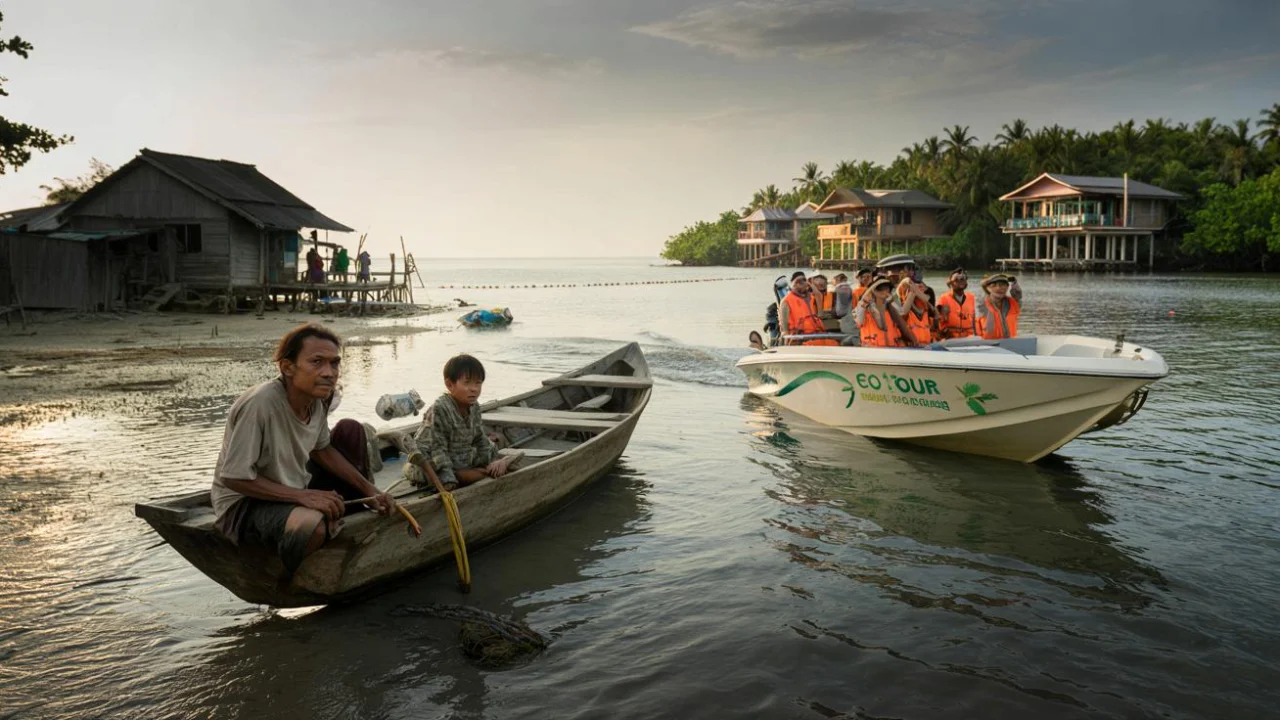
Maria Santos watched her family’s fishing boat bob empty in the harbor. For thirty years, she’d worked these waters off the coast of Costa Rica, supporting three generations with her nets. Then the eco-lodge opened on the hillside above her village. Suddenly, her traditional fishing grounds became a “marine sanctuary” where tourists could swim with dolphins.
“They told us it would help the environment,” Maria says, her weathered hands folding a net she can no longer use. “But nobody asked if it would help us.”
The wooden boat that now cuts across those same waters carries a dozen foreign visitors with branded life jackets and phones ready to capture the “untouched” paradise. On Instagram, this place looks like a triumph of sustainable travel. On the ground, it’s crushing the people who call it home.
The gentle face of displacement
Ecotourism sells itself as travel’s conscience. No mega-resorts, no cruise ships, no oil-slick postcards of excess. Just small groups, bamboo bungalows, reusable water bottles, maybe a yoga class at sunset. It feels clean, responsible, kind.
But talk to people who actually live in these so-called “eco-paradises” and a different story emerges. Rising rents, sacred lands turned into selfie spots, fishermen pushed away from traditional waters in the name of marine protection projects they never asked for.
“The irony is heartbreaking,” explains Dr. Elena Rodriguez, who studies sustainable tourism at Universidad Nacional. “Communities get displaced by projects designed to help them. It’s colonialism with a green badge.”
From a distance, ecotourism looks like kindness. Up close, it can cut deeper than any bulldozer.
On a tiny island in the Philippines, an international NGO recently funded a new “community-based eco-lodge.” The brochure promised fair jobs, preserved reefs, and “authentic cultural encounters.” Western volunteers came to paint walls, post social media content, and hold workshops on sustainable tourism. The project won an award at a European green travel fair before the first guest ever arrived.
Behind those glossy photos, the village was changing fast. Land around the lodge shot up in value overnight. A local schoolteacher quietly confessed that half her students might have to move to the mainland within a year. Their families simply couldn’t afford the new “eco” rents.
How green projects create invisible walls
This is how soft words hide hard impacts. When an area gets labeled as a pristine eco-destination, investors quickly follow, along with stricter rules decided in distant offices. The transformation happens in predictable stages:
- Land designation: Traditional fishing zones become “protected marine areas”
- Access restrictions: Forest paths require permits and English-language documents
- Economic displacement: Tourism jobs pay less than traditional livelihoods
- Cultural erosion: Sacred sites become photo opportunities
- Rent inflation: Property values skyrocket beyond local wages
“We see a seal, a logo, a photo of a smiling child in traditional clothes, and we think we’re helping,” notes tourism researcher James Mitchell. “Sometimes we are. Sometimes we’re just helping someone else push locals aside more politely.”
| Traditional Livelihood | Monthly Income | Ecotourism Job | Monthly Income |
|---|---|---|---|
| Fishing boat captain | $800-1200 | Tour guide | $300-500 |
| Forest harvester | $600-900 | Lodge cleaner | $250-400 |
| Small farmer | $500-800 | Craft vendor | $200-350 |
The math doesn’t work. Ecotourism promises to replace traditional livelihoods with “sustainable” alternatives, but those alternatives often pay a fraction of what people earned before.
The activists who never leave their hotels
Meanwhile, Western activists celebrate from afar. Social media fills with posts about “supporting local communities” and “protecting indigenous culture.” The same people who would never accept a 60% pay cut in their own lives applaud when it happens to someone else, as long as it comes wrapped in environmental rhetoric.
Carlos Mendez used to earn decent money leading hunting expeditions in the Amazon. When his region became an ecotourism zone, hunting was banned. Now he guides birdwatching tours for half the pay.
“The tourists want to see ‘authentic’ jungle life,” he says. “But they don’t want to know that their authentic experience made my authentic life impossible.”
This disconnect isn’t accidental. Ecotourism marketing deliberately obscures its economic impacts. Brochures show smiling faces and pristine landscapes, but never mention the families who had to relocate when their land became a “conservation area.”
“The cruelest part is how it’s framed as help,” observes anthropologist Dr. Sarah Chen, who has documented ecotourism’s impacts across Southeast Asia. “When people resist these projects, they get labeled as anti-environment. Their own advocates turn against them.”
The real cost of feel-good travel
The numbers tell a stark story. In Costa Rica, ecotourism regions show 40% higher rates of outmigration compared to other rural areas. In Kenya, Maasai communities near eco-lodges report average income drops of 35% over the past decade. In Thailand, traditional fishing villages have shrunk by half since becoming popular ecotourism destinations.
Yet the industry continues growing. Global ecotourism revenues hit $181 billion in 2023, with Western travelers increasingly seeking “authentic” and “sustainable” experiences. The more remote and “untouched” the destination, the higher the price tag.
What would genuine sustainable tourism look like? Local leaders suggest starting with local control. Instead of international NGOs designing projects for communities, let communities design projects for themselves.
- Give land rights to indigenous groups before creating conservation areas
- Ensure tourism jobs pay living wages, not charity wages
- Respect traditional livelihoods instead of replacing them
- Share tourism profits with entire communities, not just lodge owners
Some places are trying different approaches. In Namibia, communal conservancies give local communities direct ownership of tourism revenue. In Bhutan, high-value, low-impact tourism limits visitor numbers while maximizing local benefits.
But these examples remain rare. Most ecotourism still follows the same pattern: Western organizations identify a “pristine” area, designate it for protection, invite Western tourists to experience it, and expect local people to be grateful for the economic crumbs.
The next time you see an advertisement for sustainable travel, ask yourself: who decided this place needed to be sustainable? Who profits from that decision? And who pays the real price for your eco-friendly vacation?
True kindness would start with those questions. Everything else might just be cruelty with better marketing.
FAQs
Is all ecotourism harmful to local communities?
No, but many projects prioritize Western comfort over local needs. The key is whether communities control the tourism development or have it imposed on them.
How can I tell if an ecotourism project genuinely helps locals?
Look for community ownership, living wages for local jobs, and respect for traditional livelihoods. Be suspicious if the marketing focuses more on your experience than local benefits.
Why don’t local people just refuse these projects?
Many lack legal land rights or political power. When international funding and government support align behind a project, communities have little choice but to adapt or leave.
What’s the alternative to ecotourism for conservation?
Community-controlled conservation, where locals manage their own resources and receive direct payment for environmental protection, often works better than tourism-based models.
Can responsible ecotourism actually work?
Yes, when communities have real control over tourism development and receive fair compensation. But this requires changing power structures, not just adding green labels to existing practices.
How do I travel more responsibly?
Choose locally-owned accommodations, pay fair prices for services, learn about local issues before visiting, and consider whether your presence truly helps or just makes you feel better.


