
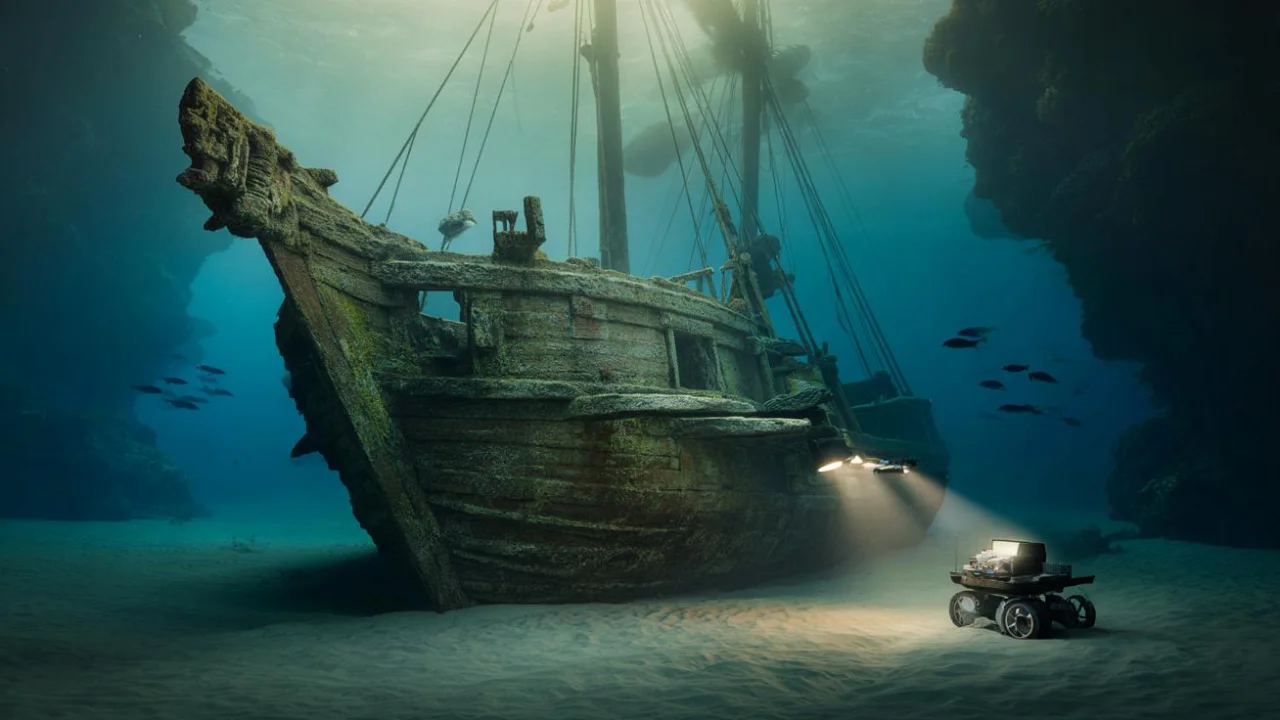
Maria Santos had been diving these waters off Western Australia for twenty years, guiding tourists to coral reefs and searching for lost fishing gear. Last Tuesday, something made her stop mid-descent and hover motionless thirty meters below the surface. Through her mask, she could see what looked like the ghostly outline of a massive wooden structure, perfectly preserved in the cold depths.
“I’ve never seen anything like it,” she told her dive partner later. “It was like swimming into a museum that someone forgot to build walls around.”
What Maria discovered turned out to be far more significant than anyone imagined. She had stumbled upon one of maritime archaeology’s most remarkable finds: an explorers ship from the late 1700s, sitting intact on the seafloor like a time capsule waiting to be opened.
When the Sea Decides to Keep Secrets
The sonar readings came back clean at first. Then, gradually, a shape emerged from the digital noise that made everyone on the research vessel stop talking. Beneath 85 meters of cold Pacific water, the wooden hull of an 18th-century explorers ship rested upright, as if it had simply been parked there yesterday.
Maritime archaeologist Dr. James Fletcher described the moment their remote operated vehicle first swept over the wreck: “We’re looking at carved timbers that are still sharp enough to cut yourself on. Iron fittings covered in centuries of marine growth, but the wood underneath looks like it was submerged last month.”
For decades, local fishermen had reported snagging their nets on “something big” in this area. Aboriginal elders had oral histories of a “ghost ship” that appeared in their traditional fishing grounds. Now those stories have coordinates, measurements, and a preservation status that has archaeologists calling it “unprecedented.”
The explorers ship appears to be from the great age of Pacific exploration, likely part of either British or Dutch expeditions mapping trade routes between Asia and the emerging colonies. Archival research suggests several vessels went missing along this stretch of coast between 1770 and 1780, including one reported “overdue from Batavia” in Dutch East India Company records.
What Makes This Discovery So Extraordinary
Most wooden ships from this era have long since been devoured by marine borers or scattered by storms. This explorers ship survived for reasons that marine archaeologists describe as “a perfect storm of preservation conditions.”
Dr. Sarah Chen, who leads the underwater survey team, explained: “The water temperature here stays consistently cool year-round. There’s very little oxygen at that depth, and virtually no wood-boring organisms. The seabed is soft sediment that cradles the hull instead of grinding against it.”
- Water depth: 85 meters – deep enough to avoid surface storms
- Temperature: Constant 8-10°C – too cold for most destructive organisms
- Oxygen levels: Less than 2% – preventing rapid decay
- Sediment type: Fine sand and silt – providing cushioned support
- Current patterns: Minimal disturbance from water movement
Early sonar mapping suggests the ship measures approximately 40 meters in length, making it a substantial vessel for its era. The masts are gone, likely broken off during the sinking, but the hull structure remains remarkably complete.
| Ship Component | Preservation Status | Archaeological Significance |
|---|---|---|
| Main Hull | 90% intact | Construction techniques, wood types |
| Stern Section | Excellent condition | Captain’s quarters, navigation equipment |
| Cargo Hold | Partially buried | Trade goods, supplies, personal items |
| Bow Structure | Good condition | Ship identification, decorative elements |
Opening a Time Capsule Without Breaking It
The challenge now facing archaeologists is how to study this explorers ship without damaging it. Traditional salvage techniques would destroy the very preservation conditions that kept it intact for 250 years.
“We’re essentially performing surgery on history,” explains Dr. Fletcher. “One wrong move and we could lose information that’s been waiting centuries to tell its story.”
The team’s approach combines cutting-edge technology with archaeological patience. High-resolution cameras create detailed 3D models of every surface. Specialized equipment takes microscopic samples of wood and metal for analysis. Ground-penetrating sonar maps what lies buried in the sediment without disturbing it.
Marine archaeologist Lisa Rodriguez, who has worked on similar sites in the Caribbean, notes: “This isn’t just about the ship itself. It’s about recreating the entire world these explorers lived in. Their tools, their food, their personal belongings – it’s all potentially preserved down there.”
The sediment surrounding the explorers ship may contain organic materials that normally disappear within decades of submersion. Leather goods, textiles, paper documents, even food remains could be preserved in the oxygen-free environment.
What This Means for Our Understanding of Early Exploration
This discovery comes at a time when historians are reassessing the early exploration period. Traditional accounts focused on famous captains and successful voyages, but wrecks like this tell the stories of the expeditions that didn’t make it home.
“Every explorers ship that went down took with it not just lives, but knowledge,” says maritime historian Dr. Patricia Moore. “Maps that were never completed, observations that were never recorded, discoveries that were never shared. This wreck could fill in gaps we didn’t even know existed.”
The cargo hold, still largely buried, may contain trading goods that reveal economic relationships between European powers and Pacific communities. Navigation instruments could show how sailors of the era calculated their position. Personal belongings might provide intimate glimpses into the daily lives of 18th-century explorers.
For Australia, the find adds another layer to the complex story of early European contact. While the east coast exploration routes are well documented, this western discovery suggests more extensive maritime activity than previously understood.
Local Aboriginal communities have been consulted about the find, as their oral histories may contain references to the ship’s arrival or loss. Traditional knowledge keepers are working with archaeologists to ensure cultural considerations are respected throughout the research process.
The Long Road Ahead
Full excavation of the explorers ship could take decades. Each artifact must be carefully extracted, conserved, and analyzed. The ship itself may eventually be raised, though that decision is still years away.
Funding for the project comes from universities, government heritage agencies, and private donors who recognize the significance of the find. Tourism interest is already building, with plans for a museum display featuring 3D models and recovered artifacts.
For now, the explorers ship rests where it has for two and a half centuries, guarded by research vessels and protected by maritime law. But soon, its story will begin to emerge from the depths, adding new chapters to our understanding of an era when the world’s oceans were highways to the unknown.
FAQs
How was this explorers ship discovered?
Marine surveys for a modern infrastructure project detected the wreck using sonar equipment in late 2023.
Why is the ship so well preserved after 250 years?
Cold water temperatures, low oxygen levels, and protective sediment created perfect preservation conditions that prevented normal decay.
What nationality was this explorers ship?
Researchers believe it was likely British or Dutch, based on construction style and historical records of missing vessels in the area.
Will the ship be raised to the surface?
That decision is still years away. Currently, archaeologists are studying it underwater to avoid damaging the preservation conditions.
Can the public visit the wreck site?
The site is protected under maritime law and closed to recreational divers, but plans are underway for museum displays of findings and 3D models.
What artifacts might be found inside the ship?
Potentially navigation instruments, trading goods, personal belongings, food supplies, and documents – all preserved by the oxygen-free environment.


