
Marie Dubois never thought much about the massive wind turbines spinning lazily beyond her vineyard in Provence. They were just part of the horizon, like the mountains or the ancient stone walls that divided her property. But last month, something changed her perspective completely.
Her electricity bill arrived with a number that made her sit down hard in her kitchen chair. Nearly €400 for two months. Her neighbor knocked on the door an hour later, waving his own bill and asking if she’d seen the news about France’s new energy plans.
“Maybe those big white things aren’t so bad after all,” Marie said, squinting at the turbines through her window. Little did she know, she was looking at just the beginning of France’s most ambitious energy transformation in decades.
The numbers behind France’s renewable energy revolution
France is about to make one of the boldest energy moves in European history. The country has committed to nearly tripling its renewable energy capacity by 2035, jumping from around 70 gigawatts today to somewhere between 180-200 gigawatts in just over a decade.
This isn’t just another political promise. It’s a complete restructuring of how France powers itself, moving away from heavy reliance on nuclear energy and fossil fuel imports toward a diversified clean energy portfolio.
“We’re witnessing the fastest energy transition France has ever attempted,” says energy analyst Claire Montpelier from the French Institute for Sustainable Energy. “The scale is unprecedented, and frankly, it has to be if we want to meet our climate commitments.”
The transformation touches every corner of French energy production. Solar installations will expand dramatically across rooftops, unused agricultural land, and industrial sites. Offshore wind farms will stretch along both Atlantic and Mediterranean coastlines. Even biomass and hydroelectric projects are getting significant upgrades.
Breaking down France’s renewable energy expansion plan
The sheer scope of this expansion becomes clearer when you look at the specific targets and timelines France has set for itself:
| Energy Source | Current Capacity (GW) | 2035 Target (GW) | Growth Factor |
|---|---|---|---|
| Solar Power | 15 | 75-80 | 5x increase |
| Onshore Wind | 20 | 40-45 | 2x increase |
| Offshore Wind | 1 | 40 | 40x increase |
| Hydroelectric | 25 | 27 | Steady growth |
| Biomass | 8 | 12 | 50% increase |
The most dramatic changes will happen in solar and offshore wind. Solar capacity alone will grow from 15 gigawatts to nearly 80 gigawatts, meaning you’ll see panels appearing on everything from suburban rooftops to massive solar farms in rural areas.
Offshore wind represents the biggest leap. France currently has just one gigawatt of offshore wind capacity, but plans call for 40 gigawatts by 2035. That means dozens of new wind farms sprouting from coastal waters.
- Major offshore wind zones planned off Normandy, Brittany, and the Mediterranean coast
- New floating wind technology for deeper waters where traditional turbines can’t reach
- Investment in port infrastructure to support massive turbine installation projects
- Partnerships with European manufacturers to build turbines locally
- Grid modernization to handle variable renewable power sources
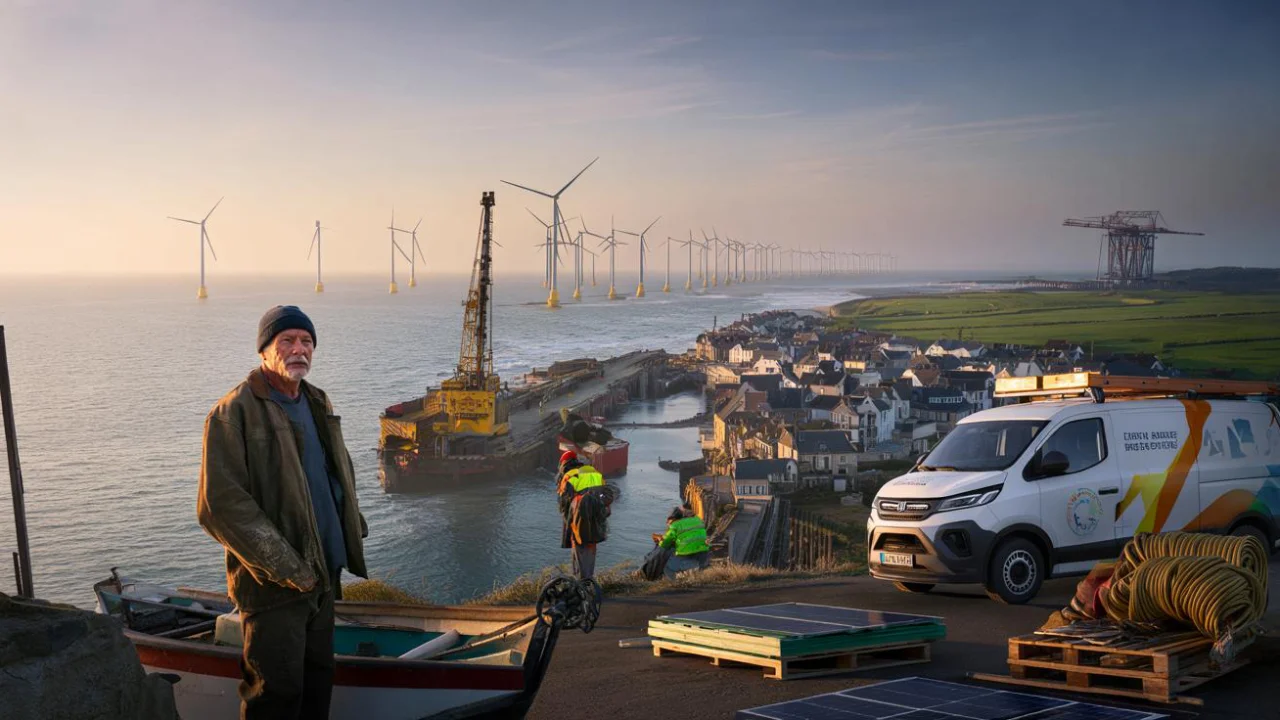
“The offshore wind expansion alone will require completely reimagining our coastal industrial capacity,” explains maritime engineer François Leroux. “We’re talking about transforming sleepy fishing ports into major industrial hubs practically overnight.”
What this means for ordinary French citizens
For people like Marie in Provence, this massive expansion of France renewable energy capacity could mean several concrete changes to daily life over the next decade.
Energy bills should become more predictable and potentially lower. When the wind blows and the sun shines, electricity prices drop. More renewable capacity means more of these low-cost hours throughout the year.
The visual landscape will change dramatically. Rural areas will see more solar installations and wind turbines. Coastal regions will have wind farms visible on the horizon. Urban areas will see more rooftop solar panels and small wind installations.
Job opportunities will multiply in unexpected places. Small towns near planned wind farms are already seeing companies scout locations for maintenance facilities. Solar installation crews are in high demand. Port cities are preparing for thousands of new jobs related to offshore wind construction.
“My son just got hired by a solar company that didn’t exist two years ago,” says Bernard Rousseau, a farmer in Normandy who recently leased part of his land for a solar project. “The money from the lease helps with the farm, and now he has steady work too.”
Energy independence will improve significantly. France currently imports about 60% of its energy needs. Tripling renewable capacity could cut that dependency substantially, making the country less vulnerable to price shocks from international crises.
The challenges ahead for France’s energy transformation
Ambitious plans face real-world obstacles, and France’s renewable energy expansion isn’t immune to practical problems.
Grid infrastructure needs massive upgrades to handle variable power sources. When the wind stops blowing in one region, electricity needs to flow quickly from areas where it’s still generating power. This requires billions of euros in new transmission lines and smart grid technology.
Local opposition could slow projects significantly. French communities have historically been skeptical of large industrial projects, and wind turbines often face resistance from residents worried about noise, visual impact, or effects on property values.
Supply chain constraints are already appearing. Global demand for solar panels, wind turbines, and specialized cables has outpaced production capacity. France will compete with other countries pursuing similar aggressive renewable targets.
“The engineering challenges are solvable, but the timeline is incredibly tight,” warns infrastructure specialist Dr. Anne-Sophie Leclair. “We’re essentially trying to rebuild the entire energy system in 12 years while keeping the lights on the whole time.”
Skilled worker shortages could become critical. Installing and maintaining this much renewable capacity requires specialized technicians, engineers, and construction workers. France’s technical education system is scrambling to train enough people for the surge in demand.
Why Europe is watching France’s renewable push closely
France’s success or failure in tripling its renewable energy capacity will influence energy policy across Europe. As the continent’s second-largest economy, France becoming a renewable energy powerhouse would demonstrate that large, industrialized nations can rapidly transform their energy systems.
Other European countries are pursuing similar goals, but France’s combination of strong government commitment, industrial capacity, and geographic advantages for renewables makes it a crucial test case.
If successful, France could become a net energy exporter to neighboring countries during peak renewable production periods. If the transition stumbles, it could slow renewable adoption across the continent and undermine climate commitments.
The economic implications extend beyond energy. French companies are positioning themselves to export renewable energy technology and expertise to other countries attempting similar transitions.
“France has the chance to turn its late start in renewables into an advantage,” says European energy policy expert Dr. Klaus Weber. “They can learn from early mistakes made elsewhere and build the most efficient renewable energy system in Europe.”
FAQs
How much will France’s renewable energy expansion cost?
Estimates suggest the total investment could reach €200-300 billion over the next decade, funded through a combination of government spending, private investment, and European Union support programs.
Will this expansion affect France’s nuclear power plants?
Nuclear power will remain important in France’s energy mix, but its relative share will decrease as renewable capacity grows. Some older nuclear plants may close as planned, while others will continue operating alongside expanded renewable sources.
When will ordinary consumers see the benefits of increased renewable energy?
Energy bill impacts should begin appearing within 3-5 years as the first major solar and wind projects come online, though the most significant benefits will likely emerge after 2030 when capacity reaches critical mass.
What happens if France doesn’t meet its 2035 renewable energy targets?
Missing the targets could result in EU penalties, higher energy costs, continued import dependence, and failure to meet climate commitments, potentially affecting France’s international standing on environmental issues.
How will weather variability affect France’s increased reliance on renewables?
France is investing heavily in grid modernization, energy storage systems, and connections with neighboring countries to manage the intermittent nature of wind and solar power while maintaining reliable electricity supply.
Will rural communities benefit from the renewable energy expansion?
Rural areas should see significant economic benefits through land lease payments for solar and wind projects, new job opportunities, and improved local infrastructure, though some communities may experience visual and noise impacts from new installations.


