
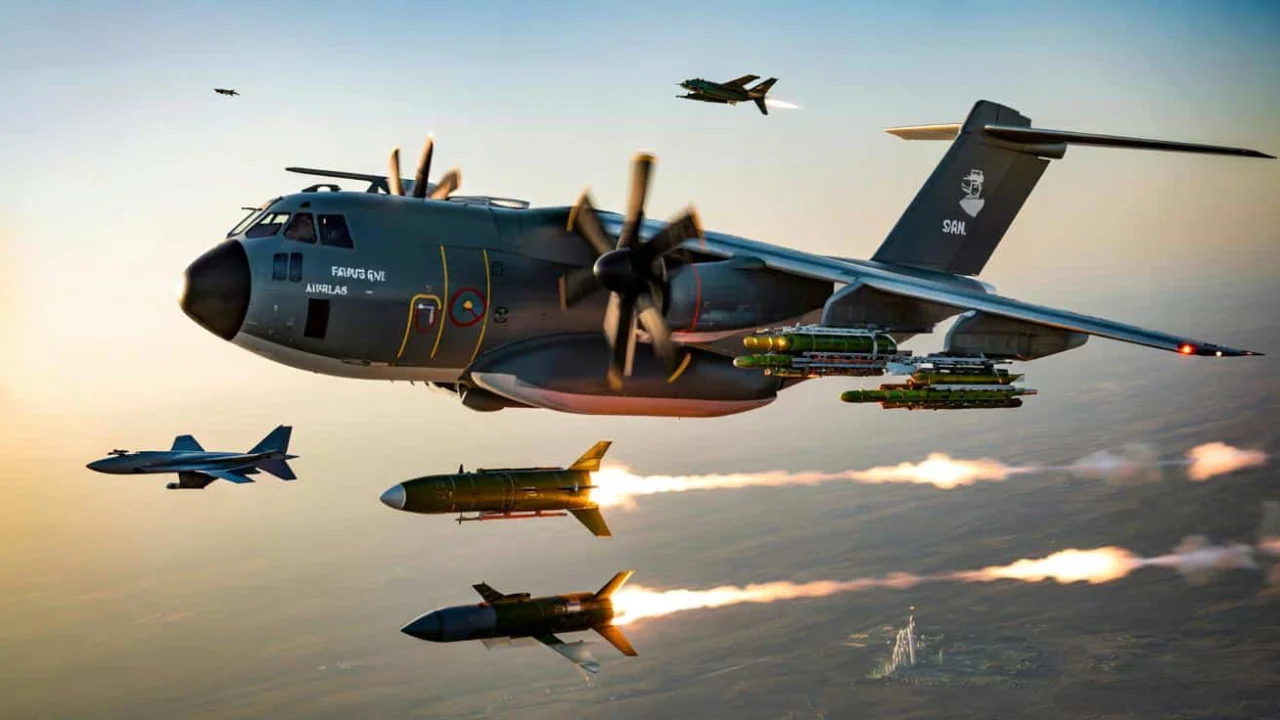
Captain Marie Dubois had flown hundreds of cargo missions in her A400M Atlas, shuttling supplies across Africa and the Middle East. To her, the massive 141-ton aircraft was like a reliable truck with wings – unglamorous but essential. Last month, during a routine briefing at her French Air Force base, everything changed.
“What if I told you your cargo plane could become our most potent strike weapon?” her commander asked the stunned pilots. The room fell silent. Nobody expected their workhorse transport to evolve into a frontline fighter.
That conversation reflects a seismic shift happening within the French Air and Space Force. Military planners are quietly transforming their thinking about the A400M Atlas, and the implications could reshape modern warfare.
The French Air Force A400M Gets a Combat Makeover
The French Air Force A400M program is undergoing a dramatic evolution. What started as a simple cargo hauler is being studied for conversion into a multi-role strike platform capable of carrying missiles, guided bombs, and even advanced energy weapons into contested airspace.
Built by Airbus, the A400M Atlas normally operates in the shadows of military operations. It ferries vehicles, ammunition, and soldiers between bases. The aircraft was originally designed to replace aging C-160 Transalls and complement American-made C-130 Hercules transports – not to hunt enemy radars or punch holes through sophisticated air defenses.
French defense planners now want to extract much more value from each aircraft. Instead of waiting until air superiority is secured, the Atlas could join the first wave of attacks.
“The French government is studying ways to arm the A400M with precision missiles and guided bombs, turning a logistical asset into a long-range strike tool,” explains defense analyst Philippe Moreau.
The concept is elegantly simple: leverage the aircraft’s massive internal volume, robust wing structure, and powerful electrical systems as a flexible weapons platform. Munitions could be stored inside the cargo hold on modular racks or mounted externally under the wings and fuselage. A single A400M could potentially release dozens of standoff weapons in one mission.
What Makes the A400M Atlas Perfect for This Role
The French Air Force A400M already possesses impressive baseline capabilities that traditional bombers struggle to match. Its existing specifications make it an ideal candidate for weaponization:
| Specification | Value |
| Maximum payload | 35,000 kg |
| Range without refueling | 9,000 km |
| Cruise speed | Mach 0.68–0.72 |
| Internal fuel capacity | 50,000 kg |
| Troop capacity | Up to 116 paratroopers |
| Cargo hold volume | 340 m³ |
The aircraft’s four TP400 turboprop engines generate approximately 11,600 horsepower each, enabling operations from short, rough airstrips while maintaining substantial lifting capacity. This versatility allows the A400M to operate from forward bases that would be inaccessible to traditional strategic bombers.
More importantly, the aircraft can fly at very low altitudes using automatic flight modes, even in poor visibility conditions. This capability is crucial for avoiding radar detection and serving frontline bases under enemy surveillance.
The substantial onboard power generation is equally significant. Any future “high-energy” weapons – including directed-energy pods, electronic warfare systems, or advanced radar suites – require enormous amounts of electricity to function effectively.
“The A400M’s electrical generation capacity far exceeds what you’d find on most fighter aircraft,” notes aerospace engineer Dr. Claire Rousseau. “That opens doors to weapons systems that simply wouldn’t be feasible on smaller platforms.”
How This Changes Modern Air Warfare
The transformation of the French Air Force A400M into a strike platform represents more than just adding weapons to a cargo plane. It fundamentally alters how air campaigns might be conducted in future conflicts.
Traditional strike missions require dedicated bomber aircraft, fighter escorts, and extensive logistical support. These operations are expensive, complex, and vulnerable to enemy countermeasures. An armed A400M could potentially perform multiple roles within a single mission profile.
Consider this scenario: An A400M takes off carrying both combat supplies and standoff weapons. It releases its missiles against enemy targets from long range, then continues to a forward operating base where it delivers ammunition and equipment to ground forces. On the return trip, it could evacuate wounded personnel or transport additional supplies.
This multi-role capability could prove especially valuable in conflicts where air bases are under constant threat. The A400M’s ability to operate from rough, short airstrips means it could continue missions even after main airbases are damaged or destroyed.
The economic advantages are equally compelling. Rather than maintaining separate fleets of bombers, transports, and support aircraft, military forces could potentially consolidate multiple functions into versatile platforms like the armed A400M.
“You’re essentially getting a bomber, transport, and tanker rolled into one aircraft,” explains retired French Air Force Colonel Antoine Leclerc. “The cost savings and operational flexibility could be game-changing for smaller air forces.”
Challenges and Concerns
Converting the French Air Force A400M into a strike platform isn’t without significant obstacles. The aircraft wasn’t designed for combat missions, and several technical hurdles must be overcome.
Survivability remains the primary concern. Unlike purpose-built bombers with stealth characteristics and defensive systems, the A400M is essentially a large, slow-moving target. Operating in contested airspace would require either standoff weapons with extended ranges or comprehensive electronic warfare protection.
The aircraft’s transport-focused design also presents integration challenges. Weapons systems must be carefully balanced against cargo capacity, and new software systems would be needed to manage both transport and combat functions simultaneously.
International regulations add another layer of complexity. Arms export controls and NATO interoperability requirements could limit which weapons systems can be integrated and which nations could operate armed variants of the aircraft.
Training represents perhaps the most significant challenge. Pilots and crews would need to master both traditional transport operations and complex combat missions – a demanding skill set that few military aviators currently possess.
“We’re asking transport pilots to think like bomber crews while maintaining their logistics expertise,” acknowledges Air Force training officer Major Sophie Dubois. “It’s a completely new paradigm that will require extensive retraining programs.”
What This Means for Global Military Balance
The French Air Force A400M strike conversion program could trigger similar developments worldwide. Other nations operating the A400M – including Germany, Spain, the UK, and Turkey – may pursue their own weaponization programs.
This trend could democratize strategic strike capabilities. Nations that couldn’t afford dedicated bomber fleets might suddenly possess long-range strike options through converted transport aircraft. The implications for regional military balances could be substantial.
The United States is already exploring similar concepts with its C-130 Hercules fleet through the “Rapid Dragon” program, which allows cargo aircraft to deploy cruise missiles from their cargo holds. Russia and China are likely monitoring these developments closely and may respond with their own programs.
For civilian aviation, the trend raises questions about the dual-use nature of transport aircraft. Airlines and cargo operators might find their aircraft subject to new scrutiny and export restrictions if military variants become widespread.
The transformation of the French Air Force A400M from cargo hauler to strike platform represents a fundamental shift in military aviation philosophy. As defense budgets tighten and conflicts become more complex, multi-role platforms may become the norm rather than the exception.
FAQs
How many A400M aircraft does the French Air Force operate?
France currently operates 20 A400M Atlas aircraft, with plans to eventually field a total of 50 units across all variants.
What types of weapons could the A400M carry?
Potential weapons include standoff cruise missiles, guided bombs, electronic warfare pods, and possibly directed-energy weapons, though specific armaments remain classified.
Would armed A400Ms replace dedicated bomber aircraft?
No, they would supplement rather than replace bombers, providing additional flexibility for missions where traditional strike aircraft might be unsuitable.
How much would it cost to convert an A400M to a strike platform?
Conversion costs haven’t been publicly disclosed, but estimates suggest modifications could cost $20-50 million per aircraft depending on the weapons systems integrated.
When might we see armed A400Ms in service?
If development proceeds, prototype testing could begin within 2-3 years, with operational deployment potentially occurring by the late 2020s.
Could other countries buy armed versions of the A400M?
Export of armed variants would depend on French government approval and compliance with international arms control agreements, limiting potential customers.


