
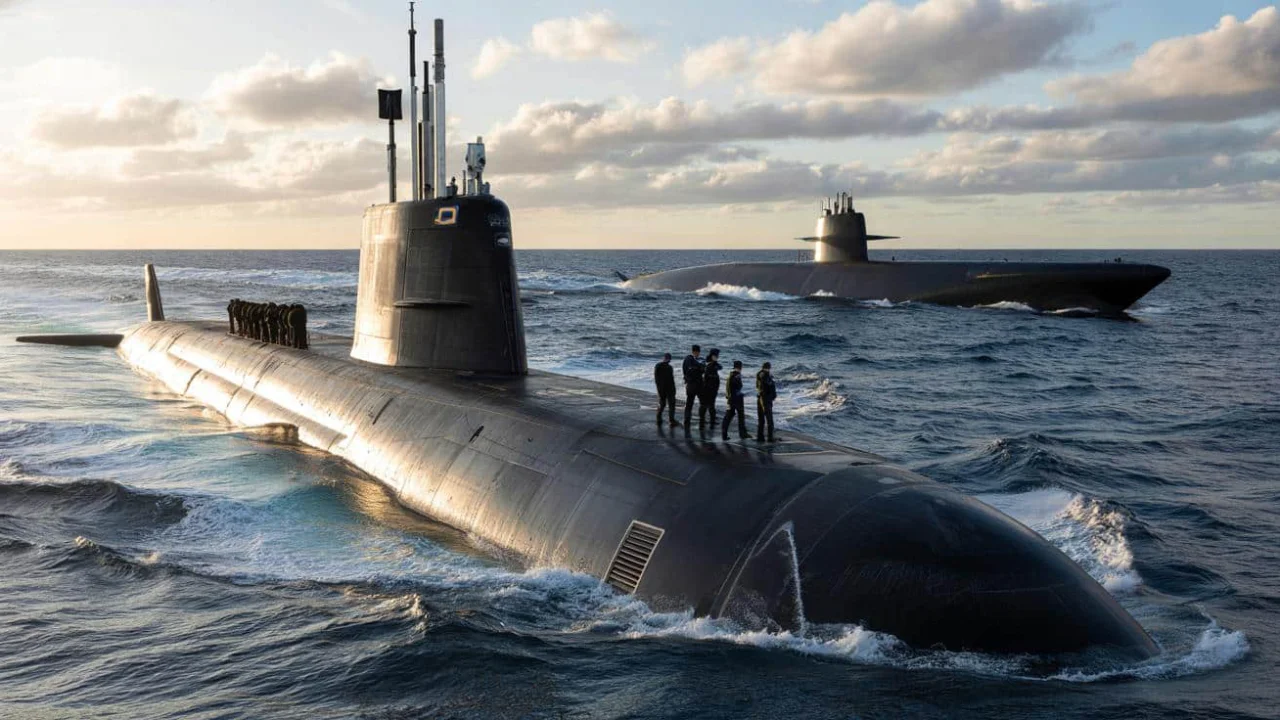
Admiral Jean-Baptiste Colbert would have smiled at the scene in Cherbourg last month. Workers cheered as a massive steel hull emerged from its construction hall, gleaming under the French sun. This wasn’t just another submarine launch – it was France flexing its naval muscles in a rivalry that’s burned for centuries.
The submarine they unveiled, De Grasse, represents something bigger than its 5,200-ton frame suggests. It’s France’s bold statement that it won’t play second fiddle to Britain’s Royal Navy anymore.
And surprisingly, the French might actually be winning this underwater chess match.
France’s New Underwater Giant Changes Everything
The french nuclear submarine De Grasse marks a turning point in European naval power. This fourth boat in France’s Barracuda class – known locally as the Suffren class – isn’t just replacing old hardware. It’s reshaping how we think about submarine warfare.
At 99 meters long and nearly 9 meters wide, De Grasse packs serious punch. Its nuclear reactor gives it virtually unlimited underwater endurance, while its 63-person crew operates some of the most advanced sonar and weapons systems on the planet.
“This submarine represents a generational leap for French naval capabilities,” notes defense analyst Marie Dubois. “It’s not just about the technology – it’s about France proving it can still build world-class submarines independently.”
The construction involved roughly 2,500 people, including 800 subcontractors. That’s thousands of French jobs tied to maintaining the country’s naval edge. De Grasse will join its sister ships Suffren, Duguay-Trouin, and Tourville in gradually replacing France’s aging Rubis-class attack submarines.
What makes this particular submarine remarkable isn’t just its size – it’s the technology packed into that hull. The Barracuda class features the most advanced sonar suite France has ever developed, with passive arrays capable of detecting enemy submarines at unprecedented distances. The submarine’s stealth characteristics have been refined through extensive computer modeling and tank testing, making it one of the quietest submarines ever built.
The nuclear reactor powering De Grasse represents decades of French nuclear expertise. Unlike many other naval nuclear programs that rely on foreign technology, France’s submarine reactors are entirely domestic designs. This K15 reactor provides enough power to drive the submarine at speeds exceeding 25 knots underwater while remaining virtually silent.
The Numbers Game: France vs Britain Under the Waves
Raw numbers tell one story, but availability tells another. Britain technically operates more nuclear submarines than France, but that advantage is shrinking fast.
Here’s how the two naval powers stack up in 2025:
| Submarine Type | France | United Kingdom |
| Ballistic Missile Submarines (SSBN) | 4 (Triomphant class) | 4 (Vanguard class) |
| Attack Submarines (SSN) | 6-7 (Rubis/Barracuda) | 7 (Astute class) |
| Total Nuclear Submarines | 10-11 | 11 |
The real story emerges when you look at operational availability. The Royal Navy has struggled with extended maintenance periods and crew shortages. Some British submarines spend months in dry dock when they should be patrolling.
France took a different approach. Their nuclear submarine fleet maintains an impressive operational rate of over 270 days per year – roughly 74% availability. That’s industry-leading performance that stems from systematic planning and investment in maintenance infrastructure.
“Britain has more hulls, but France has more submarines actually doing their job,” explains naval expert Captain David Richardson. “When your deterrent submarine is in maintenance for eight months, it doesn’t matter how advanced it is.”
The British submarine force faces several challenges that France has largely avoided. Recruitment and retention problems plague the Royal Navy’s submarine service, with critical technical specialties experiencing severe shortages. Meanwhile, aging dock facilities at Devonport and Faslane struggle to handle maintenance demands efficiently.
France’s submarine maintenance benefits from the integrated approach at Cherbourg, where Naval Group operates one of Europe’s most advanced submarine construction and maintenance facilities. The same shipyard that builds new submarines also handles major overhauls, creating efficiency synergies that keep French boats operational longer.
The availability advantage translates directly into operational capability. A french nuclear submarine spending 270 days per year at sea can complete roughly twice as many missions as a British submarine averaging 180 operational days annually.
What This Means for European Defense
The shifting balance affects more than national pride. These submarines patrol critical sea lanes, protect nuclear deterrents, and project power thousands of miles from home.
France’s improved submarine capabilities impact several key areas:
- Mediterranean Security: French submarines increasingly patrol North African coasts and Eastern Mediterranean waters, monitoring refugee routes and countering regional instability
- Indo-Pacific Presence: New Caledonia and French Polynesia provide strategic bases for Pacific operations, allowing France to challenge Chinese expansion
- Atlantic Patrols: French subs monitor Russian submarine activity in the Atlantic, particularly the critical GIUK gap between Greenland, Iceland, and the UK
- NATO Missions: Higher availability means France can contribute more to alliance operations without compromising national security requirements
- Nuclear Deterrent Protection: Attack submarines escort ballistic missile submarines, ensuring France’s nuclear deterrent remains credible
The strategic implications extend beyond military capability. France’s submarine program supports roughly 20,000 direct and indirect jobs across the defense industrial base. This economic impact strengthens political support for continued investment in submarine technology.
European allies increasingly look to France for underwater expertise. The recent AUKUS agreement between Australia, Britain, and the United States highlighted France’s frustration with being excluded from Indo-Pacific submarine cooperation. However, France’s independent capabilities position it as an alternative partner for countries seeking submarine technology without complete dependence on Anglo-American systems.
“France offers something unique in submarine partnerships – genuine technology transfer without political strings,” notes international defense consultant Roberto Silva. “That’s increasingly valuable in today’s multipolar world.”
The Technology Edge: Innovation Below the Surface
De Grasse incorporates technological advances that give France distinct advantages over its competitors. The submarine’s combat management system integrates artificial intelligence to process sonar data faster than human operators could manage alone. This AI assistance doesn’t replace human decision-making but enhances situational awareness dramatically.
The submarine’s weapons systems represent another area of French innovation. De Grasse can launch the new MdCN (Missile de Croisière Naval) cruise missile, giving it precision strike capability against land targets up to 1,000 kilometers away. This transforms French attack submarines from purely anti-submarine platforms into multi-mission strategic assets.
Stealth technology receives particular attention in the Barracuda design. Special anechoic coatings absorb enemy sonar signals while the submarine’s hull shape minimizes acoustic signatures. Even the propeller design incorporates advanced computational fluid dynamics to reduce cavitation noise.
The crew benefits from technological advances too. Modern life support systems provide better air quality and noise reduction, while improved automation reduces crew fatigue during long patrols. These seemingly minor improvements translate into better operational performance when submarines spend months submerged.
The Future of French Naval Power
De Grasse won’t be the last. France plans to build six Barracuda-class submarines total, with the final boats entering service in the early 2030s. Each costs roughly €1.5 billion, but that investment pays dividends in capability and jobs.
These new submarines feature several advantages over their predecessors:
- 50% larger than the Rubis class they’re replacing
- Advanced sonar systems for better detection
- Improved stealth capabilities
- Longer patrol endurance
- Modern crew facilities reducing fatigue
- Multi-mission flexibility for various operational scenarios
- Reduced maintenance requirements through improved design
Beyond the immediate Barracuda program, France is already planning the next generation. The SNLE 3G program will replace the current Triomphant-class ballistic missile submarines in the 2030s, while studies for a future attack submarine class are underway.
France’s submarine industrial base continues expanding to meet growing demand. Naval Group has invested heavily in new construction facilities and digital design tools. Advanced manufacturing techniques like additive manufacturing are being integrated into submarine construction, potentially reducing costs and construction time.
The export market offers additional opportunities. Several countries have expressed interest in French submarine technology, from Brazil’s ongoing submarine program to potential sales in Asia and the Middle East. These exports could fund continued French innovation while spreading development costs across multiple customers.
Britain isn’t standing still, of course. The Royal Navy is developing its next-generation submarine program, but budget constraints and technical challenges have caused delays. The planned SSN-AUKUS program with Australia and the United States promises advanced capabilities but won’t deliver submarines until the late 2030s at the earliest.
Meanwhile, France’s consistent investment in submarine technology is paying off. The country that gave the world the first military submarine in 1863 is proving it still knows how to rule beneath the waves.
“Napoleon said an army marches on its stomach,” jokes French naval historian Claude Mercier. “Today’s French Navy swims on its submarines – and they’re swimming very well indeed.”
The implications of France’s submarine success extend far beyond national rivalry. As global maritime tensions increase and underwater warfare becomes more sophisticated, France’s independent submarine capabilities position it as a major player in 21st-century naval power. The french nuclear submarine program represents not just military capability, but national technological sovereignty in an increasingly connected world.
FAQs
How big is the French nuclear submarine De Grasse?
De Grasse is 99 meters long, 8.8 meters wide, and displaces 5,200 tons when submerged, making it significantly larger than previous French submarines.
How many nuclear submarines does France have compared to Britain?
France operates 10-11 nuclear submarines while Britain has 11, but French submarines maintain higher operational availability rates of around 74% compared to Britain’s lower availability.
What makes French submarines different from British ones?
French submarines are built entirely with domestic technology, while British submarines rely on American nuclear reactor designs and weapons systems, giving France greater technological independence.
How long can the De Grasse stay underwater?
As a nuclear-powered submarine, De Grasse can remain submerged for months, limited only by food supplies and crew endurance rather than fuel, with typical patrol lengths of 70-90 days.
When will all six Barracuda-class submarines be operational?
The complete Barracuda class will enter service gradually through the early 2030s, with De Grasse expected to be fully operational by 2027 after extensive sea trials and crew training.
Why does submarine availability matter more than total numbers?
A submarine in maintenance can’t patrol, deter enemies, or respond to crises, making operational availability crucial for effective naval power projection and maintaining continuous deterrent capability.


