
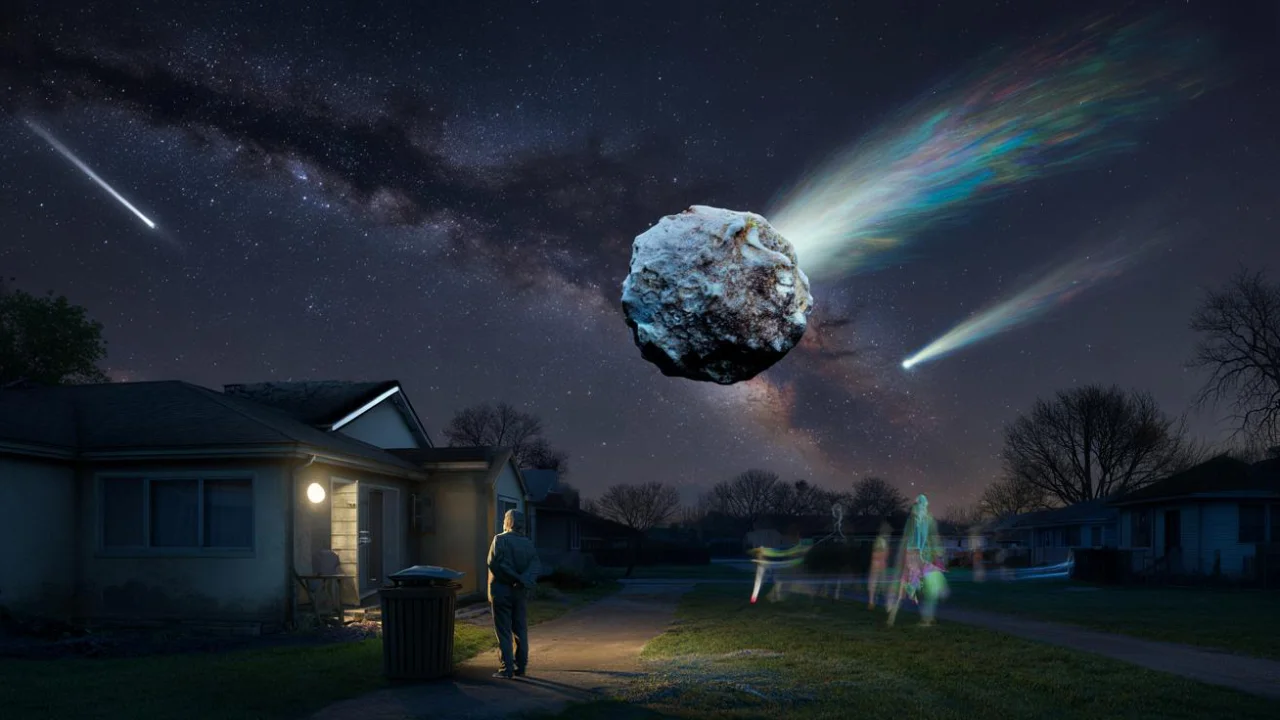
Sarah Martinez thought she knew her neighborhood pretty well. Every morning for twelve years, she’d walked her dog past the same houses, waved to the same neighbors, dodged the same potholes. Then one Tuesday, she spotted a moving truck parked outside the old Henderson place. New people were moving in, carrying boxes she’d never seen, speaking a language she couldn’t identify.
That’s exactly how astronomers felt when they discovered interstellar comet 3I/Atlas in late 2024. Our solar system—this quiet cosmic neighborhood we thought we understood—suddenly had another unexpected visitor. Not the first, not the second, but the third confirmed object from somewhere else entirely, just passing through.
The difference is, Sarah could walk over and introduce herself to her new neighbors. We can only watch these cosmic visitors from billions of miles away, wondering what else might be drifting through our celestial backyard without an invitation.
When space gets uncomfortably crowded
The ATLAS survey in Hawaii spotted something unusual moving across the sky in November 2024. At first glance, 3I/Atlas looked like any other comet—a dirty snowball with a glowing tail, the kind astronomers catalog every few months. But the numbers told a different story.
This interstellar comet was moving too fast. Its orbit bent the wrong way. Everything about its trajectory screamed “outsider” rather than “local resident.” Within weeks, astronomers confirmed what made everyone slightly uncomfortable: 3I/Atlas came from somewhere else entirely, just like ‘Oumuamua in 2017 and comet 2I/Borisov in 2019.
“We’re starting to realize our solar system isn’t the isolated bubble we once imagined,” explains Dr. Rebecca Chen, a planetary scientist at the University of Colorado. “These interstellar visitors are showing us that space is far busier than we ever suspected.”
The pattern is becoming impossible to ignore. Three confirmed interstellar objects in seven years suggests these cosmic wanderers aren’t rare flukes—they’re regular commuters on million-year journeys between star systems.
What we’re learning from our uninvited guests
Each interstellar comet teaches us something new about the universe beyond our solar system. Here’s what scientists have discovered from studying these cosmic visitors:
- Speed matters: All three objects move faster than anything born in our solar system could naturally achieve
- Origins remain mysterious: We can trace their paths backward, but pinpointing their home star systems proves nearly impossible
- Composition varies wildly: ‘Oumuamua appeared rocky, 2I/Borisov looked like a typical comet, and 3I/Atlas shows unique spectral signatures
- Detection improves constantly: Better telescopes and smarter algorithms help us spot these objects sooner and track them longer
- Numbers keep climbing: Astronomers now estimate dozens of interstellar objects pass through our solar system every year
The most unsettling revelation? We’re probably missing most of them. Current detection methods only catch the biggest, brightest, or closest interstellar visitors. Smaller objects—asteroid-sized chunks, comet fragments, or debris from planetary collisions billions of miles away—slip past completely unnoticed.
| Object | Discovery Year | Type | Notable Features |
|---|---|---|---|
| ‘Oumuamua | 2017 | Asteroid-like | Cigar-shaped, accelerated unexpectedly |
| 2I/Borisov | 2019 | Comet | Familiar comet behavior, water and carbon monoxide detected |
| 3I/Atlas | 2024 | Comet | Unusual spectral signatures, highly eccentric orbit |
Dr. Michael Rodriguez from the Jet Propulsion Laboratory puts it bluntly: “Every time we think we understand the baseline traffic through our solar system, another interstellar object shows up and forces us to revise our estimates upward.”
Why this matters more than you might think
These interstellar visitors aren’t just academic curiosities for astronomers to study. They’re changing how we think about planetary defense, the search for life, and humanity’s place in the galaxy.
Consider the uncomfortable math: if we’re detecting three interstellar objects in seven years with current technology, how many are we missing? Conservative estimates suggest dozens pass through annually. More aggressive calculations put the number in the hundreds.
Most pose zero threat to Earth—they’re too small, too distant, or on paths that never come close to our planet. But “most” isn’t “all,” and that distinction matters when you’re talking about objects moving at cosmic speeds with unpredictable trajectories.
“The real concern isn’t immediate danger,” notes Dr. Lisa Park, director of the Near-Earth Object Research Center. “It’s that we’re operating our planetary defense systems based on incomplete information about what’s actually out there.”
Then there’s the tantalizing possibility that these interstellar objects carry traces of life from other star systems. Every comet, every fragment, every chunk of cosmic debris represents a sample from somewhere else entirely. If panspermia—the idea that life spreads between planets and star systems—turns out to be real, these visitors might be the delivery mechanism.
The discovery of 3I/Atlas also forces uncomfortable questions about our detection capabilities. Current surveys can only spot interstellar objects when they’re relatively close and bright. By the time we notice them, they’re often already heading back out of the solar system.
Imagine trying to study international visitors to your city, but you can only see them for the last five minutes of their stay. That’s essentially what astronomers face with interstellar comets and asteroids.
What comes next in our cosmic neighborhood watch
The astronomy community is scrambling to build better detection systems. New telescopes, improved software, and international coordination efforts aim to spot interstellar visitors sooner and study them longer.
The Vera Rubin Observatory, scheduled to begin operations soon, should dramatically increase detection rates. Its wide-field camera and automated scanning protocols could identify interstellar objects months or even years before they reach their closest approach to the Sun.
But technology alone won’t answer the deeper questions these visitors raise. Where do they come from? What do they tell us about planetary formation in other star systems? Are we seeing the cosmic equivalent of leaves blowing in the wind, or something more structured and purposeful?
Dr. Elena Vasquez from the European Space Agency summarizes the challenge perfectly: “We’ve gone from thinking interstellar visitors were impossibly rare to realizing they might be embarrassingly common. Now we need to figure out what that means for everything we thought we knew about our place in the galaxy.”
As detection technology improves and more interstellar objects reveal themselves, one thing becomes clear: our solar system isn’t the quiet suburb we once imagined. It’s more like a busy intersection where cosmic traffic from across the galaxy briefly crosses paths with our small corner of space.
The next time you look up at the night sky, remember that somewhere out there, another interstellar visitor might already be on its way—carrying stories and samples from star systems we can barely imagine, reminding us that the universe is far stranger and more connected than we ever dared to believe.
FAQs
What makes an object “interstellar” versus local to our solar system?
Interstellar objects have hyperbolic orbits and speeds that exceed our solar system’s escape velocity, meaning they’re not gravitationally bound to the Sun and must have originated elsewhere.
How dangerous are interstellar comets like 3I/Atlas to Earth?
The vast majority pose no threat since they follow paths that don’t intersect Earth’s orbit, but astronomers monitor all detected objects to assess any potential impact risks.
Could these interstellar visitors carry alien life?
It’s theoretically possible through panspermia, where microorganisms survive the journey between star systems, but no evidence of life has been detected on any interstellar object so far.
How many interstellar objects pass through our solar system?
Conservative estimates suggest dozens annually, while some models propose hundreds, though most remain undetected due to their small size or dim appearance.
Why are we only discovering these objects recently?
Improved telescope technology, automated sky surveys, and better computer algorithms now allow astronomers to detect and track objects that would have been missed just a decade ago.
Can we send spacecraft to study interstellar visitors?
The extreme speeds and brief visit durations make spacecraft intercepts extremely challenging with current technology, though future missions are being planned for when detection capabilities improve.


