
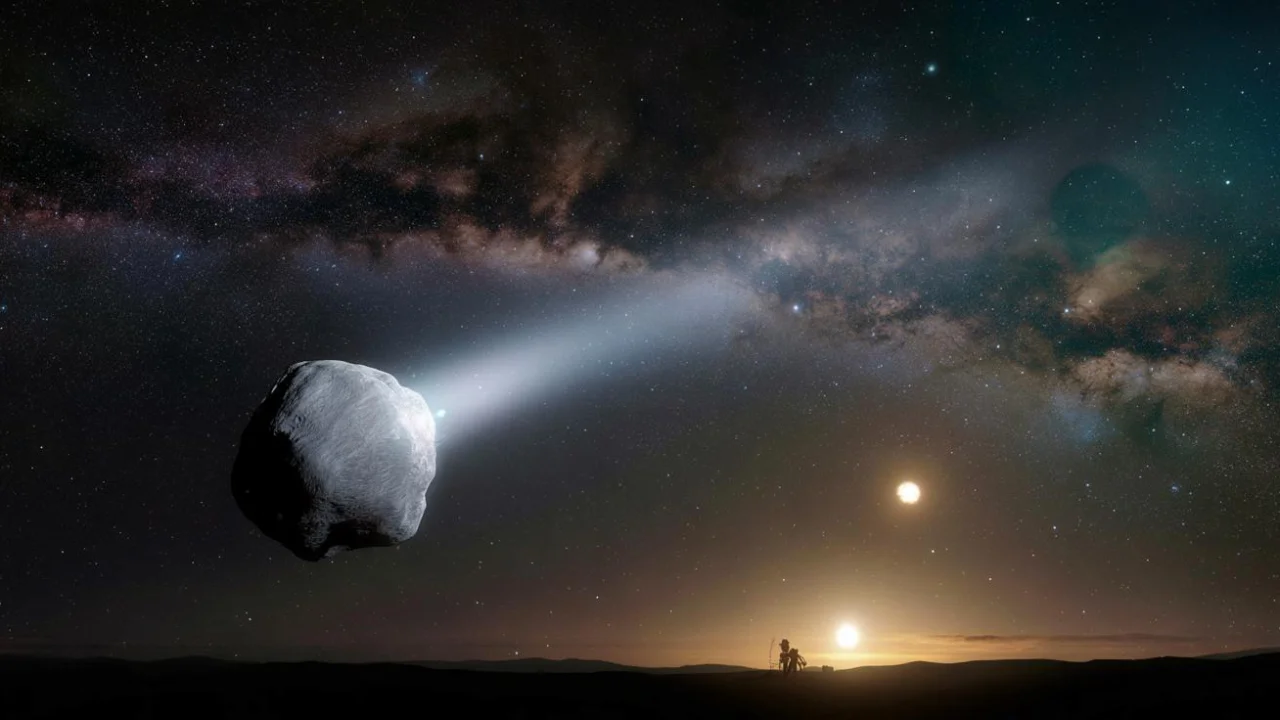
Sarah Martinez had been tracking comets for fifteen years from her backyard observatory in Arizona when she noticed something that made her stomach drop. The object she’d been casually observing for weeks wasn’t following the rules. Its path didn’t curve back toward the Sun like every other comet she’d ever seen.
Instead, it was heading straight out into the void, carrying secrets from another star system. She was looking at what would become known as Comet 3I Atlas, and with it came a realization that changed how we think about our solar neighborhood forever.
What Sarah discovered that night represents more than just another interstellar object. It’s a wake-up call that forces us to confront an uncomfortable truth: we have no idea what’s really passing through our solar system.
The Visitor That Looked Too Normal
Comet 3I Atlas doesn’t look like something from science fiction. Through a standard telescope, you’d see exactly what you’d expect from any comet—a fuzzy gray blob with a faint tail, nothing more remarkable than thousands of other icy visitors we’ve cataloged over the decades.
But appearances can be deceiving. The difference lies in the numbers, specifically in its orbital trajectory. Unlike comets born in our solar system, 3I Atlas follows a hyperbolic path. This means it’s not gravitationally bound to our Sun at all.
“When we first ran the calculations, I had to double-check everything,” explains Dr. Robert Weryk, the astronomer who initially identified the object. “Here was something that looked completely ordinary, but was actually a visitor from deep space.”
The ATLAS survey system, designed to catch potentially dangerous asteroids, flagged 3I Atlas as unusual when its orbital eccentricity exceeded the threshold that separates local objects from interstellar travelers. What seemed like routine data processing became a moment of profound scientific significance.
This marks only the third confirmed interstellar object ever discovered, following ‘Oumuamua in 2017 and Comet Borisov in 2019. But unlike ‘Oumuamua’s bizarre cigar shape, 3I Atlas looks disturbingly normal.
Key Details About Our Cosmic Visitors
The discovery of 3I Atlas reveals crucial information about interstellar objects and raises serious questions about detection capabilities. Here’s what we know about these mysterious visitors:
- Interstellar objects travel at speeds between 26-87 kilometers per second relative to the Sun
- They originate from other star systems, potentially billions of years old
- Most pass through the inner solar system undetected due to their faint appearance
- Current detection methods miss an estimated 90% of interstellar visitors
- These objects could carry organic compounds or even primitive life forms
| Object Name | Discovery Year | Type | Notable Features |
|---|---|---|---|
| ‘Oumuamua | 2017 | Asteroid-like | Cigar-shaped, accelerated unexpectedly |
| Borisov | 2019 | Comet | Clear coma and tail, carbon monoxide detected |
| 3I Atlas | 2024 | Comet | Looks completely normal, nearly missed |
The most troubling aspect of 3I Atlas isn’t what it tells us about interstellar space—it’s what it reveals about our own ignorance. If this object looks so ordinary that we almost missed it entirely, how many others have slipped past unnoticed?
“The scary part is that 3I Atlas nearly fell through the cracks,” notes Dr. Michele Bannister, a planetary astronomer at the University of Canterbury. “If our automated systems hadn’t flagged its unusual orbit, we might never have known it was from another star.”
The Hidden Traffic in Our Solar System
The implications extend far beyond academic curiosity. Every interstellar object represents a potential treasure trove of scientific data about distant star systems, but we’re missing most of them due to technological limitations and observational gaps.
Current estimates suggest that several interstellar objects pass through our solar system every year, but our detection rate hovers around 10%. This means we’re essentially flying blind through a cosmic highway we didn’t even know existed.
The situation becomes more concerning when you consider the potential risks. While the odds remain extremely low, some interstellar objects could theoretically pose collision threats to Earth. More importantly, they might carry organic materials or even microscopic life forms from their home systems.
For space agencies and astronomers, this revelation demands immediate action. NASA and other organizations are already discussing enhanced survey programs designed specifically to catch interstellar visitors before they disappear back into deep space.
“We need to accept that our solar system isn’t the isolated island we once thought,” explains Dr. Alan Fitzsimmons from Queen’s University Belfast. “We’re part of a galactic ecosystem, and we need to start acting like it.”
What This Means for Future Space Exploration
The discovery of 3I Atlas forces us to reconsider fundamental assumptions about solar system security and scientific opportunity. Each missed interstellar object represents lost chances to study material from distant worlds without launching expensive interstellar missions.
Space agencies are now racing to develop rapid-response capabilities for future interstellar visitors. The goal is to launch small probes that could intercept and study these objects during their brief passage through our neighborhood.
Private space companies are also taking notice. The potential scientific and commercial value of interstellar materials could justify significant investment in detection and intercept technologies.
But perhaps the most important impact is psychological. 3I Atlas reminds us that space isn’t empty—it’s full of travelers from distant worlds, most of which pass by completely unnoticed.
As our detection capabilities improve, we’ll likely discover that interstellar objects are far more common than previously thought. This could revolutionize our understanding of how star systems interact and exchange material across galactic distances.
FAQs
How do we know 3I Atlas came from another star system?
Its hyperbolic orbit means it’s not gravitationally bound to our Sun and must have originated elsewhere in the galaxy.
Could interstellar objects pose a threat to Earth?
While extremely unlikely, some could theoretically impact Earth, which is why improved detection systems are crucial for planetary defense.
How many interstellar objects pass through our solar system?
Scientists estimate several per year, but we currently detect only about 10% of them due to technological limitations.
What makes 3I Atlas different from previous interstellar discoveries?
Unlike ‘Oumuamua’s unusual shape or Borisov’s distinctive features, 3I Atlas looks completely ordinary, raising concerns about how many similar objects we’ve missed.
Could these objects carry life from other worlds?
It’s theoretically possible that interstellar objects could harbor microscopic life or organic compounds from their origin systems.
What are scientists doing to find more interstellar objects?
Space agencies are developing enhanced survey programs and rapid-response systems to detect and study future interstellar visitors before they leave our solar system.


