
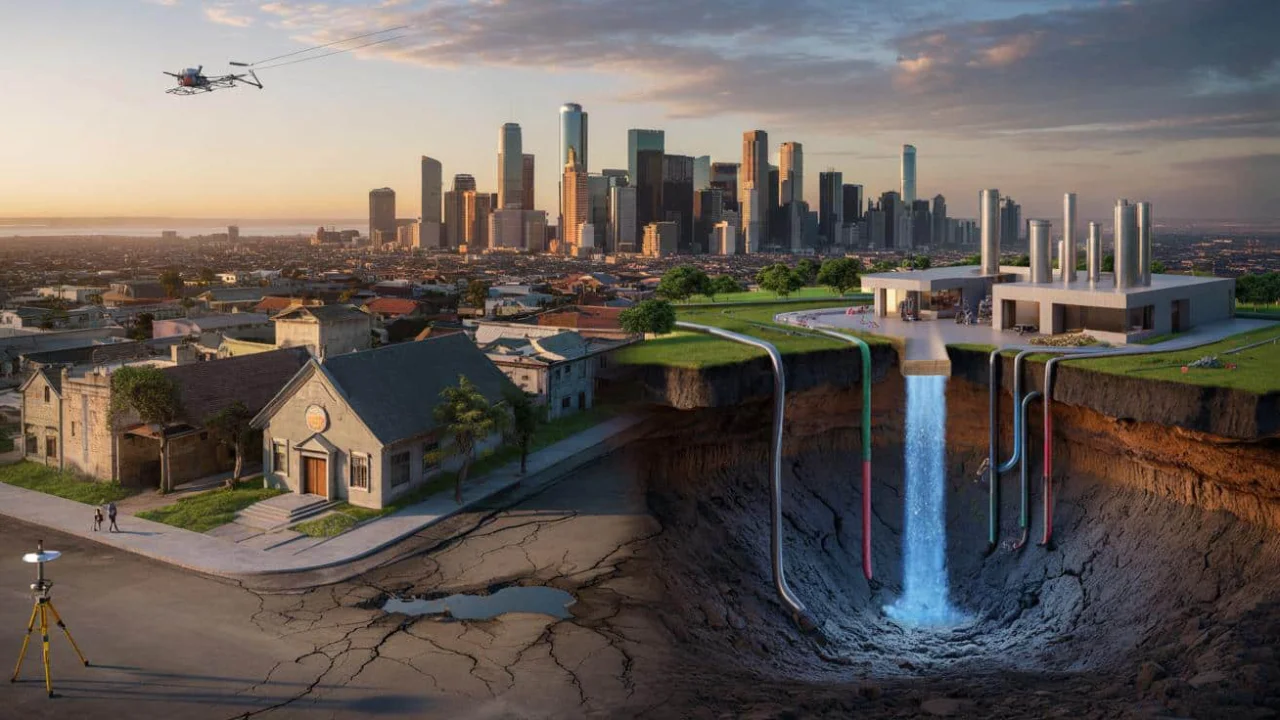
Maria walks to the same corner store every morning in Mexico City, but the sidewalk feels different each year. The concrete slabs that once lay flat now tilt at odd angles, creating tiny steps where there used to be smooth pavement. Her grandmother’s house, built in the 1950s, now sits noticeably lower than the street. The front gate that once opened easily now scrapes against the ground with every push.
What Maria doesn’t realize is that her neighborhood is slowly disappearing beneath her feet. Mexico City sinks about 20 centimeters every year – roughly the height of a smartphone. But across town, engineers are fighting back with an unexpected weapon: they’re pumping millions of gallons of water into abandoned oil fields, trying to push the ground back up.
This isn’t just Mexico City’s problem. From Houston’s crooked church steps to Jakarta’s tilting skyscrapers, land subsidence threatens some of the world’s largest cities. The solution? Fill the empty spaces we created when we drained the Earth of its resources.
Why Our Cities Are Slowly Sinking Into the Ground
Land subsidence happens when we remove too much from underground. Think of the Earth like a sponge – when you squeeze out the water, it gets smaller and denser. For over a century, we’ve been squeezing oil, gas, and groundwater from beneath major cities without putting much back.
“The ground beneath our feet isn’t as solid as we think,” explains Dr. Sarah Chen, a geological engineer who has studied subsidence in Asia. “When you remove fluids from underground reservoirs, the rock layers compress under the weight of everything above them.”
The process is invisible but relentless. Building foundations shift, roads crack, and entire neighborhoods slowly sink. In Jakarta, some areas drop 25 centimeters per year – so fast that the city is literally racing to build sea walls before parts of it slip below sea level.
Unlike earthquakes or floods, land subsidence doesn’t make headlines. It’s too slow, too quiet. But its effects add up over decades, creating problems that cost billions to fix and sometimes can’t be fixed at all.
The Cities Fighting Back With Underground Water Injection
Engineers have discovered that pumping water into depleted oil and gas fields can slow or even reverse land subsidence. The concept is straightforward: refill the underground spaces to restore some of the support structure beneath the city.
Here’s how the process works and where it’s being tested:
| City/Region | Subsidence Rate | Injection Method | Results |
|---|---|---|---|
| Long Beach, California | Was 71cm/year | Seawater injection since 1958 | Reduced to near zero |
| Wilmington Oil Field | Was 76cm/year | Water flooding operations | Stabilized ground levels |
| Po Valley, Italy | 2-5cm/year | Managed aquifer recharge | 50% reduction in some areas |
| Tokyo Bay | Was 20cm/year | Groundwater restrictions + injection | Nearly eliminated subsidence |
The key factors that make water injection successful include:
- Targeting specific geological layers that once contained oil or gas
- Using treated water or seawater to avoid contaminating groundwater
- Monitoring ground movement with satellite technology and ground sensors
- Coordinating injection rates with local geology and urban development
- Maintaining long-term operations – stopping injection often leads to renewed sinking
“We’re essentially giving the underground formations an IV drip,” says petroleum engineer Dr. James Rodriguez, who has worked on injection projects in California. “The goal isn’t to pump the city back up to where it was, but to stop it from sinking further.”
Real-World Impact on Millions of Urban Residents
The effects of land subsidence touch every aspect of city life, often in ways residents don’t immediately connect to underground fluid extraction. Roads develop persistent potholes that reappear no matter how often they’re repaired. Buildings develop stress cracks that run deeper than surface wear. Drainage systems that worked perfectly for decades suddenly can’t handle normal rainfall.
In Houston, entire neighborhoods have seen property values drop as subsidence damages become visible. Homeowners face insurance claims for foundation problems that traditional policies don’t cover. Some areas flood more frequently because the land has sunk below the level of nearby waterways.
“My house used to be the same height as my neighbor’s,” explains longtime Houston resident Tom Martinez. “Now there’s a two-foot difference. Our front yards look like stairs going down the block.”
The economic costs are staggering. Mexico City spends over $100 million annually repairing infrastructure damaged by subsidence. Jakarta is considering relocating its capital partly because of sinking problems. Venice installed a massive flood barrier system that costs billions to operate, largely because the city has sunk relative to sea level.
But water injection projects offer hope for cities willing to invest in long-term solutions:
- Reduced infrastructure repair costs over time
- Preserved property values in affected neighborhoods
- Improved flood management as ground levels stabilize
- Extended lifespan of existing buildings and utilities
- Prevention of permanent, irreversible ground loss
The challenge is that injection projects require decades of consistent operation. “You can’t just try this for five years and expect lasting results,” notes Dr. Chen. “The ground took decades to sink, and it takes decades of support to stabilize it.”
The Technical Challenge of Pushing Back Against Gravity
Water injection isn’t as simple as finding an old oil well and turning on a hose. Engineers must carefully map underground geology, identify the right rock layers, and calculate precise injection rates. Too little water, and the subsidence continues. Too much, and you risk creating other geological problems.
The process requires constant monitoring with satellite technology that can detect ground movement down to millimeters. Injection wells must be maintained, water sources secured, and environmental impacts assessed. In coastal cities like Long Beach, engineers pump seawater into offshore oil fields, creating a barrier that also helps prevent saltwater intrusion into freshwater aquifers.
“Every city’s geology is different,” explains Dr. Rodriguez. “What works in California might not work in Indonesia. You need detailed studies and custom engineering for each location.”
Despite the complexity, successful projects prove the concept works. Long Beach went from sinking 71 centimeters per year to essentially stable ground. Parts of Tokyo that were dropping 20 centimeters annually now show minimal subsidence. These victories required sustained political will and funding, but they demonstrate that land subsidence can be controlled.
FAQs
How long does water injection take to stop land subsidence?
Results typically become visible within 2-5 years, but full stabilization can take 10-20 years of consistent injection operations.
Is pumped water safe for drinking water supplies?
Injection projects use treated water or seawater pumped into deep, isolated rock layers that don’t connect to drinking water aquifers.
Can water injection actually lift sinking ground back up?
In some cases, yes – but the primary goal is usually to stop further sinking rather than reverse all previous subsidence.
How much does a city-wide water injection project cost?
Initial setup costs range from $50-200 million, with annual operating costs of $5-15 million, depending on the size and complexity of the project.
What happens if a city stops water injection after starting?
Subsidence typically resumes, sometimes at accelerated rates, making consistent long-term operation essential for success.
Which cities are most at risk for land subsidence?
Coastal megacities built on soft sediments with histories of oil, gas, or groundwater extraction face the highest risk, including Jakarta, Bangkok, Shanghai, and parts of California.


