
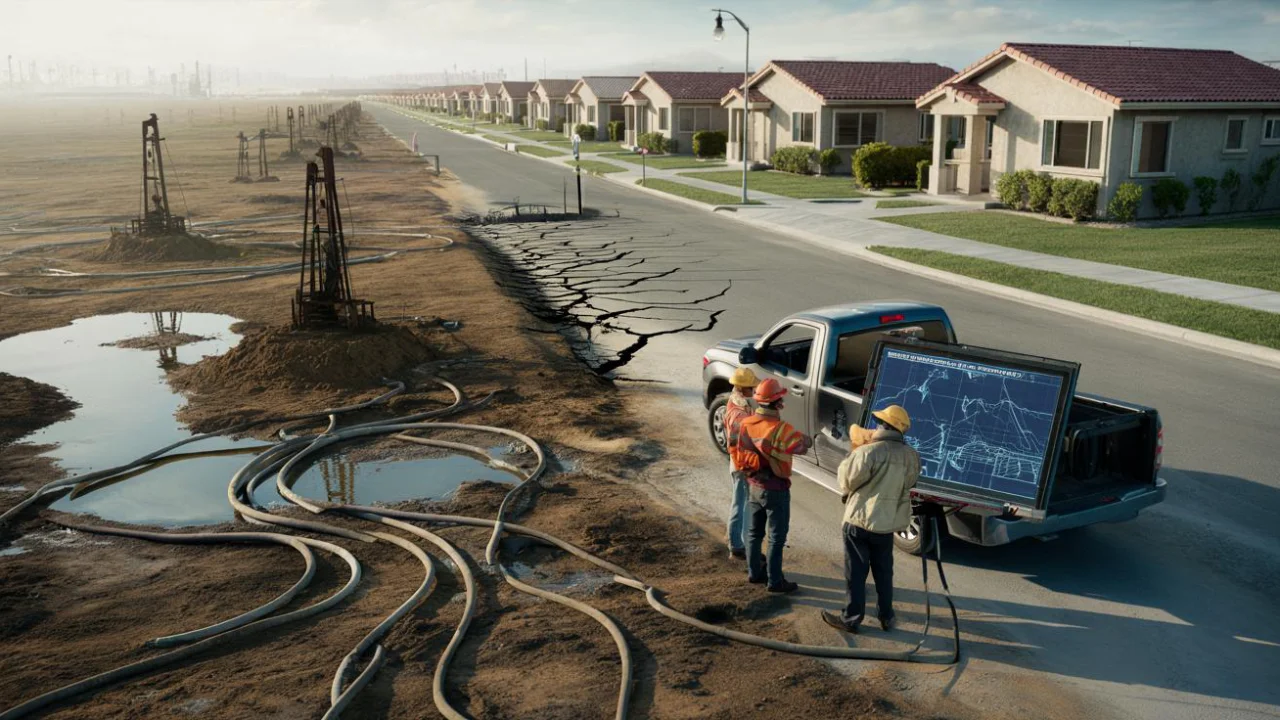
Maria Gonzalez noticed it first when her kitchen cabinet doors started hanging crooked. Then came the hairline crack zigzagging up her living room wall. At night, she could hear the house settling with tiny pops and creaks that weren’t there when she bought the place five years ago.
Her neighbor across the street had the same problem. So did the family two blocks over. All of them lived in Bakersfield, California, where oil companies have been pumping crude from beneath their feet for over a century. Now those same companies are pumping water back into the exhausted wells, claiming it will fix the slowly sinking ground.
Maria isn’t convinced. “They broke it,” she says, pointing to the fresh crack above her doorframe. “Now they want us to believe they can fix it with the same methods that caused the problem.”
The underground battle between oil extraction and gravity
Land subsidence happens when we remove massive amounts of fluid from underground rock formations. Think of it like deflating a balloon buried in sand. The balloon collapses, and everything above it settles downward.
For decades, oil and gas companies extracted billions of barrels of crude from beneath California’s Central Valley, Texas, and other energy-rich regions. When you pull that much liquid from underground, the rock layers compress and the surface drops. The result is gradual but relentless sinking that can damage roads, buildings, and entire neighborhoods.
“We’ve essentially been mining the support structure under our cities,” explains Dr. Sarah Chen, a geological engineer who studies subsidence patterns. “Every barrel of oil we extract leaves a tiny void that eventually gets filled by the weight of everything above it.”
Now engineers are trying a different approach: flooding exhausted oil fields with treated water to restore underground pressure. The theory sounds logical, but the reality is more complicated.
The numbers behind the sinking and the attempted fixes
Land subsidence affects millions of people worldwide, with some regions experiencing dramatic drops that make headlines and others dealing with subtle changes that go unnoticed for years.
| Location | Annual Subsidence Rate | Primary Cause | Population Affected |
|---|---|---|---|
| Jakarta, Indonesia | 6-15 inches per year | Groundwater extraction | 10 million |
| Mexico City, Mexico | 8-12 inches per year | Aquifer depletion | 21 million |
| Central Valley, California | 1-6 inches per year | Groundwater pumping | 4 million |
| Houston, Texas | 0.5-2 inches per year | Oil/gas extraction | 7 million |
| Venice, Italy | 1-2 mm per year | Industrial water use | 260,000 |
The water injection projects show mixed results:
- Some areas experience 2-4 centimeters of ground uplift within the first year
- Subsidence rates decrease by 30-60% in treated zones
- Adjacent untreated areas continue sinking at previous rates
- Long-term effects remain unknown due to short monitoring periods
- Costs range from $50,000 to $200,000 per injection well
“The early results look promising on paper,” says Tom Rodriguez, a petroleum engineer working on water injection projects. “We’re seeing measurable ground uplift and slower subsidence rates. But we’re essentially conducting a massive experiment with cities sitting on top.”
Why some experts worry we’re creating bigger problems
The water flooding approach has critics who argue we might be trading one disaster for several others. Injecting millions of gallons of water into depleted rock formations doesn’t restore them to their original state.
Dr. Linda Park, a seismologist at UC Berkeley, points to several concerns that keep her awake at night. “Rock that has been compressed doesn’t expand uniformly when you add water back,” she explains. “You get differential movement, where some areas rise while others stay put or even sink further.”
This creates new problems:
- Uneven ground movement can damage infrastructure more than gradual, uniform sinking
- Water injection may trigger small earthquakes as rock layers adjust
- Contaminated water could migrate into drinking water supplies
- The process only works as long as companies keep pumping water, creating long-term dependency
The earthquake risk particularly worries seismologists. Oklahoma experienced a 4,000% increase in earthquakes after oil companies began large-scale wastewater injection. While California’s geology is different, some experts fear similar results.
“We’re essentially playing geological roulette,” warns Dr. Park. “The short-term benefits might prevent some subsidence, but we could be setting up larger, more unpredictable ground movements in the future.”
What this means for millions of urban residents
For people like Maria Gonzalez, the technical debate feels abstract. She needs to know whether her house will keep sinking, whether her property value will plummet, and whether her family is safe.
The honest answer is that nobody knows for certain. Water injection projects are too new to provide long-term data, and every geological formation responds differently.
Urban planners face difficult decisions with limited information. Do they approve new construction in areas with active water injection? How do they value property in zones where the ground might rise, fall, or move unpredictably?
“We’re asking cities to bet their futures on experimental technology,” says urban planning consultant Michael Torres. “Some areas might benefit, but others could experience new types of ground instability we haven’t seen before.”
Insurance companies are already responding by excluding subsidence damage from standard homeowner policies. Residents in affected areas often discover too late that their cracked foundations and damaged walls aren’t covered.
The human cost extends beyond property damage. Elderly residents struggle with doors that no longer close properly. Families worry about their children’s safety in schools built on unstable ground. Business owners watch their buildings develop structural problems that could force closure.
Meanwhile, oil companies tout their water injection programs as environmental success stories, claiming they’re both managing wastewater and protecting communities from subsidence. Critics argue this narrative shifts responsibility away from the companies that created the problem in the first place.
As monitoring continues and more data becomes available, the true effectiveness and risks of flooding exhausted oil fields will become clearer. For now, millions of people living above these underground experiments can only wait and watch for new cracks in their walls.
FAQs
What causes land subsidence in oil and gas regions?
When companies extract oil, gas, or groundwater, they remove the fluid pressure that helps support underground rock layers, causing them to compress and the surface to sink.
How does water injection supposedly fix subsidence?
Engineers pump treated water into exhausted oil fields to restore underground pressure, which can slow or partially reverse ground sinking in some areas.
Is water flooding a permanent solution to subsidence?
No, the process only works as long as companies continue pumping water, and rock that has already compressed rarely returns to its original state.
What are the risks of injecting water into old oil fields?
Potential risks include triggering earthquakes, contaminating groundwater, creating uneven ground movement, and long-term dependency on continued water injection.
How can residents protect themselves from subsidence damage?
Homeowners should monitor their properties for cracks, consider specialized subsidence insurance, and stay informed about injection projects in their area.
Which cities are most affected by land subsidence?
Major affected areas include parts of California’s Central Valley, Houston, Mexico City, Jakarta, and Venice, with millions of residents dealing with sinking ground.


