
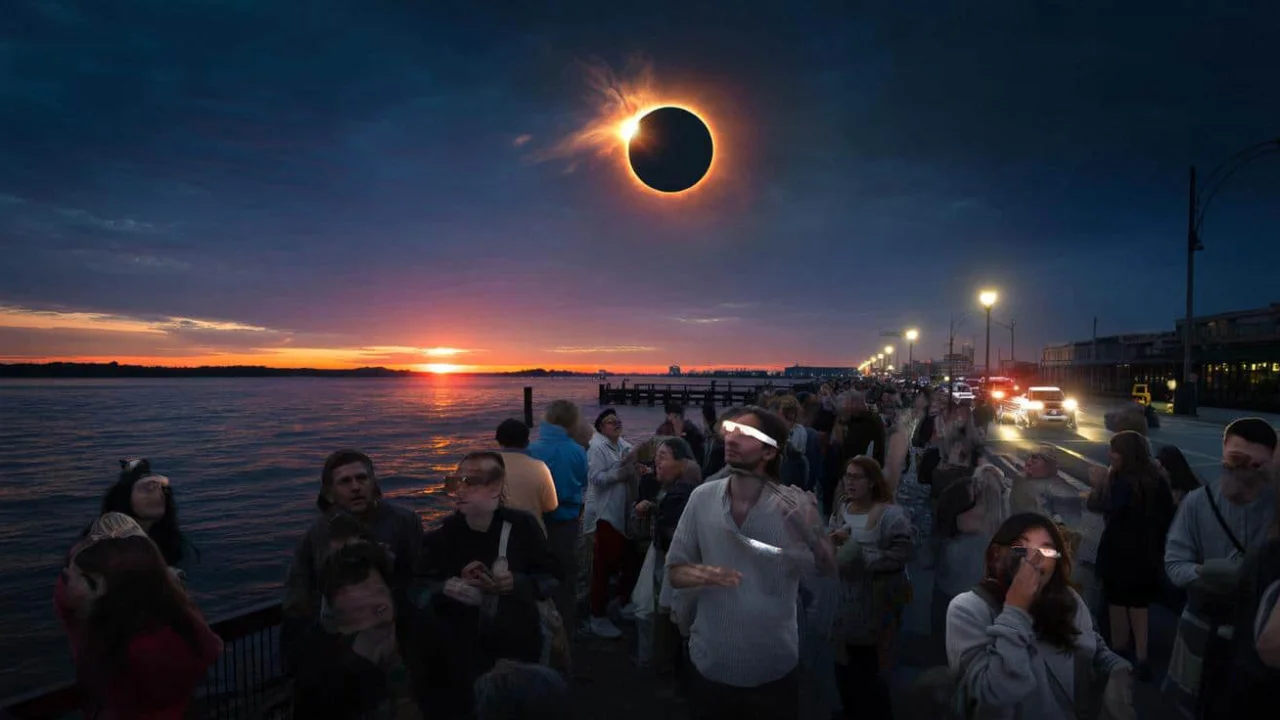
Maria was setting up her lunch cart on the plaza when the first customers started pointing at the sky. “Eclipse today,” one regular said, ordering his usual sandwich. She laughed and kept slicing tomatoes—until the light around her began to change color.
What started as normal Tuesday afternoon sunlight slowly shifted to something golden, then amber, then eerily dim. The pigeons that usually fought over crumbs went silent. Maria looked up to see a thin crescent of sun, getting smaller by the minute.
In six minutes, her bustling lunch spot would transform into something that felt like the edge of the world.
When the longest eclipse of the century steals the show
This isn’t just another eclipse. What’s heading our way is the longest total solar eclipse of the century—a rare astronomical event that will plunge parts of the world into darkness for up to six minutes and four seconds.
Most total solar eclipses last between two to three minutes. Some flash by in under a minute. But this one? It’s different. The Moon will slide perfectly between Earth and the Sun, casting a shadow so precise and so lingering that entire regions will experience what scientists are calling the eclipse of a lifetime.
“We’re talking about the kind of event that happens maybe once every few hundred years,” says Dr. Elena Rodriguez, a solar physicist at the National Observatory. “The alignment has to be absolutely perfect, and this time, everything is lining up beautifully.”
The path of totality will stretch across multiple continents, creating a narrow band where day will literally turn to night. But here’s what makes this eclipse extraordinary: the duration. Six minutes might not sound long, but when you’re standing under a black sun in the middle of the afternoon, it feels eternal.
What makes this eclipse break all the records
The science behind this record-breaking event comes down to precise timing and perfect positioning. Several factors need to align for an eclipse to last this long:
- The Moon must be at just the right distance from Earth
- Earth must be at its farthest point from the Sun
- The eclipse path must cross the equator at the optimal angle
- The observer must be positioned at the exact center of the shadow path
This eclipse delivers on all counts. The Moon will appear slightly larger than usual, completely covering the Sun’s bright disk. Meanwhile, the Sun will appear slightly smaller because Earth sits farther away in its orbit.
| Eclipse Characteristic | This Century’s Longest | Average Eclipse |
|---|---|---|
| Maximum Duration | 6 minutes 4 seconds | 2-3 minutes |
| Path Width | 258 kilometers | 160-200 kilometers |
| Temperature Drop | 10-15°F | 5-10°F |
| Darkness Level | Near complete | Twilight-like |
“The geometry is just perfect,” explains Dr. James Chen, an eclipse researcher. “It’s like the universe decided to give us the ultimate show.”
Where the magic happens and who gets front row seats
The path of totality will sweep across several countries, but not everyone gets the full experience. The longest duration—those precious six minutes—will occur over the Pacific Ocean and parts of Central America.
Major cities in the path include portions of Mexico, Guatemala, and Belize. Millions of people will witness totality, while many more in surrounding areas will see a partial eclipse.
But even if you’re not directly in the path, you’ll notice something. Partial eclipse viewers will see the Sun gradually eaten away by the Moon’s shadow, creating an otherworldly crescent shape in the sky.
Hotels along the path of totality are already booking up fast. “We’ve had people calling from around the world,” says Miguel Santos, who manages a resort in the Yucatan Peninsula. “They want to be here for those six minutes.”
What actually happens when day becomes night
The experience of totality goes far beyond just darkness. It’s a complete sensory transformation that affects everything around you.
As the Moon covers more of the Sun, shadows become razor-sharp. The light takes on an eerie, silvery quality that photographers love but find impossible to fully capture. Temperature drops noticeably—sometimes by 15 degrees Fahrenheit in just minutes.
Animals react in fascinating ways. Birds often return to their roosts, thinking evening has arrived. Nocturnal creatures may emerge. Pets can become confused or anxious.
But the most dramatic moment comes when the last sliver of sunlight disappears. Suddenly, you can see the Sun’s corona—those wispy, ethereal flames that dance around the edge of our star. It’s the only time you can look directly at the Sun safely without special glasses.
“People often describe a profound emotional response,” notes Dr. Sarah Williams, who has witnessed twelve total eclipses. “There’s something primordial about watching the Sun disappear in the middle of the day.”
The ripple effects nobody talks about
This longest eclipse of the century will impact more than just the people lucky enough to see it. The event creates a massive economic boost for regions in the path of totality.
Local businesses prepare for months. Restaurants stock extra food. Gas stations order more fuel. Hotels raise their rates and still sell out. Some towns see their population triple or quadruple for eclipse day.
But there are challenges too. Traffic jams are legendary after totality ends, as hundreds of thousands of people try to leave at the same time. Cell phone networks often crash from overuse. Emergency services prepare for unusual accidents as people crane their necks skyward while driving.
Air travel also gets interesting. Some airlines adjust flight schedules to give passengers eclipse views from 35,000 feet. Others face delays as air traffic controllers manage increased volume in eclipse zones.
Getting ready for your six minutes of cosmic history
If you’re planning to witness this record-breaking eclipse, preparation matters. First and most important: never look directly at the Sun without proper eclipse glasses, except during the brief moment of totality.
The best viewing locations offer clear skies and minimal light pollution. Weather apps become crucial in the days leading up to the eclipse, as clouds can ruin the entire experience.
Bring supplies for an outdoor wait. Eclipses don’t run on human schedules—you might be standing in a field for hours before those magical six minutes arrive.
And don’t forget to look around, not just up. Watch how shadows behave. Notice the strange quality of light. Feel the temperature change. The eclipse isn’t just happening in the sky—it’s happening all around you.
FAQs
How often do eclipses this long happen?
Eclipses lasting over six minutes are extremely rare, occurring perhaps once every few centuries in any given location.
Is it safe to look at the eclipse?
Only during the moment of totality when the Sun is completely covered. Otherwise, you must use certified eclipse glasses.
Will the eclipse affect my electronics?
No, solar eclipses don’t damage electronics, though cell networks may be overloaded from heavy usage.
Can I photograph the eclipse with my phone?
You can try, but phones aren’t designed for this. The corona is very dim, and your phone may not capture what your eyes see.
What should I do if it’s cloudy?
Even through light clouds, you’ll notice the dramatic change in light and temperature during totality.
Will animals really act strange?
Yes, many animals respond to the sudden darkness as if nighttime has arrived, which can lead to unusual behavior.


