
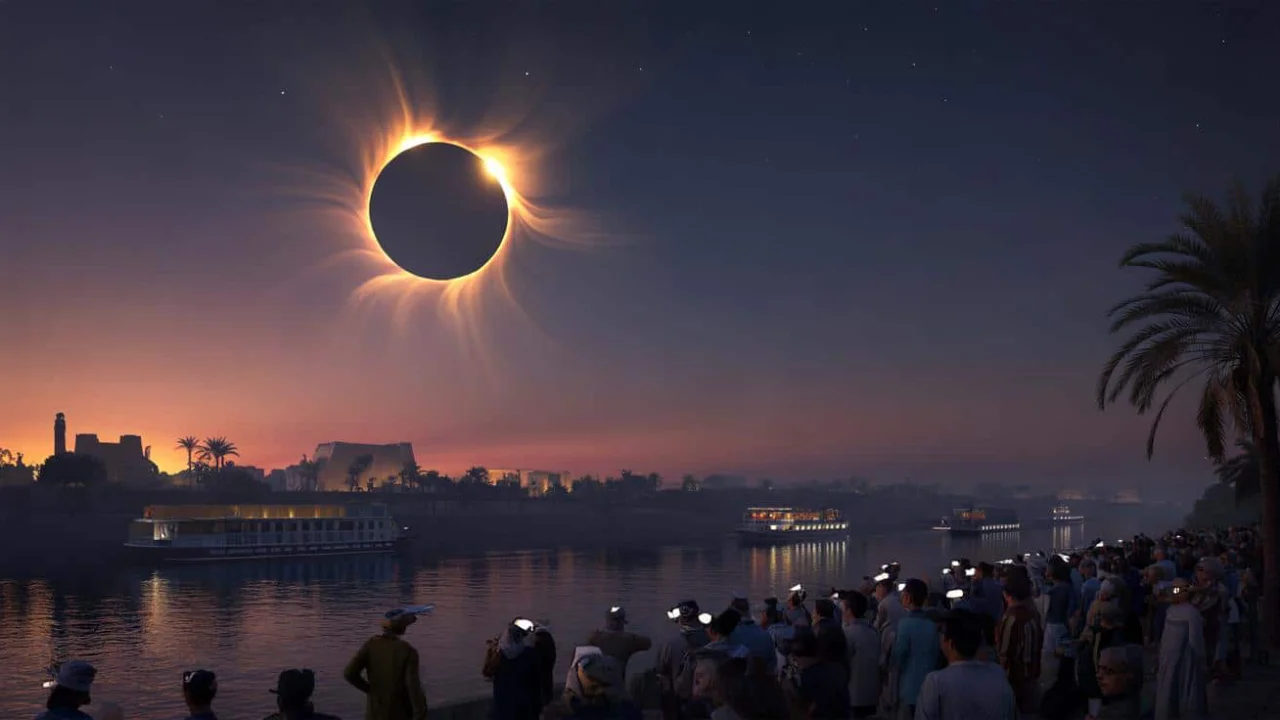
Maria stared at her phone screen, reading the family group chat for the third time. Her aunt in Cairo had just shared a grainy astronomy article with the caption: “You need to come visit in 2027 – the sky will go completely dark for over 6 minutes!”
At first, Maria rolled her eyes. Another forwarded message from Aunt Fatima, probably about some conspiracy theory. But something made her click the link. The headline stopped her cold: the longest solar eclipse of the century was coming, and it had an official date.
She realized she’d been holding her breath. Where would she be when day turned to night for six and a half minutes? And why did that question suddenly feel so important?
August 2, 2027: When the Sky Goes Dark
The longest solar eclipse century event is no longer a distant possibility. Astronomers have confirmed that on August 2, 2027, the Moon will position itself perfectly between Earth and the Sun, creating the most spectacular total solar eclipse of the 21st century.
This isn’t just another eclipse. While most recent eclipses have offered just 2-3 minutes of totality, this celestial show will last up to 6 minutes and 23 seconds in some locations. That’s more than double the duration of the famous 2017 eclipse that captivated millions across America.
“We’re looking at something truly extraordinary here,” explains Dr. Sarah Chen, a solar physicist at the International Observatory Coalition. “The duration alone makes this the eclipse of a lifetime for most people.”
The path of totality will sweep across North Africa and parts of the Middle East, with prime viewing locations including Egypt, Sudan, and parts of the Arabian Peninsula. But even outside this narrow band, hundreds of millions of people across Europe, Africa, and western Asia will witness a dramatic partial eclipse.
Where to See the Longest Solar Eclipse Century Spectacle
The eclipse path creates a map of once-in-a-lifetime opportunities. Here’s what you need to know about the key viewing locations:
| Location | Duration of Totality | Eclipse Start Time | Best Viewing Conditions |
|---|---|---|---|
| Luxor, Egypt | 6 minutes 23 seconds | 2:40 PM local time | Excellent – clear desert skies |
| Khartoum, Sudan | 5 minutes 54 seconds | 3:15 PM local time | Good – minimal cloud cover expected |
| Riyadh, Saudi Arabia | 4 minutes 12 seconds | 4:20 PM local time | Very good – arid climate advantage |
| Gibraltar, Spain | 3 minutes 45 seconds | 1:25 PM local time | Moderate – potential coastal clouds |
The eclipse will begin over the Atlantic Ocean and race across the Earth’s surface at over 1,500 miles per hour. As it crosses into North Africa, millions of people will experience the eerie phenomenon of daytime darkness.
Tourism boards are already preparing for the influx. Egypt’s Ministry of Tourism estimates they could see over 2 million eclipse tourists, making it potentially the largest astronomical tourism event in the country’s history.
Why This Eclipse Breaks All the Records
The exceptional duration of this longest solar eclipse century event comes down to perfect cosmic timing. The Moon will be near perigee – the closest point in its elliptical orbit around Earth. This means it appears about 6% larger in our sky than during an average eclipse.
Meanwhile, Earth will be near aphelion, its farthest point from the Sun, making our star appear slightly smaller. This combination creates the ideal conditions for maximum eclipse duration.
Key factors making this eclipse special:
- Moon at near-perfect distance for maximum shadow size
- Eclipse path crosses optimal geographic regions with clear skies
- Duration exceeds 6 minutes in multiple locations
- Visibility extends across three continents
- Next comparable eclipse won’t occur until 2114
“The geometry has to be just right,” notes Dr. Michael Rodriguez, eclipse expert at the Royal Astronomical Society. “We’re talking about a cosmic ballet where the timing, distances, and positions align in ways that happen maybe once per century.”
What Happens When Day Becomes Night
For those lucky enough to stand in the path of totality, the experience transcends simple observation. As the Moon’s shadow races toward you at supersonic speed, the temperature can drop by 10-15 degrees Fahrenheit within minutes.
The horizon glows with a 360-degree sunset effect while the Sun’s corona – normally invisible – erupts into view as a shimmering crown of plasma extending millions of miles into space. Stars become visible in the darkened sky, and animals often exhibit confused behavior, with birds returning to roost as if nightfall has arrived.
“I’ve witnessed eight total eclipses, and each one still gives me chills,” says Dr. Lisa Park, who studies eclipse effects on wildlife. “But a six-minute eclipse? That gives you time to really absorb the experience, to move beyond the initial shock and truly observe the corona’s structure.”
Photography enthusiasts are already planning elaborate setups. The extended duration means more opportunities to capture the corona’s delicate streamers and any solar prominences that might be visible during totality.
Global Excitement and Economic Impact
The tourism industry is already buzzing with preparations. Hotels along the eclipse path are taking reservations years in advance, and some have already sold out their August 2027 availability.
Egypt’s tourism minister recently announced a nationwide “Eclipse 2027” campaign, promoting the country as the premier destination for the longest solar eclipse century viewing. Similar efforts are underway in Sudan and other nations along the totality path.
Airlines are adding special eclipse flights, offering passengers aerial views above potential cloud cover. Several cruise lines have announced eclipse-specific itineraries positioning their ships in the Mediterranean and Red Sea for optimal viewing.
“We’re expecting this to rival the 2017 American eclipse in terms of public interest, but with a much more international audience,” explains tourism economist Dr. James Wright. “The economic impact could reach several billion dollars across the affected regions.”
Educational institutions worldwide are already incorporating the eclipse into their curriculum, with many planning student trips to witness this rare celestial event firsthand.
FAQs
How long will the longest solar eclipse century event last?
The maximum duration of totality will be 6 minutes and 23 seconds, occurring in parts of Egypt. Most locations along the path will experience 4-6 minutes of totality.
Is it safe to look directly at the eclipse?
Only during the brief period of totality when the Sun is completely blocked. At all other times, you must use proper eclipse glasses or indirect viewing methods to avoid serious eye damage.
When is the next eclipse this long?
The next total solar eclipse exceeding 6 minutes duration won’t occur until 2114, making this truly a once-in-a-lifetime opportunity for most people alive today.
Can I see the eclipse from Europe?
Yes, most of Europe will experience a partial eclipse, with some southern regions seeing up to 90% of the Sun covered. However, only the narrow totality path will experience complete darkness.
What’s the best way to photograph the eclipse?
Use a solar filter on your camera during partial phases, remove it only during totality, and practice your settings beforehand. The 6-minute duration provides more opportunities for great shots than typical eclipses.
How much will it cost to travel to see the eclipse?
Prices vary widely by destination, but expect premium rates for hotels and flights. Budget travelers should book early and consider less popular viewing locations along the totality path for better deals.


