
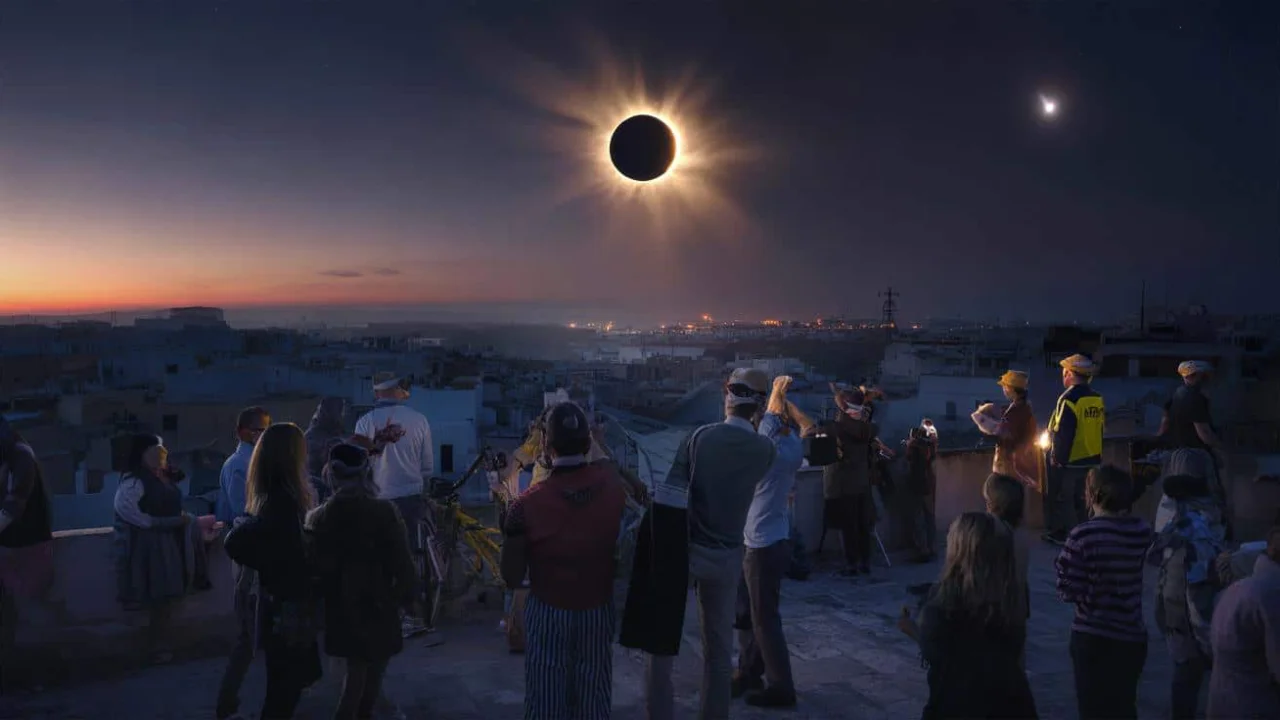
Sarah’s alarm went off at 5:30 AM on April 8, 2024. She’d driven eight hours from Chicago to Indiana, camping in a stranger’s backyard just to witness four minutes and twenty-eight seconds of totality. When the moon finally swallowed the sun that afternoon, she found herself crying—actually crying—as the world turned into something from a dream. The temperature dropped fifteen degrees. Birds went quiet. And for those precious minutes, every person around her forgot about their phones and just stared up in wonder.
That’s the power of a total solar eclipse. It transforms ordinary people into temporary mystics, reminding us we’re spinning on a rock through space.
Now astronomers are telling us to mark our calendars again. Because what’s coming in 2027 will make Sarah’s four-minute experience look like a brief preview of the main event.
August 2, 2027: When Day Becomes Night for Over Six Minutes
The longest solar eclipse of the 21st century has an official date: August 2, 2027. And when that day arrives, millions of people across three continents will witness something truly extraordinary.
This won’t be just another eclipse. At its peak, the moon will block the sun for an unprecedented 6 minutes and 23 seconds—nearly two minutes longer than any eclipse most living people have experienced.
“We’re talking about an event that will literally stop traffic across multiple countries,” says Dr. Elena Rodriguez, a solar physicist at the European Space Observatory. “The last time we saw anything close to this duration was in 2009, and that eclipse created traffic jams from India to China.”
The path of totality will stretch approximately 165 miles wide, carving a spectacular route from the Atlantic Ocean across southern Spain, through the Mediterranean, darkening parts of Egypt, Saudi Arabia, and Yemen before ending in the Arabian Sea.
Where to Experience the Longest Solar Eclipse
Not all locations along the eclipse path are created equal. The duration and quality of the experience varies dramatically based on your position within the shadow’s trajectory.
| Location | Duration of Totality | Local Time | Weather Likelihood |
|---|---|---|---|
| Seville, Spain | 3 minutes 58 seconds | 11:43 AM | 85% clear skies |
| Luxor, Egypt | 6 minutes 18 seconds | 2:15 PM | 95% clear skies |
| Mecca, Saudi Arabia | 6 minutes 23 seconds | 4:07 PM | 90% clear skies |
| Socotra Island, Yemen | 5 minutes 12 seconds | 5:32 PM | 80% clear skies |
Egypt and Saudi Arabia emerge as the sweet spots for this celestial show. The combination of maximum eclipse duration, favorable weather patterns, and accessible infrastructure makes these regions prime viewing territory.
Key features that make this eclipse exceptional:
- The moon will be near its closest approach to Earth (perigee), appearing larger in the sky
- Earth will be near its farthest point from the sun (aphelion), making the sun appear slightly smaller
- The shadow will move relatively slowly across the surface, extending totality duration
- Summer weather patterns provide optimal viewing conditions across most of the path
“The geometric alignment is almost perfect,” explains Dr. Michael Chen, eclipse researcher at the International Astronomical Union. “It’s like the universe conspired to give us the longest possible show.”
Why This Eclipse Matters Beyond the Spectacle
While the visual drama captures headlines, the longest solar eclipse offers unprecedented scientific opportunities. The extended duration allows researchers to conduct observations impossible during shorter eclipses.
Scientists plan to study the sun’s corona in detail, potentially unlocking mysteries about solar wind and magnetic field behavior. The six-minute window provides enough time for multiple experimental setups and data collection methods.
Tourism industries across the eclipse path are already preparing for what could be the largest astronomical tourism event in decades. Hotels in prime viewing locations report bookings opening three years in advance.
“We’re seeing interest levels that eclipse even major sporting events,” says Maria Santos, tourism director for Andalusia, Spain. “People are treating this like a once-in-a-lifetime pilgrimage.”
The economic impact extends beyond hotels and restaurants. Local airports are expanding capacity, tour operators are designing specialized eclipse packages, and even cruise lines are planning maritime viewing expeditions.
Planning Your Eclipse Experience Now
The smart money says start planning immediately. The 2024 eclipse across North America saw hotel prices surge 500% in prime viewing locations, with many accommodations booked solid two years in advance.
Transportation networks across the eclipse path are already strategizing for the influx. Spanish railway authorities are adding extra services to Seville. Egyptian tourism boards are developing special eclipse tours combining ancient monuments with astronomical observation.
“Don’t wait until 2026 to book your trip,” warns eclipse veteran photographer James Harrison, who has captured twelve total eclipses worldwide. “The best spots fill up faster than concert tickets for popular bands.”
Essential planning considerations include:
- Book accommodations in the totality path as early as possible
- Research backup locations in case of unexpected weather
- Invest in proper eclipse safety glasses from reputable suppliers
- Consider guided tours with astronomical expertise
- Plan for massive traffic delays before and after the event
The longest solar eclipse of our century promises to unite millions of people under a shared moment of cosmic wonder. Whether you’re a seasoned eclipse chaser or someone who’s never looked up at the sky with serious intent, August 2, 2027 offers an experience that will reshape how you see our place in the solar system.
FAQs
How often do total solar eclipses this long occur?
Total solar eclipses lasting over 6 minutes happen roughly once every 200-300 years for any given location on Earth.
Can I see the eclipse from outside the totality path?
Yes, but you’ll only experience a partial eclipse, which lacks the dramatic day-to-night transformation and corona visibility of totality.
Is it safe to look directly at the eclipse?
Never look directly at the sun without proper eclipse safety glasses, except during the brief moment of totality when the moon completely covers the sun’s bright surface.
How much will eclipse travel cost?
Based on previous eclipses, expect accommodation prices to increase 300-500% in prime viewing locations, with total trip costs ranging from $2,000-$8,000 depending on destination and duration.
What if it’s cloudy on eclipse day?
Cloud cover can completely obscure the eclipse, which is why many experienced eclipse chasers book mobile tours that can relocate to clearer skies within the totality path.
Will the next eclipse after 2027 be as spectacular?
The next total solar eclipse of comparable duration won’t occur until 2150, making the 2027 eclipse truly a once-in-a-lifetime opportunity for current generations.


