
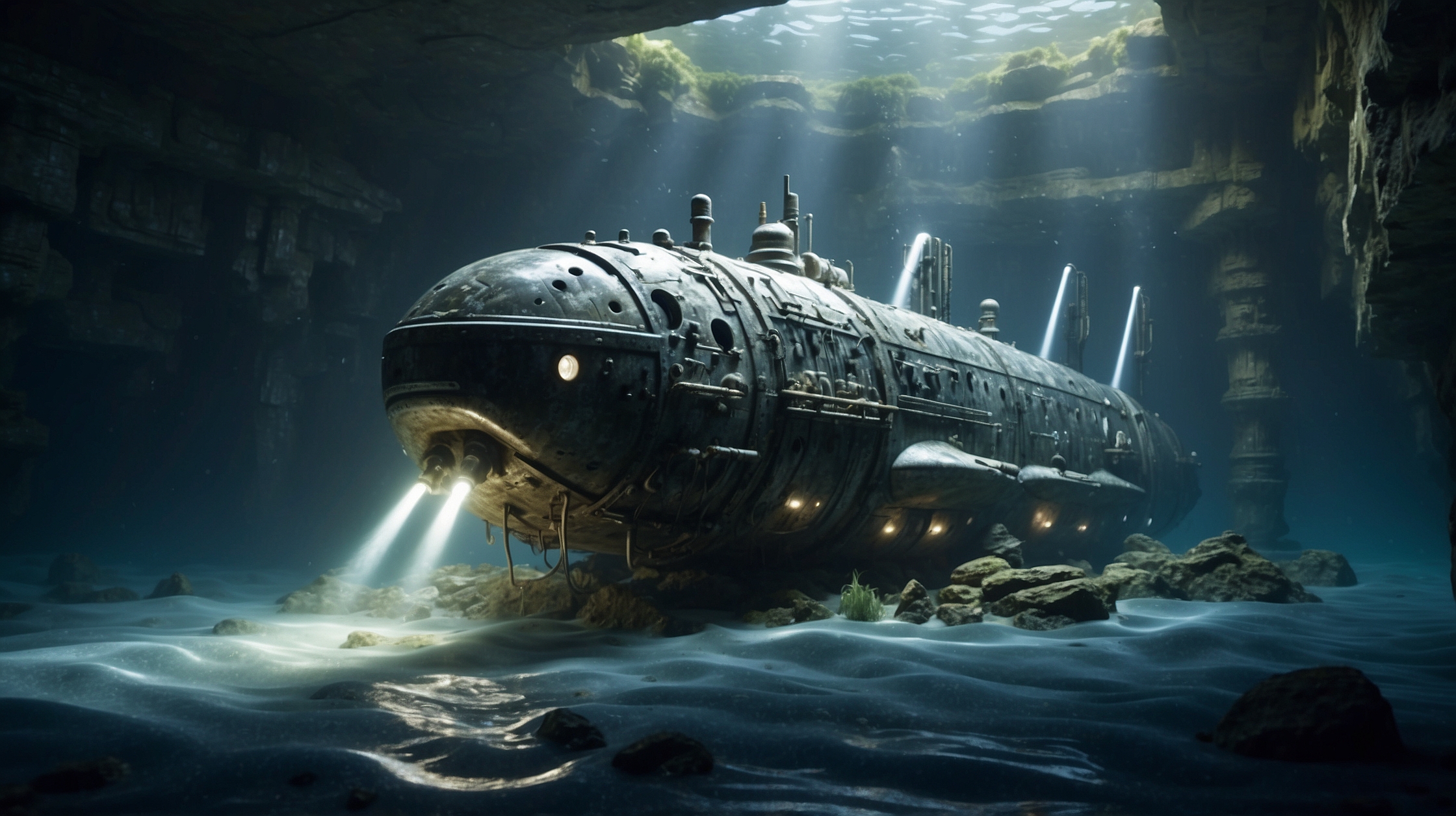
A groundbreaking underwater discovery, revealed through a routine military survey, has captivated archaeologists and historians around the world. Found a staggering 2,670 meters beneath the surface of the ocean, the previously unknown ancient structure may dramatically shift our understanding of prehistoric civilizations and their technological capabilities. This exceptional find challenges many long-standing academic timelines and could force a major re-evaluation of what we thought we knew about early seafaring and engineering.
Experts agree that discoveries at such depths are exceedingly rare, especially those with clear signs of intelligent human construction. The structure, believed to be more than 10,000 years old, includes signs of deliberate design, such as geometric layouts and uniform stone placement. Initial sonar and submersible footage suggest the presence of steps, corridors, and what could be ceremonial chambers — all preserved in near-pristine condition due to the conditions at the ocean floor. The confirmation of this as a human-made relic might represent one of the most important archaeological finds of the 21st century, with implications for multiple academic fields from anthropology and history to geology and oceanography.
Discovery highlights and key insights
| Feature | Details |
|---|---|
| Location | Undisclosed oceanic trench, 2,670 meters deep |
| Date of Discovery | March 2024 (revealed April 2024) |
| Discovering Agency | Classified military oceanographic survey |
| Structure Age | Estimated over 10,000 years old |
| Preservation State | Exceptionally intact due to deep-sea environmental isolation |
| Materials Found | Stone masonry, possible metallic alloys |
| Significance | Suggests advanced prehistoric oceanic civilization |
Why this archaeology find is different
The sheer depth of this site sets it apart from nearly all known underwater archaeological discoveries. Most sunken cities, such as those typically cited in Mediterranean or South Asian regions, lie at depths of no more than 100 meters. At 2,670 meters, the pressure, temperature, and light conditions make exploration not only immensely difficult but also limit the decay of materials, contributing to the incredible preservation of the discovered structure.
This type of preservation opens new windows into the past, offering potentially undisturbed environments where organic materials, tools, and possibly even ancient biological remnants could survive the ravages of time. Experts believe that if human or cultural artifacts are found intact at this site, it would indicate a level of civilization development and chronological placement far more complex than previously theorized.
What the structure reveals about ancient civilizations
Preliminary visual scans using high-resolution sonar and autonomous underwater vehicles revealed a design that includes patterned walls, symmetrical chambers, and what researchers describe as “purpose-driven architecture.” These elements point to a civilization that had an understanding of construction principles far beyond their supposed technological stage.
Even more astonishing is the apparent spatial planning resembling urban structuring. The division of the structure into multiple connected rooms, and the presence of what may be step-like features resembling amphitheater seating, suggests a sophisticated social or ceremonial function. The discovery could rewrite our understanding of when and how early civilizations evolved complex social systems and architectural ingenuity.
Geological analysis and dating methods underway
Geologists are currently analyzing the sediment cradling the structure to determine a more accurate age. Using isotopic dating, carbon residue samples, and surrounding strata analysis, initial estimates position the structure at over 10,000 years old — predating prominent ancient civilizations like Mesopotamia, the Indus Valley, and Ancient Egypt.
“This is perhaps the oldest intact man-made structure ever found beneath the ocean. It directly challenges the conventional narrative of early civilization timelines.”
— Dr. Helena Kurnik, Marine Archaeologist and Oceanic Epoch Specialist
However, scientists caution that definitive dating could take months, if not years, due to the complexity of seabed geology and the extreme conditions at the site. Remote-operated vehicles and atmospheric submersibles remain critical to this phase of research.
The technology enabling deep sea discoveries
The discovery was made possible by a new generation of military-grade sonar technology designed to identify threats and obstacles on the ocean floor. In this case, the high-resolution mapping software identified unexpected symmetrical anomalies — triggering a deeper investigation. The survey, originally intended as a defense mapping drill, became a pivotal point for archaeological science.
Autonomous underwater vehicles (AUVs) equipped with multi-beam side-scan sonar allowed detailed visuals of the structure to be captured without direct human presence. This technology, once exclusive to military and commercial deep-sea drilling sectors, is now starting to revolutionize how we explore the planet’s uncharted underwater territories.
“We’re only scratching the surface of what’s hidden inside our oceans. This structure opens the door to reconsider how and where ancient peoples may have thrived — including in places we never thought to look.”
— Cmdr. Erik Stallings, Naval Hydrographic Survey Unit (Retired)
Public interest and open-science calls grow
News of the deep-sea find has already ignited public curiosity and academic demand for transparency. Scientists and educators across multiple fields are calling on the military agencies involved to release expanded imagery and data sets for peer review. Independent ocean research institutes are also requesting permission to contribute exploratory missions to verify and expand on the initial findings.
Historians are among those most intrigued, noting that such structures may correspond with mythical or oral traditions of sunken civilizations. Some experts point to the possibility of lost cultures similar to those referenced in ancient texts and legends.
“The implications are tremendous. If independently verified with peer-reviewed evidence, this could become a Rosetta Stone for reevaluating human history pre-Ice Age.”
— Dr. Serafina Lutz, Anthropologist and Author
What changed this year
While underwater research has been evolving for decades, 2024 has marked a turning point in interest and funding directed toward deep-sea archaeology. The application of AI-powered pattern recognition and unmanned robotics has enabled discoveries previously thought impossible. Governmental policies around declassification of exploration missions have also softened, allowing civilian experts marginal access to once-classified data — as exemplified in this find.
Winners and Losers in the academic community
| Winners | Losers |
|---|---|
| Archaeologists advocating prehistoric oceanic civilizations | Traditional historians promoting linear evolution of civilization |
| Marine geologists and underwater robotics developers | Academic skeptics of legends like Atlantis or Lemuria |
| Public science advocates seeking open-access data | Exclusive military research institutions reluctant to share discoveries |
Short FAQs about the underwater archaeological discovery
How was the structure discovered at such depth?
The find came during a military sonar survey intended for ocean floor mapping. Anomalies in the data led to further investigation using autonomous underwater vehicles.
Is the structure confirmed to be human-made?
Early visuals, geometric patterns, and construction-like features strongly suggest intentional design. However, official classification is pending peer-reviewed research.
What makes this different from other underwater ruins?
Its depth — 2,670 meters — and pristine preservation due to extreme low temperatures and absence of light make it uniquely intact compared to previous finds.
Why is this discovery significant for history?
If proven to be man-made and over 10,000 years old, it would considerably predate all known ancient civilizations, rewriting human development timelines.
Can the public see images or visit the site?
Currently, images are limited and controlled due to military involvement. Civilian scientific missions are petitioning for access to expand study and transparency.
What kind of civilization could have built this?
While speculative for now, the advanced features suggest a highly developed yet prehistoric culture capable of stone construction and possibly maritime navigation.
What happens next with the discovery?
Further geological sampling, satellite analysis, and international peer review will drive next steps. There are also calls for collaborative expeditions to retrieve artifacts.
Could this be related to Atlantis or similar legends?
Some experts have suggested that ancient myths may contain references to real lost cultures. However, rigorous scientific validation is required before making such connections.


