
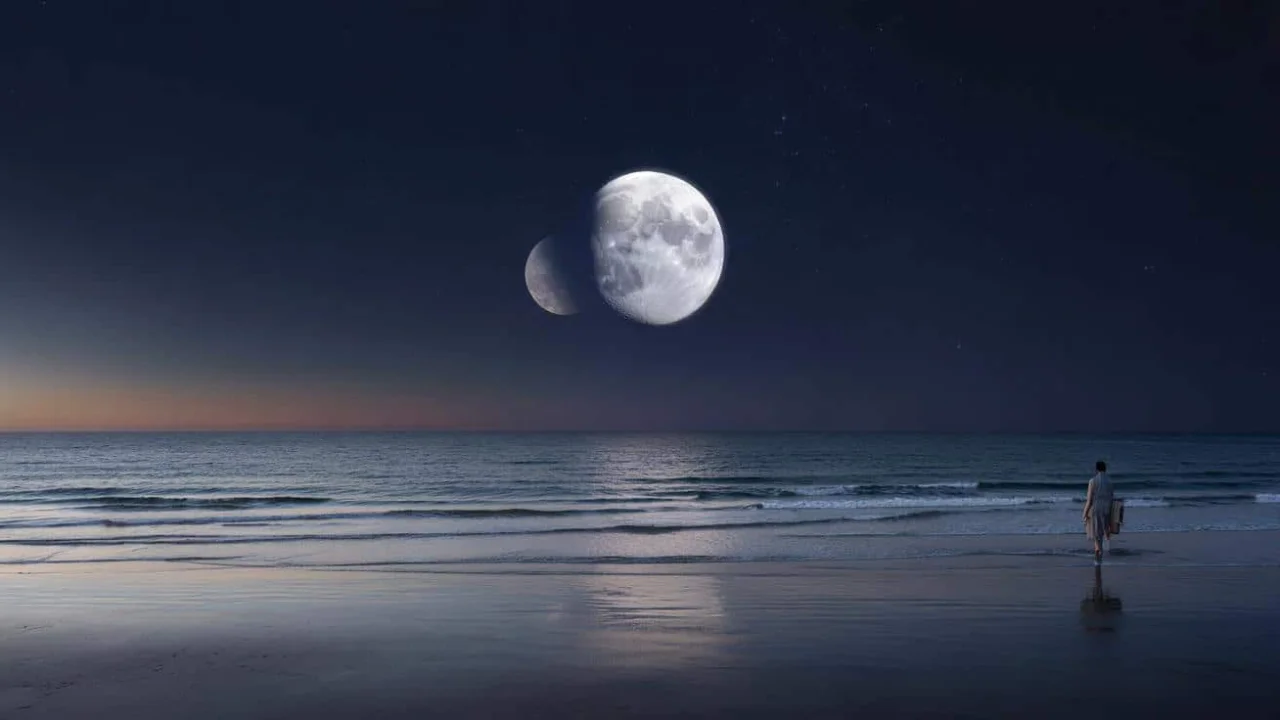
Sarah noticed it first during her midnight beach walks. The high tide that used to reach the old driftwood log now stopped just short, leaving a narrow strip of dry sand. Her grandfather had always told her stories about fishing from that same spot, where the waves once crashed with such force they’d soak his boots. Now, fifty years later, the ocean seemed gentler, almost polite in its approach to shore.
What Sarah didn’t know was that she was witnessing something extraordinary happening right above her head. The same moon that guided her evening strolls was quietly, imperceptibly drifting away from Earth, taking with it the raw power of our planet’s tides and slowly stretching our days into something entirely new.
This isn’t science fiction or some distant future concern. The moon drifting away from Earth is happening right now, at this very moment, and it’s been reshaping life on our planet for billions of years.
Your Days Are Getting Longer (But You’ll Never Notice)
Every year, our faithful lunar companion moves about 3.8 centimeters farther from Earth. That’s roughly the same rate your fingernails grow. It sounds impossibly small, yet this tiny retreat is having profound effects on our planet that ripple through time itself.
“People think of celestial mechanics as this grand, dramatic thing,” explains Dr. Michael Chen, a lunar researcher at the Pacific Observatory. “But the reality is much more subtle. The moon is literally stealing energy from Earth’s rotation, one tide at a time.”
Here’s how it works: billions of years ago, Earth spun much faster. A single day lasted only about six hours. Our planet rotated like a carnival ride, but the moon’s gravitational pull created massive tides that acted like cosmic brakes. As these tides crashed against coastlines and ocean floors, they gradually slowed Earth’s rotation.
The result? Our days have been stretching ever since. What started as six-hour days eventually became the 24-hour cycle we know today. And the process continues.
The Science Behind Our Drifting Moon
Scientists have been tracking the moon drifting away using some remarkably clever methods. During the Apollo missions, astronauts placed special mirror arrays on the lunar surface. These retroreflectors still sit there today, waiting for laser beams from Earth.
Researchers fire laser pulses at these mirrors and measure how long it takes for the light to return. With timing equipment precise enough to measure billionths of a second, they can calculate the exact distance to the moon on any given day.
- The moon moves away at 3.8 cm per year
- Earth’s rotation slows by 1.7 milliseconds per century
- Ancient eclipses recorded on clay tablets confirm this pattern
- Tidal forces transfer Earth’s rotational energy to the moon’s orbit
- The process has been ongoing for over 4 billion years
“What amazes me is that we can verify this using ancient astronomical records,” says Dr. Linda Rodriguez, a specialist in tidal dynamics. “Babylonian eclipse observations from 2,500 years ago match perfectly with our laser measurements today.”
| Time Period | Day Length | Moon Distance | Tide Strength |
|---|---|---|---|
| 4 billion years ago | 6 hours | Much closer | Extremely strong |
| 620 million years ago | 22 hours | Closer | Stronger |
| Today | 24 hours | 384,400 km | Current levels |
| Future (billions of years) | 47 hours | Much farther | Very weak |
What This Means for Life on Earth
The moon drifting away affects more than just day length and tide strength. This gradual change has shaped the evolution of life itself. Many marine creatures depend on tidal rhythms for breeding, feeding, and migration patterns that have developed over millions of years.
Consider the humble horseshoe crab, which has timed its spawning to high tides for over 400 million years. Or the grunion fish in California, which beaches itself during the highest spring tides to lay eggs. As tides become gentler over geological time, these ancient rhythms face gradual but persistent pressure to adapt.
“We’re talking about changes that happen over such long timescales that most species can adapt,” notes Dr. Rodriguez. “But it’s fascinating to think that the moon’s distance has been a hidden driver of evolution all along.”
The practical effects today remain minimal. Computer systems that require precise timekeeping occasionally add “leap seconds” to account for Earth’s slowing rotation, but for everyday life, the changes are invisible.
The Moon’s Ultimate Destination
This process won’t continue forever. Eventually, the moon drifting away will reach a point where Earth and moon become tidally locked to each other. The same side of Earth will always face the moon, just as the same side of the moon always faces Earth today.
When that happens billions of years from now, days will be about 47 hours long, and the moon will appear stationary in the sky. But here’s the cosmic twist: by then, the sun will have evolved into a red giant star, making these distant tidal calculations largely academic.
“It’s humbling to realize we’re living through this slow-motion cosmic dance,” reflects Dr. Chen. “Every time you check your watch, you’re measuring the result of billions of years of gravitational choreography between Earth and moon.”
For now, we can appreciate this gentle cosmic evolution happening above us. The next time you watch the tide roll in, remember that you’re witnessing the moon’s subtle influence on our planet – an influence that’s been quietly shaping Earth’s story since the very beginning, one tiny drift at a time.
FAQs
How long has the moon been drifting away from Earth?
The moon has been gradually moving away from Earth for about 4.5 billion years, ever since it formed.
Will the moon eventually leave Earth completely?
No, the moon will never escape Earth’s gravity entirely. It will eventually reach a stable distance where both bodies become tidally locked.
Can we feel the effects of longer days in our lifetime?
No, the change is far too small to notice. A day becomes only 1.7 milliseconds longer each century.
Do other planets experience this same phenomenon?
Yes, many moons throughout the solar system are slowly drifting away from their host planets due to similar tidal forces.
How do scientists know the moon is moving away?
They use laser ranging experiments with mirrors placed on the lunar surface by Apollo astronauts, measuring the distance with incredible precision.
What would happen if the moon suddenly stopped drifting away?
This scenario is physically impossible given the laws of orbital mechanics, but if it occurred, Earth’s rotation rate would remain constant rather than continuing to slow down.


