
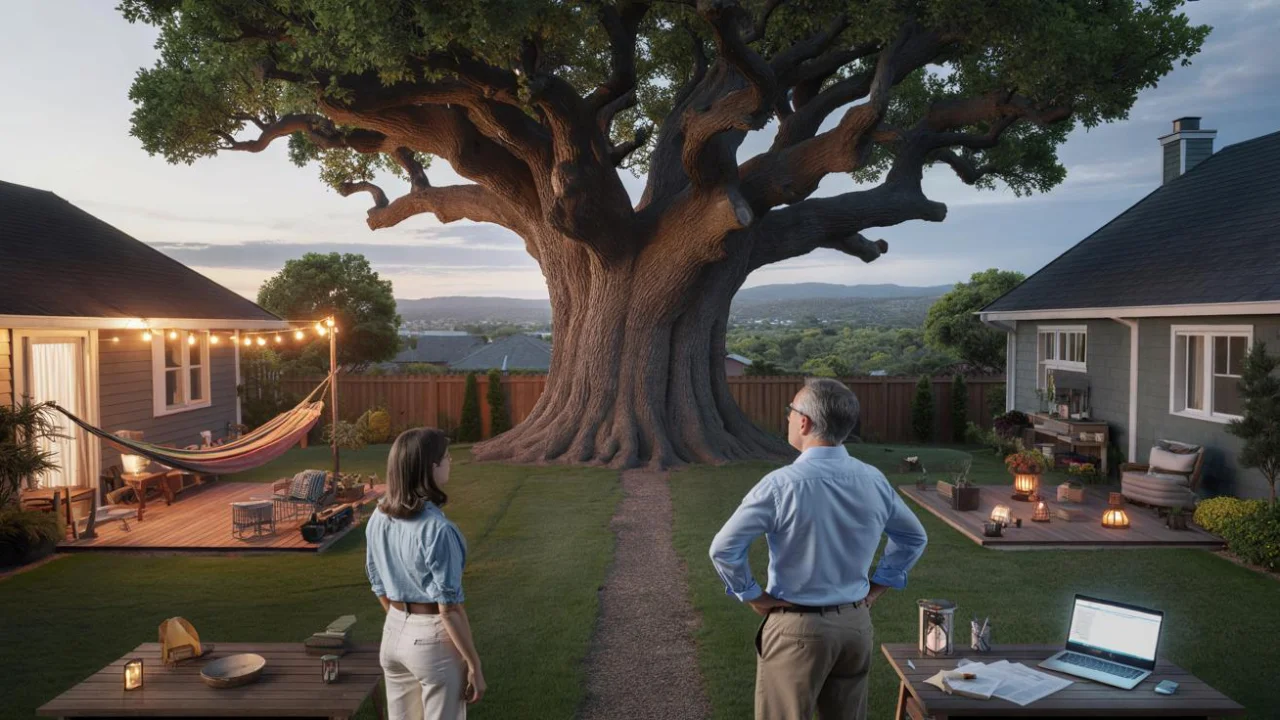
Sarah Martin still remembers the exact moment she fell in love with her house. It wasn’t the updated kitchen or the hardwood floors that sold her. It was stepping into the backyard and seeing that magnificent oak tree, its ancient branches creating a natural cathedral above the lawn. “I literally gasped,” she says. “I knew my kids would build treehouses and my grandkids would swing from those branches.”
Three weeks later, a certified letter from her neighbors changed everything. The Butlers wanted the centuries-old tree gone, claiming it blocked their view and dropped debris on their property. What started as a neighbor tree dispute over branches and leaves has exploded into a full-scale legal battle that’s dividing more than just their backyards.
Now, eighteen months later, both families have spent thousands on lawyers, the tree still stands, and their quiet suburban street has become ground zero for one of the most complex property disputes their town has ever seen.
When Property Lines Meet Ancient Roots
The massive oak at the center of this neighbor tree dispute predates both houses by decades, possibly centuries. Its trunk straddles the exact property line, making it what lawyers call a “boundary tree” – technically owned by both properties.
For the Martins, the tree represents everything they wanted in suburban life. They’ve hung string lights through the branches, built a small deck around its base, and watch their children climb its sturdy limbs. “It’s not just a tree,” Sarah explains. “It’s the heart of our home.”
But across the fence, the Butlers see something entirely different. After 14 years in their house, they’ve watched the oak’s canopy grow thicker each season, gradually blocking what used to be an unobstructed sunset view over the valley. “We used to see three church steeples from our deck,” says Tom Butler. “Now we can barely make out the horizon.”
Property law expert Jennifer Walsh explains the complexity: “Boundary trees create unique challenges because both owners have rights, but they also share responsibilities. Neither party can unilaterally decide to remove or significantly alter the tree.”
The Legal Battlefield Gets Messy
What makes this neighbor tree dispute particularly complicated isn’t just the location – it’s the competing claims both families are making. The situation involves multiple legal concepts that vary significantly by state and local jurisdiction.
| Legal Issue | Martin’s Position | Butler’s Position |
|---|---|---|
| Property Rights | Tree enhances property value | Tree reduces property value |
| View Rights | No guaranteed right to view | Established view being blocked |
| Safety Concerns | Tree is healthy and stable | Large branches pose storm risk |
| Maintenance | Willing to share costs | Want complete removal |
The Butlers have documented their complaints meticulously. They’ve collected falling branches, photographed clogged gutters filled with oak leaves, and hired an arborist to assess what they claim are dangerous limbs. Their folder of evidence includes before-and-after photos showing how the tree’s growth has changed their view over the years.
Meanwhile, the Martins commissioned their own tree expert, who declared the oak “structurally sound and an exceptional specimen.” They argue that the Butlers knew about the tree when they bought their house and can’t now claim it’s a nuisance.
Real estate attorney Michael Chen sees these cases regularly: “Tree disputes are emotional because they’re really about different visions of what suburban life should look like. One family’s natural paradise is another family’s maintenance nightmare.”
Common Ground Proves Impossible to Find
The most frustrating aspect of this neighbor tree dispute is how many reasonable solutions both sides have rejected. The Martins offered to pay for professional trimming to open up the Butlers’ view. The Butlers responded that anything short of complete removal was unacceptable.
City mediation sessions have gone nowhere. The mediator suggested several compromises:
- Selective branch removal to restore partial views
- Shared costs for professional maintenance
- Installation of root barriers to prevent property damage
- Regular arborist inspections to address safety concerns
Both families walked away from mediation unsatisfied. “They want our tree dead,” Sarah Martin says bluntly. Tom Butler counters: “They want us to live in permanent shadow.”
The legal costs are mounting rapidly. Each family has spent over $15,000 on attorneys, expert witnesses, and court filings. The tree, meanwhile, continues growing, its branches reaching a little further each season.
Why These Battles Are Becoming More Common
This neighbor tree dispute reflects broader changes in how Americans view property rights and suburban living. As housing prices rise and lot sizes shrink, conflicts over views, privacy, and shared spaces are increasing nationwide.
Environmental lawyer Lisa Rodriguez points to several trends driving these conflicts: “People are paying more for homes and expect more control over their immediate environment. At the same time, there’s growing awareness of trees’ environmental value, creating competing interests.”
The legal landscape varies dramatically by location. Some states have “view ordinances” that protect established sight lines. Others prioritize tree preservation, making removal extremely difficult even on private property.
Insurance implications add another layer of complexity. If the oak damages the Butler’s roof during a storm, determining liability becomes a nightmare when the tree spans both properties.
Property values complicate everything further. Real estate appraisers disagree about whether the tree adds or subtracts value, with estimates varying by thousands of dollars depending on the appraiser’s perspective.
The Human Cost of Legal Warfare
Beyond the legal complexities, this neighbor tree dispute has destroyed relationships and divided the entire neighborhood. Other residents report feeling forced to choose sides, with some supporting the tree’s preservation while others sympathize with the blocked view.
The Martin children no longer play in the front yard. Sarah says they’re embarrassed by the ongoing conflict and worry their neighbors hate them. Tom Butler admits the stress has affected his sleep and his marriage. “This has consumed our lives,” he says.
Both families have considered selling, but the ongoing legal dispute creates disclosure requirements that complicate any sale. They’re essentially trapped in a battle neither really wanted but both feel they cannot abandon.
Community mediator Robert Kim explains the psychological toll: “Tree disputes tap into deep feelings about home, safety, and control. Once positions harden, finding compromise becomes nearly impossible.”
What Happens Next
The case is heading to trial, where a judge will ultimately decide the tree’s fate. Legal experts suggest the outcome could set precedent for similar neighbor tree disputes throughout the region.
Possible court rulings range from complete removal to mandatory shared maintenance agreements. The judge might also order compensation if one party’s property value has been significantly impacted.
Whatever the decision, both families acknowledge their relationship is probably beyond repair. The centuries-old oak has become a symbol of everything that can go wrong when neighbors stop talking and start litigating.
As spring arrives, the tree is budding again, preparing for another season of growth while its human neighbors prepare for another round of court battles. The oak, unchanged by their conflict, continues reaching toward the sky it has known for generations.
FAQs
Can my neighbor force me to remove a tree on my property?
Generally no, but if the tree poses genuine safety risks or violates local ordinances, you might be required to trim or remove it. Laws vary significantly by state and municipality.
Who’s responsible when a boundary tree causes damage?
Both property owners typically share liability for boundary trees, but specific responsibility depends on the type of damage, local laws, and whether either owner was negligent in maintenance.
Do I have a legal right to my view?
Most places don’t guarantee view rights unless specifically established through easements or local view ordinances. However, some jurisdictions do protect “established views” under certain circumstances.
Can I trim my neighbor’s tree branches that hang over my property?
In most states, you can trim branches that cross onto your property, but you cannot damage the tree’s health and may need to return the cut branches to your neighbor.
How much do neighbor tree disputes typically cost?
Legal costs can range from $5,000 to $50,000 or more, depending on complexity and duration. Many experts recommend mediation as a much less expensive alternative to litigation.
Should I get a lawyer for a tree dispute with my neighbor?
Start with direct communication and consider mediation first. Consult a lawyer if the dispute involves significant property damage, safety concerns, or if your neighbor has already taken legal action.


