
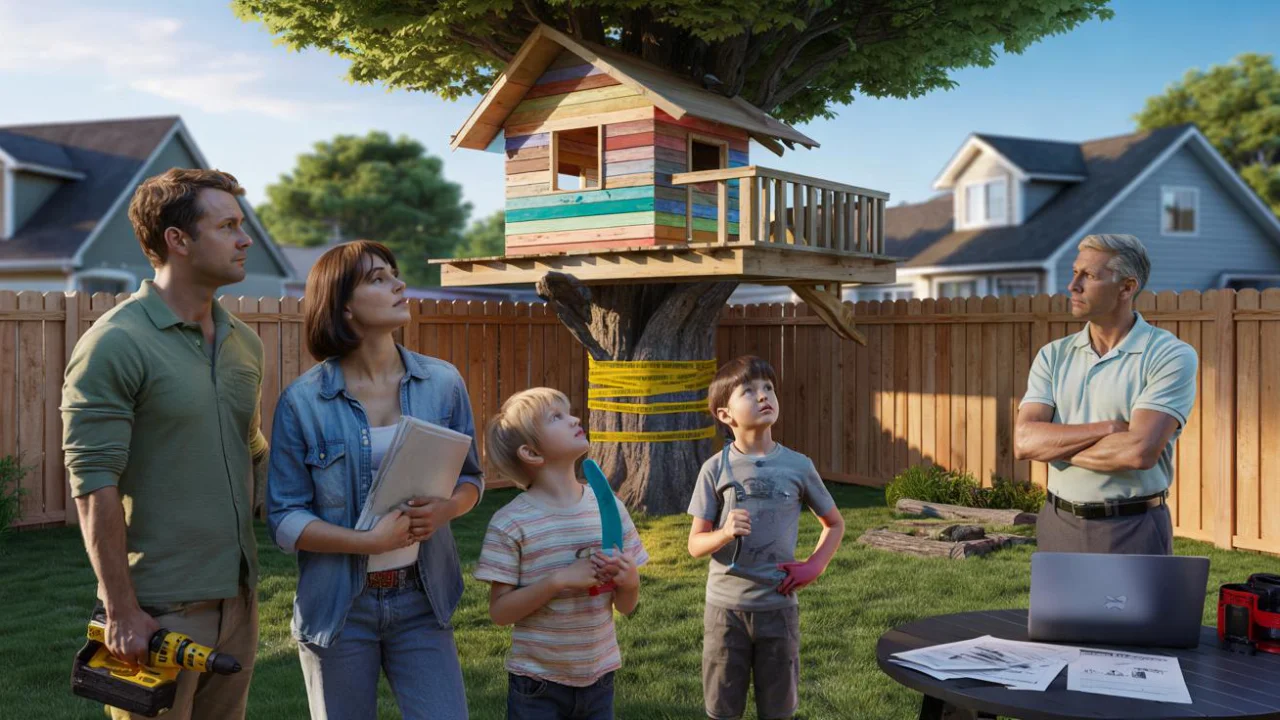
Sarah Martinez stood in her backyard last Tuesday morning, holding a cup of coffee that had gone cold hours ago. Above her, wrapped in yellow caution tape like a crime scene, sat the treehouse she and her husband built for their two kids over spring break. The wooden platform that once echoed with laughter now stood empty and silent, a monument to what happens when neighborhood goodwill collides with legal technicalities.
What started as a weekend DIY project has become a cautionary tale about modern suburbia, where a simple act of parenting can spiral into court battles, divided communities, and children caught in the crossfire. The Martinez family treehouse has sparked a debate that goes far beyond their backyard: Are we protecting our kids, or are we protecting them right out of childhood?
This neighborhood treehouse feud isn’t just about building codes or property lines. It’s about the growing tension between safety regulations and the simple joy of letting kids be kids.
How a family project became a legal nightmare
The trouble started innocently enough. Like thousands of parents across America, the Martinez family decided to build their children a treehouse. They spent three weekends in April constructing what they thought was a modest platform in their backyard maple tree.
“We followed a YouTube tutorial, bought lumber from Home Depot, and thought we were giving our kids something special,” Sarah explains. “We never imagined it would end up in court.”
The 8-by-10-foot platform included basic safety features: railings, a sturdy ladder, and a small roof. To the Martinez family, it represented childhood dreams coming to life. To their neighbor, Robert Chen, it represented a potential liability and safety hazard.
Chen filed a complaint with the city three months after construction, citing concerns about the structure’s proximity to his property line and its compliance with local building codes. What followed was a cascade of inspections, violations, and legal notices that transformed a simple family project into a neighborhood battleground.
“I wasn’t trying to hurt anyone,” Chen says. “But when you build something that close to my fence, something that could fall and hurt someone, I have to speak up. We live in a society with rules for a reason.”
The legal battle that divided a street
The city inspection revealed multiple code violations that caught the Martinez family completely off guard. Their homemade treehouse failed to meet several municipal requirements that they never knew existed.
Key violations included:
- No building permit obtained before construction
- Structure built too close to property line (3 feet instead of required 10 feet)
- Platform height exceeds residential guidelines without safety barriers
- Materials not rated for permanent outdoor structures
- No professional engineering assessment for tree stability
| Violation Type | City Requirement | Martinez Structure |
|---|---|---|
| Property Setback | 10 feet minimum | 3 feet from fence |
| Building Permit | Required for all structures | None obtained |
| Platform Height | 8 feet maximum | 12 feet above ground |
| Professional Inspection | Required for elevated structures | DIY construction only |
The city issued a cease-and-desist order, demanding the structure be removed or brought into compliance within 30 days. The cost of compliance? Nearly $15,000 in permits, professional assessments, and structural modifications.
“We built this thing for maybe $800 in materials,” says David Martinez. “Now they’re telling us we need to spend twenty times that amount or tear it down. It feels completely insane.”
When neighbors become enemies
The neighborhood treehouse feud quickly escalated beyond the two families involved. The Martinez family launched a social media campaign to save their treehouse, sharing photos of their disappointed children and questioning whether safety regulations had gone too far.
Chen received anonymous letters calling him a “childhood destroyer” and found his car keyed twice. The neighborhood WhatsApp group split into factions, with heated arguments breaking out over everything from property rights to parenting philosophy.
“This whole situation has made me question everything about where we live,” says Jennifer Walsh, a neighbor who supported the Martinez family. “When did building a treehouse for your kids become a legal offense? What’s next, permits for sandbox construction?”
But other residents sided with Chen, arguing that rules exist for everyone’s protection.
“I know it seems harsh, but what happens if that tree falls in a storm and crushes someone’s house?” asks neighborhood resident Michael Torres. “Or if a child gets seriously injured because the platform wasn’t built to proper standards? We’d all be asking why the city didn’t enforce its own rules.”
The real cost of childhood safety
Child development experts warn that cases like the Martinez treehouse represent a broader cultural shift away from independent play and risk-taking that children need for healthy development.
“We’re seeing kids who are afraid to climb trees, afraid to take normal childhood risks, because every activity has been regulated or removed,” explains Dr. Amanda Foster, a pediatric psychologist who specializes in childhood development. “Treehouses teach kids about problem-solving, risk assessment, and independence. When we eliminate these experiences, we eliminate important learning opportunities.”
The statistics on childhood outdoor activity paint a concerning picture. Studies show that children today spend 90% less time outdoors than their parents did, partly due to increased safety regulations and liability concerns.
However, safety advocates argue that building codes exist for legitimate reasons. Insurance claims related to homemade structures have increased 340% over the past decade, with tree-related incidents accounting for a significant portion of homeowner liability cases.
“Nobody wants to see children hurt, but nobody wants to see them wrapped in bubble wrap either,” says municipal law expert Janet Richardson. “The challenge is finding the right balance between reasonable safety measures and allowing families the freedom to create memorable childhood experiences.”
A community searches for middle ground
As the court date approaches, both sides of the neighborhood treehouse feud are showing signs of exhaustion. The Martinez family faces mounting legal costs, while Chen deals with ongoing harassment from treehouse supporters.
Some community leaders are proposing compromise solutions, including a streamlined permit process for small residential structures and clear guidelines for DIY projects. The city council has agreed to review current building codes to determine if modifications might prevent future conflicts.
“Maybe we need a ‘treehouse permit’ that’s simpler and cheaper than a full building permit,” suggests city councilwoman Lisa Park. “Something that ensures basic safety without requiring families to hire engineers and architects for a weekend project.”
Meanwhile, the Martinez children have started playing at friends’ houses more often, their own backyard now a reminder of adult complications they don’t understand. The treehouse sits empty, its yellow caution tape fluttering in the breeze like a flag of surrender.
The case has attracted attention from family advocacy groups and municipal law reform organizations, who see it as a symbol of regulatory overreach in residential communities. Whatever the court decides, the neighborhood treehouse feud has already accomplished something neither side intended: it’s started a conversation about how we balance safety with childhood joy in modern America.
FAQs
Do I need a permit to build a treehouse in my backyard?
Requirements vary by city, but many municipalities require permits for structures over 100 square feet or 8 feet in height.
What are the most common building code violations for homemade treehouses?
Property line setbacks, height restrictions, lack of permits, and inadequate safety barriers are the most frequent issues.
Can neighbors legally force removal of a treehouse on my property?
If the structure violates local building codes or poses safety risks, neighbors can file complaints that may result in removal orders.
How much does it typically cost to build a code-compliant treehouse?
Professional installations range from $8,000 to $30,000 depending on size and local requirements, compared to $500-2,000 for DIY versions.
Are there insurance implications for backyard treehouses?
Homeowner’s insurance may not cover injuries or damage from unpermitted structures, potentially leaving families liable for accidents.
What’s the best way to avoid treehouse-related neighbor disputes?
Check local building codes first, discuss plans with adjacent neighbors, and consider obtaining proper permits even for simple structures.


