
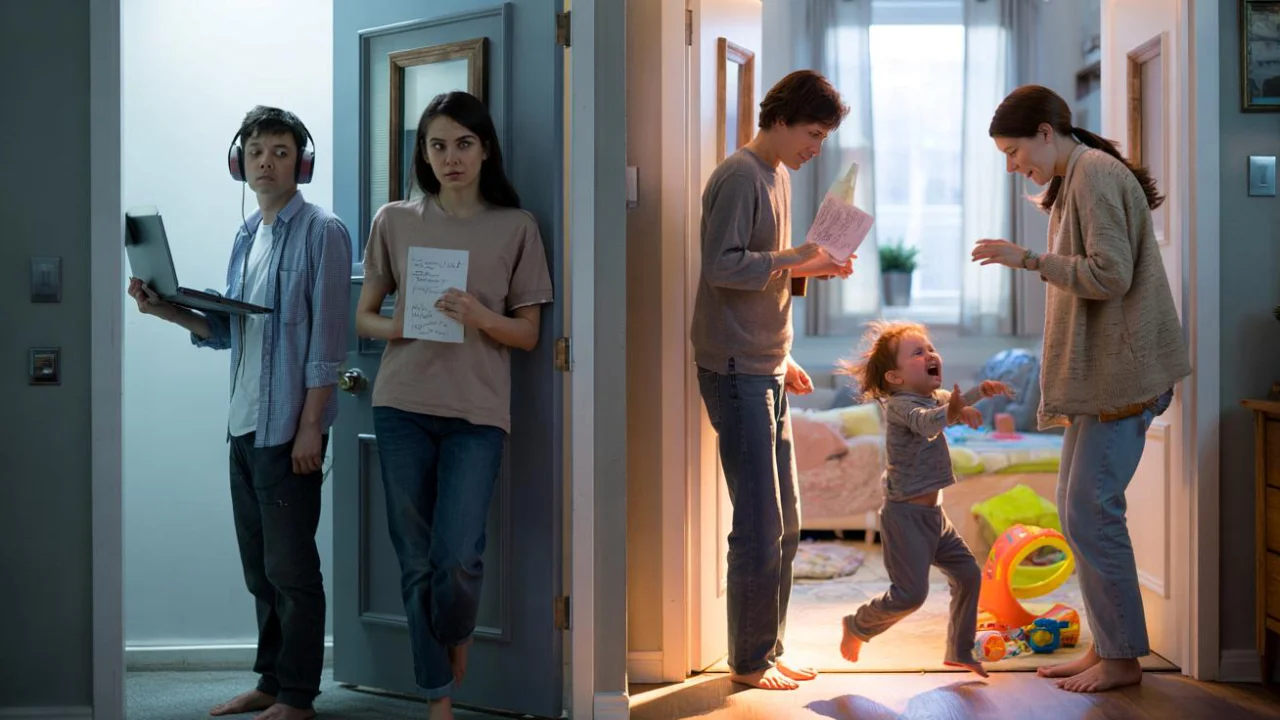
Sarah pressed her ear against the thin apartment wall at 2:47 a.m., listening to her upstairs neighbor’s bass drop for the fourth time that night. The vibrations rattled her bedroom window and sent her cat scrambling under the bed. Tomorrow was her biggest presentation at work, and she’d already been lying awake for three hours.
She wasn’t alone. Across the building, Mike was typing an angry text to his landlord about the family next door whose toddler seemed to practice Olympic sprinting at 6 a.m. every morning. Down the hall, elderly Mrs. Chen was googling “how to soundproof apartment walls” for the dozenth time this month.
What started as individual frustrations with noisy neighbors has exploded into a nationwide conversation about modern living, personal boundaries, and who really has the right to peace in their own home.
When apartment living becomes a noise nightmare
The statistics tell a stark story. According to recent housing surveys, noise complaints have increased by 35% in urban areas over the past five years. Property management companies report that neighbor disputes now account for nearly 40% of all tenant complaints, with noise being the number one issue.
“We’re seeing more conflicts than ever before,” says Maria Rodriguez, a property manager who oversees 200 units in downtown Phoenix. “People are working from home, living in smaller spaces, and everyone’s stress levels are through the roof.”
The problem isn’t just about volume. It’s about timing, frequency, and the type of noise that drives people to the breaking point. A recent viral Reddit post perfectly captured this tension when a childless couple left a polite note asking their neighbors to keep their toddler quieter during early morning and late evening hours.
The response was explosive. Thousands of comments poured in, splitting sharply between those who sympathized with the sleep-deprived couple and parents who felt personally attacked for simply existing with children.
The most common noise complaints and their impact
Understanding what pushes neighbors over the edge reveals patterns that go beyond simple inconsideration. Here’s what’s really driving people crazy:
| Type of Noise | Peak Hours | Impact Level | Most Affected Group |
|---|---|---|---|
| Loud music/TV | 10 PM – 2 AM | High | All ages |
| Children running/screaming | 6 AM – 8 AM | Very High | Work-from-home adults |
| Heavy footsteps | 11 PM – 6 AM | Moderate | Light sleepers |
| Barking dogs | Various | High | Shift workers |
| Loud conversations | Late evening | Moderate | Early risers |
The psychological impact goes deeper than lost sleep. Dr. Jennifer Walsh, an environmental psychologist, explains that chronic noise exposure triggers the same stress responses as physical threats.
“Your body doesn’t know the difference between a saber-tooth tiger and a neighbor’s subwoofer at midnight,” Walsh notes. “Both activate fight-or-flight responses that can lead to anxiety, depression, and even cardiovascular problems over time.”
The most frustrating complaints often involve repetitive, unpredictable sounds that happen during traditionally quiet hours:
- Early morning exercise routines with jumping or weights
- Late-night gaming sessions with loud reactions
- Weekend parties that extend past building quiet hours
- Inconsistent sleep schedules that create noise at odd hours
- Uncontrolled pets left alone for extended periods
Why normal people become noise monsters
Most noisy neighbors aren’t intentionally malicious. The rise in complaints stems from several converging factors that have transformed how we live and work.
The work-from-home revolution created an unexpected collision. People who once spent 8-10 hours away from their apartments are now home all day, hyperaware of every sound around them. Meanwhile, their neighbors continue living as they always have, not realizing their daily routines now disrupt someone’s workspace.
“I never noticed how much my upstairs neighbor walked around until I started working from home,” admits Rachel Kim, a marketing coordinator in Seattle. “Now every footstep feels like it’s happening directly in my brain.”
Housing density plays a massive role too. Modern apartment construction often prioritizes aesthetics and cost savings over sound insulation. Paper-thin walls and floors mean activities that would be perfectly reasonable in a detached house become neighborhood disturbances.
Mental health challenges have amplified sensitivity to noise. Dr. Marcus Thompson, who studies urban stress patterns, points out that anxiety and depression make people more reactive to environmental triggers.
“When you’re already overwhelmed, a barking dog at 11 p.m. doesn’t just wake you up – it feels like an assault on your last shred of peace,” Thompson explains.
Social isolation compounds the problem. People who once had strong community connections now view neighbors as strangers whose lives inconvenience them rather than fellow humans navigating similar challenges.
The real cost of neighbor noise wars
Beyond individual stress, these conflicts are reshaping entire communities. Property values in buildings with ongoing noise disputes drop significantly. Management companies report spending increasing amounts of time mediating conflicts instead of maintaining properties.
Some cities are experimenting with new approaches. Portland recently launched a “neighbor mediation” program that pairs trained counselors with disputing residents. Early results show 60% of conflicts resolve without formal complaints or evictions.
“Most people just want to be heard and understood,” says program coordinator Lisa Chang. “When both sides realize they’re dealing with real human beings facing real challenges, solutions usually emerge.”
The housing market has responded with “quiet-certified” buildings that feature enhanced soundproofing and stricter noise policies. These units command 15-20% higher rents but often have waiting lists.
Technology offers some hope. Apps like “NoiseScore” help renters research building noise levels before signing leases. Smart home devices can monitor decibel levels and send gentle reminders when noise exceeds reasonable levels.
But the deeper solution requires rebuilding the social fabric that once made neighborhood conflicts manageable. Communities that invest in shared spaces, regular social events, and clear communication channels see dramatically fewer noise complaints.
The viral Reddit note that started this conversation actually had a happy ending. After weeks of online debate, the two families met face-to-face. The parents implemented quiet hours and carpet padding. The couple bought noise-canceling headphones and offered to babysit occasionally.
“We realized we were both just trying to survive in a world that’s gotten too loud and too isolated,” the childless neighbor later posted. “Sometimes the answer isn’t who’s right or wrong – it’s remembering we’re all human beings trying to find peace in the same small space.”
FAQs
What are quiet hours in most apartment buildings?
Typically 10 PM to 8 AM on weekdays and 11 PM to 9 AM on weekends, though policies vary by building and local ordinances.
Can I be evicted for noise complaints?
Yes, repeated documented noise violations can lead to eviction in most lease agreements, usually after multiple warnings and attempts at resolution.
Should I call police for noisy neighbors?
Only for extreme situations or when building management fails to respond. Most police departments prefer noise issues be handled through property management first.
How can I soundproof my apartment cheaply?
Heavy curtains, rugs, bookshelves against shared walls, and weather stripping around doors can significantly reduce noise transmission for under $200.
What’s the best way to approach a noisy neighbor?
Start with a friendly conversation during daylight hours, focusing on specific times and solutions rather than personal attacks or general complaints.
Are there apps to measure noise levels?
Yes, smartphone apps like “Sound Meter” can measure decibels and help document noise complaints with objective data rather than subjective frustration.


