
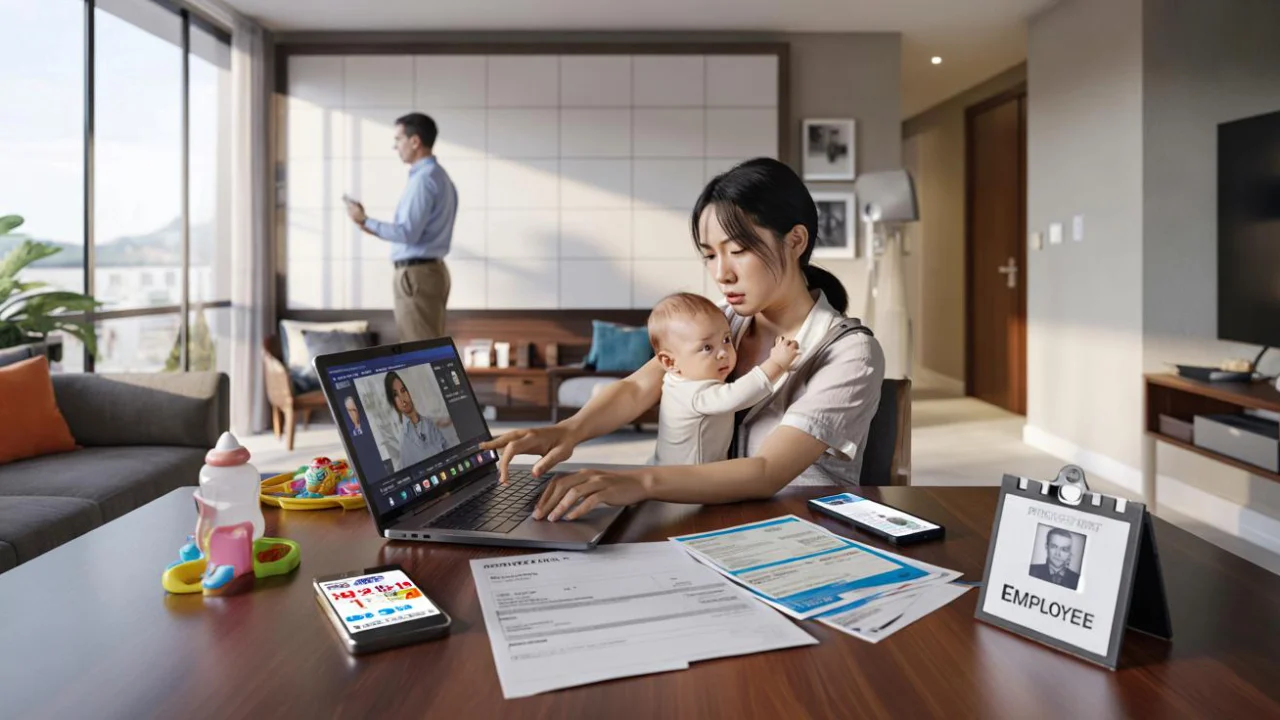
Sarah stares at her laptop screen at 2 AM, her three-month-old finally asleep in the bassinet beside her desk. Her official parental leave ended two weeks ago, but she’s been answering emails since week six. Her bank account shows the brutal math of unpaid leave—rent doesn’t pause for new babies.
She calculates the hours: forty-two hours of childcare this week, plus twenty-eight hours of remote work she couldn’t admit to her boss. Seventy hours total. Zero official pay for thirty-six of them.
What if we’re doing this completely wrong?
The broken math of modern parenting
Traditional parental leave operates on a fantasy. The fantasy says parents disappear from the workforce, someone else handles their responsibilities, and they return months later refreshed and ready. But this isn’t 1950.
Today’s parental leave looks more like an unpaid internship in chaos management. Parents juggle feedings with conference calls, pump milk between client meetings, and answer emails during 3 AM diaper changes. The work never stops—it just becomes invisible.
“We’re pretending that caring for a newborn isn’t labor,” explains Dr. Elena Rodriguez, an economist studying parental leave reform. “But ask any parent and they’ll tell you it’s the hardest job they’ve ever had.”
The numbers tell the real story. OECD research shows unpaid care work equals 15% of global GDP. In some countries, it outweighs entire manufacturing sectors. Yet this massive economic contribution gets counted as zero on every government balance sheet.
What paid parenting could actually look like
Imagine parental leave reform that treats caregiving like the essential work it is. Instead of unpaid time off, new parents would receive salaries comparable to other critical services.
Here’s how the economics could work:
| Current System | Reformed System |
| 12 weeks unpaid or partial pay | 52 weeks at 70% median wage |
| Parents lose $15,000-$40,000 income | Parents earn $35,000-$45,000 |
| Care work valued at $0 | Care work valued at market rate |
| Return to work pressure at 6-12 weeks | Genuine choice about return timing |
Several countries are already testing versions of this approach. Iceland pays parents 80% of their salary for nine months. Sweden provides 480 days at varying pay rates. These aren’t welfare programs—they’re recognition that early childcare is skilled labor.
“When we pay parents properly, we see better child development outcomes and higher workforce participation long-term,” notes workplace policy researcher Dr. Michael Chen. “It’s an investment, not an expense.”
The model could extend beyond biological parents too. Paid family caregiving could cover:
- Caring for elderly parents
- Supporting disabled family members
- Managing extended medical needs
- Adoption and foster care transitions
The economic upside nobody talks about
Parental leave reform could trigger unexpected economic benefits. When parents aren’t hemorrhaging money during their children’s first year, they spend more on local businesses, childcare services, and long-term investments.
Consumer spending from financially secure new parents increases by an average of 23% compared to families under financial stress, according to recent Federal Reserve data. This spending supports everything from pediatric healthcare to baby gear manufacturers.
But there’s a bigger prize: workforce retention. Companies currently lose billions when skilled employees don’t return from unpaid leave. They can’t afford rent, childcare, or the career gap. Proper parental leave compensation changes this calculation entirely.
“We’re finally seeing tech companies realize that investing in parental leave reform saves them money,” explains workplace consultant Lisa Park. “It costs less than constant hiring and retraining.”
The benefits compound over time:
- Higher lifetime earnings for parents
- Increased tax revenue from sustained employment
- Reduced healthcare costs from better early childhood development
- Stronger consumer spending power
Why this terrifies traditional family advocates
Not everyone celebrates the idea of treating parenting like employment. Critics worry that parental leave reform could fundamentally alter family structures and social expectations.
The concern centers on commodification. If society pays parents like employees, does that change the nature of family relationships? Some argue it transforms intimate caregiving into transactional work.
“There’s something sacred about unpaid family care,” argues family values researcher Dr. Patricia Williams. “Once you put a price tag on parenting, you risk losing the deeper emotional bonds that make families strong.”
Traditional family advocates point to potential unintended consequences:
- Government dependency replacing family responsibility
- Parents viewing children as income sources
- Reduced extended family involvement
- Weakened community support networks
The debate touches deeper cultural fault lines about gender roles, work-life balance, and the role of government in family life. Some see parental leave reform as progress toward gender equality. Others view it as government overreach that undermines traditional family structures.
But even skeptics acknowledge the current system isn’t working. When families go into debt to care for newborns, something has to change.
The real question isn’t whether to change, but how
Parental leave reform will happen—the economic pressure is too great to ignore. The question is whether we’ll design it thoughtfully or let crisis force our hand.
Smart reform would phase in gradually, test different models, and measure results carefully. It would balance economic logic with family values, ensuring that paid caregiving strengthens rather than replaces natural family bonds.
The mother in that coffee shop deserves better than juggling unpaid work while her savings disappear. So do the millions of parents making similar impossible choices every day.
Maybe it’s time to admit that caring for the next generation is real work—and start paying for it accordingly.
FAQs
How much would parental leave reform cost taxpayers?
Initial estimates suggest 0.3-0.7% of GDP annually, similar to current unemployment insurance programs. The investment typically pays for itself through increased tax revenue and reduced social services needs.
Would this replace traditional unpaid parental leave?
Most proposals offer choices—parents could take traditional unpaid leave, shorter paid leave, or flexible combinations. The goal is options, not mandates.
Could small businesses afford mandatory paid parental leave?
Reform proposals typically use government funding or shared insurance pools, similar to unemployment benefits. Individual employers wouldn’t bear the full cost.
What about parents who choose to stay home long-term?
Paid parental leave usually covers the first 6-18 months. After that, families make personal choices about work and childcare arrangements.
How do other countries handle paid parental leave?
Nordic countries, Germany, and Canada offer various models—from partial salary replacement to universal basic income for parents. Success rates vary but generally show positive economic outcomes.
Would this change how we view parenting and family relationships?
Possibly. Critics worry about commodifying family care, while supporters argue it simply recognizes the economic value of essential work that already happens.


