
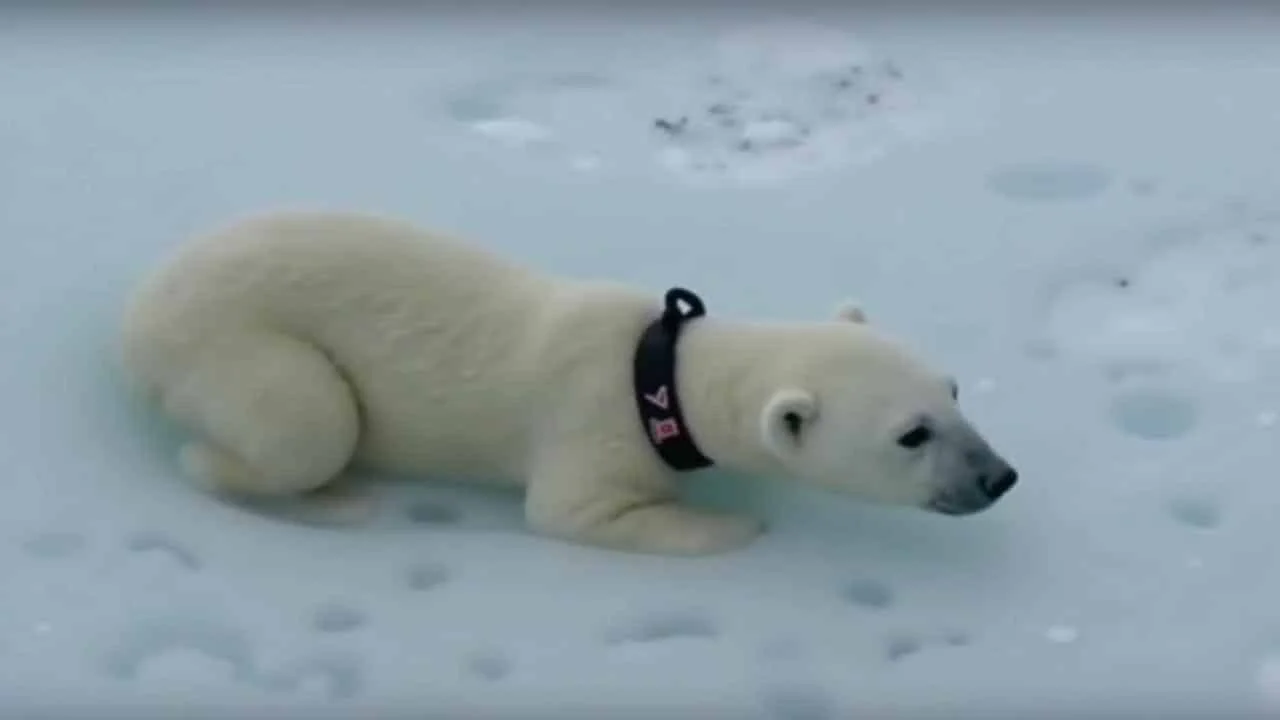
Dr. Sarah Chen had been staring at the same computer screen for three hours, watching a tiny green blip move across what should have been solid white ice. Her coffee had gone cold hours ago, but she couldn’t look away. As a marine biologist who’d spent fifteen years tracking Arctic wildlife, she’d seen bears swim before. But not like this.
“This has to be wrong,” she muttered to her colleague, pointing at the GPS coordinates that showed a young polar bear more than 400 kilometers from the nearest ice shelf. “Bears don’t just swim into the middle of nowhere.”
Except this one did. And what happened next would challenge everything scientists thought they knew about polar bear swimming endurance and the desperate lengths these animals will go to survive in a rapidly changing Arctic.
The Impossible Journey That Broke All Records
The young female polar bear, tagged just weeks earlier on what researchers thought was stable sea ice, embarked on a swimming marathon that defied biological expectations. Her GPS collar painted a straight line across open ocean – over 600 kilometers of frigid Arctic water with no guarantee of reaching solid ice on the other side.
This wasn’t a casual swim to a nearby ice floe. This was polar bear swimming at its most extreme, pushing the boundaries of what these powerful animals can physically endure. Most documented swims by polar bears cover 50-100 kilometers at most, usually between known ice formations.
“We’ve tracked adult females with cubs swimming 200-300 kilometers during ice retreat seasons, but those were emergency situations,” explains Dr. Mark Thompson, an Arctic wildlife specialist. “This young bear swam nearly twice that distance, alone, with no visible destination.”
The data revealed a grueling ten-day odyssey through choppy Arctic waters. The bear maintained an average speed of just 2 kilometers per hour – fast enough to make progress, but slow enough to drain her energy reserves with each passing hour.
What the Numbers Tell Us About This Record-Breaking Swim
The GPS tracking data provides an unprecedented window into the physical demands of long-distance polar bear swimming. Here’s what the researchers discovered:
| Swimming Metric | This Bear’s Journey | Typical Bear Swim |
|---|---|---|
| Total Distance | 687 kilometers | 50-150 kilometers |
| Duration | 9 days, 12 hours | 1-3 days |
| Average Speed | 2.1 km/hour | 2-3 km/hour |
| Rest Periods | 3 brief stops on ice fragments | Multiple rest stops |
| Bear Age | Sub-adult (3-4 years) | Usually adult females |
The most striking aspect wasn’t just the distance, but the bear’s age. Sub-adult polar bears typically have smaller fat reserves than mature adults, making this extended swimming feat even more remarkable.
- The bear swam continuously for the first 62 hours without stopping
- Water temperatures ranged from -1°C to 2°C throughout the journey
- Satellite imagery showed no visible ice formations along her route
- GPS accuracy remained consistent, ruling out equipment malfunction
- The bear lost an estimated 20-30% of her body weight during the swim
“What we’re seeing is adaptation in real-time,” notes Dr. Elena Rodriguez, a polar bear physiologist. “This bear’s body had to function like a long-distance swimmer’s, metabolizing fat stores while maintaining core temperature in near-freezing water.”
Why This Extreme Swim Matters for Arctic Wildlife
This record-breaking polar bear swimming event isn’t just a remarkable individual story – it’s a stark indicator of how climate change is forcing Arctic animals into increasingly desperate survival situations.
As Arctic sea ice continues to retreat earlier each spring and form later each fall, polar bears are facing longer swimming distances between ice formations. What was once a short hop between ice floes is becoming a marathon swim across open ocean.
The implications ripple through entire Arctic ecosystems:
- Young bears are forced into extreme situations before they’ve built adequate fat reserves
- Energy spent on long-distance swimming reduces time available for hunting and feeding
- Increased swimming distances raise mortality rates, especially for cubs and juveniles
- Successful long swims may indicate emerging behavioral adaptations to changing ice conditions
“This bear’s survival represents both hope and alarm,” explains Dr. James Arctic, lead researcher on the tracking project. “She proved these animals can endure incredible hardships, but she shouldn’t have had to.”
The bear eventually reached a stable ice formation where she spent several weeks recovering, gaining back much of her lost weight through successful seal hunting. However, researchers worry that not all bears attempting such journeys will be as fortunate.
What Scientists Learn from Extreme Polar Bear Swimming
This extraordinary swimming event has provided researchers with valuable data about polar bear physiology and behavior under extreme stress. The continuous GPS tracking offered insights that would be impossible to gather through traditional observation methods.
The bear’s swimming pattern revealed sophisticated navigation abilities. Despite swimming through featureless open water for days, she maintained a remarkably straight course toward distant ice formations that weren’t visible when she began her journey.
“She somehow knew where she was going,” observes Dr. Chen. “That suggests polar bears may have magnetic or celestial navigation abilities we’re just beginning to understand.”
The research team is now analyzing similar tracking data from other collared bears to determine if extreme swimming events are becoming more common as ice conditions continue to deteriorate.
Early findings suggest that younger bears are increasingly taking greater swimming risks, possibly because they haven’t yet learned the traditional ice-travel routes that older bears rely on.
FAQs
How far can polar bears normally swim?
Most polar bears swim 50-150 kilometers between ice formations, though adult females have been tracked swimming up to 300 kilometers during ice retreat periods.
Why did this young bear swim so far?
The bear was likely searching for stable sea ice after her original ice platform melted or broke apart, forcing her into open water with no nearby alternatives.
Can all polar bears swim such long distances?
No, long-distance swimming requires substantial fat reserves and favorable conditions. Cubs, elderly bears, and thin individuals are much less likely to survive extended swims.
How do researchers track polar bear swimming?
Scientists use GPS satellite collars that ping location data every few hours, allowing them to map bear movements across vast Arctic distances.
Is extreme polar bear swimming becoming more common?
Preliminary research suggests longer swimming distances are increasing as Arctic sea ice retreats, forcing bears to travel farther between suitable hunting habitats.
Did this bear survive her record-breaking swim?
Yes, the bear successfully reached stable ice and spent several weeks recovering, regaining much of the weight she lost during her marathon swim.


