
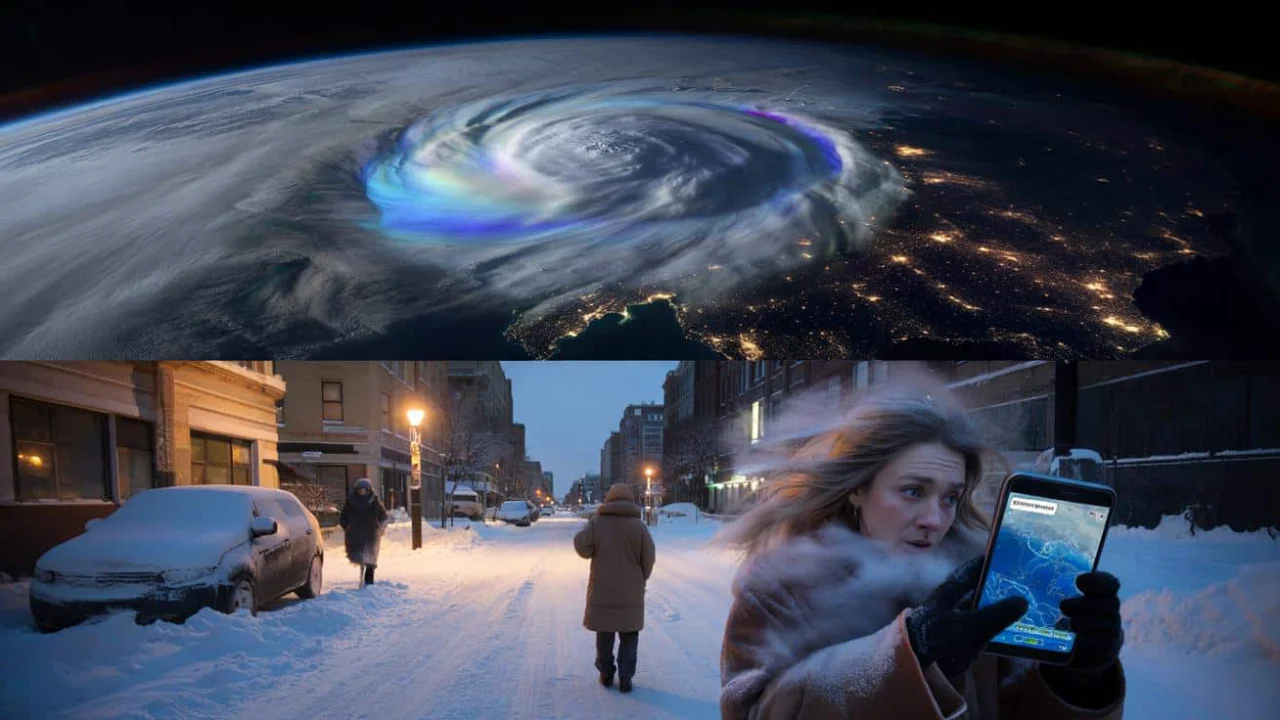
Sarah checked her phone one more time as she loaded groceries into her car last Tuesday. The weather app showed the usual mid-winter forecast – cold, but nothing alarming. What she didn’t see was the email landing in meteorologists’ inboxes across the country at that exact moment. Charts filled with swirling purple and blue, temperature readings that made seasoned forecasters double-check their data.
By the time Sarah got home and started putting away milk and bread, scientists were already discussing what could become one of the most significant polar vortex disruptions in decades. The kind that doesn’t just change your morning commute – it rewrites weather history.
That quiet Tuesday afternoon may have been the last normal day before winter shows its true teeth.
The Arctic’s Frozen Engine Is Breaking Down
Picture a massive spinning wheel of frigid air, sitting about 20 miles above the North Pole. Most winters, this polar vortex stays locked in place like a well-oiled machine, keeping the Arctic’s most brutal temperatures where they belong – in the Arctic.
But something extraordinary is happening up there right now. The stratosphere above the North Pole has suddenly warmed by more than 90 degrees Fahrenheit in just days. When temperatures spike that dramatically, the polar vortex doesn’t just wobble – it can completely collapse.
“We’re watching the atmospheric equivalent of a dam breaking,” explains Dr. Jennifer Hayes, a climatologist who has spent fifteen years studying these events. “When the polar vortex disruption reaches this magnitude, Arctic air doesn’t just leak out – it floods out.”
This isn’t theoretical anymore. The disruption is already underway, and multiple weather models are showing the same troubling pattern. Within weeks, chunks of Arctic air could be sitting over places that haven’t seen temperatures this low since the 1980s.
What Makes This Disruption Different
Not all polar vortex events are created equal. Some cause a few extra cold days. Others become the winter people talk about for the rest of their lives. Here’s what makes this one particularly concerning:
- Unprecedented warming speed: Stratospheric temperatures jumped faster than any event since detailed records began
- Multiple model agreement: European, American, and Canadian forecast systems all show similar outcomes
- Timing factors: The disruption is happening at the optimal time to affect surface weather for weeks
- Pattern recognition: The setup closely resembles the most severe historical events
- Duration indicators: Early signs suggest this could be a prolonged event rather than a brief cold snap
| Previous Major Disruptions | Year | Temperature Records | Duration |
|---|---|---|---|
| Texas Deep Freeze | 2021 | -19°F in Dallas | 8 days |
| Chicago Arctic Blast | 1985 | -29°F wind chill | 12 days |
| Beast from the East | 2018 | -17°F in London | 10 days |
| Current Event (projected) | 2024 | TBD | 14+ days |
“The scary part is how cleanly everything is lining up,” notes Dr. Marcus Chen, who monitors Arctic weather patterns. “When we see this kind of agreement between different models, it usually means Mother Nature is about to deliver something memorable.”
Where the Cold Will Hit Hardest
Geography matters when the polar vortex splits apart. The Arctic air doesn’t spread evenly – it follows specific paths based on where the disruption occurs and how atmospheric rivers channel the cold.
Current projections show the greatest impacts hitting:
- Great Lakes Region: Chicago, Detroit, and Milwaukee could see temperatures 30-40 degrees below normal
- Northeast Corridor: Boston through Philadelphia may experience their coldest stretch since 2014
- Central Plains: Kansas City to Minneapolis could face dangerous wind chills below -40°F
- Northern Europe: Scandinavia and northern UK already showing early signs of the pattern shift
The timing couldn’t be worse for energy infrastructure. Peak heating demand season combined with extreme cold creates the perfect storm for rolling blackouts and system failures.
“We’re not just talking about putting on an extra sweater,” warns Maria Rodriguez, who manages winter preparedness for a major Midwest utility company. “We’re talking about temperatures that can overwhelm heating systems and stress power grids in ways they weren’t designed to handle.”
Beyond the Headlines: What This Really Means
While meteorologists track pressure systems and temperature gradients, the real story unfolds in everyday moments. School districts making closure decisions. Emergency rooms preparing for hypothermia cases. Farmers worried about livestock and pipes bursting in homes built for milder climates.
The 2021 Texas freeze offers a preview. That polar vortex disruption left millions without power for days, caused over 200 deaths, and created economic damage exceeding $195 billion. Insurance claims alone topped $10 billion, making it one of the costliest weather events in U.S. history.
This event could potentially affect a much larger area for a longer duration.
Transportation systems face particular vulnerability. Airlines already began adjusting schedules for major hubs in Chicago and Minneapolis. Freight railroads are positioning extra crews and equipment to handle potential delays. Even mail delivery could face significant disruptions in affected regions.
Energy markets are already responding. Natural gas futures jumped 15% in the week following initial forecasts. Heating oil demand is expected to surge beyond typical seasonal patterns. Some utilities have activated emergency protocols typically reserved for the most severe weather events.
“The beautiful thing about science is we can see this coming now,” explains Dr. Hayes. “The challenging thing is that seeing it coming doesn’t make it any less intense when it arrives.”
FAQs
What exactly is a polar vortex disruption?
It happens when the ring of cold air spinning above the North Pole suddenly weakens or splits apart, allowing Arctic air to spill into lower latitudes.
How long will this extreme cold last?
Based on similar historical events, the most intense cold could persist for 10-14 days, with lingering effects lasting several more weeks.
Can this event be prevented or stopped?
No, polar vortex disruptions are natural atmospheric phenomena that occur regardless of human activity, though climate change may be affecting their frequency.
Should I prepare differently than for a normal cold snap?
Yes, this level of cold requires extra preparation including backup heating sources, emergency supplies, and protecting pipes and outdoor equipment.
Will this affect areas that don’t usually get severe cold?
Potentially yes – polar vortex disruptions can push Arctic air much farther south than typical winter weather patterns.
How confident are forecasters about this prediction?
Very confident about the disruption occurring, moderately confident about timing and location, with the exact impacts becoming clearer as the event unfolds.


