
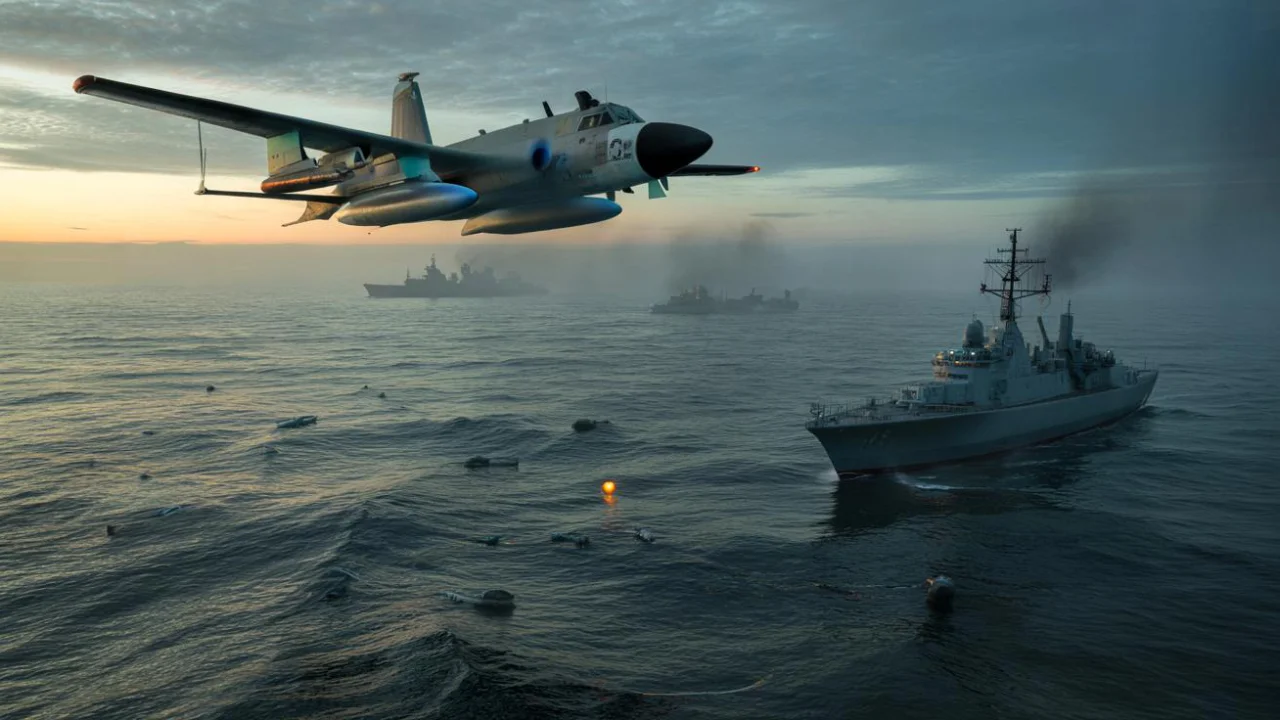
Captain Kim Jae-sun had been flying maritime patrols for twelve years, but nothing prepared him for the moment his sonar operator’s voice cracked over the intercom. “Sir, we have multiple contacts moving in formation, depth approximately 200 meters, heading directly toward our shipping lanes.” Below his P-3 Orion, somewhere in the dark waters between South Korea and China, submarines were playing a deadly game of hide and seek.
Kim’s finger hovered over the radio button that would alert naval command. One call, and within minutes, destroyers would race toward the coordinates. Anti-submarine helicopters would scramble from nearby bases. The entire region’s military apparatus would spring into motion over what might be a training exercise, a reconnaissance mission, or something far more serious.
This is the reality South Korea’s submarine hunters face every day—split-second decisions that could either prevent a disaster or accidentally trigger one.
Why South Korea’s Submarine Hunters Are Causing International Headaches
South Korea’s deployment of advanced submarine hunters represents a dramatic shift in how nations patrol contested waters. These aren’t your grandfather’s reconnaissance planes—they’re sophisticated flying command centers packed with sensors that can detect underwater movement from miles away.
The aircraft can stay airborne for up to 10 hours, dropping sonobuoys like breadcrumbs to create an underwater surveillance network. Once they locate a submarine, they can track it continuously while coordinating with surface ships and other aircraft. Most controversially, they carry live torpedoes and can engage targets without waiting for additional authorization.
“These planes essentially turn the ocean into a fishbowl,” says Dr. Sarah Chen, a maritime security analyst at Seoul National University. “Nothing moves underwater in these areas without South Korea knowing about it within minutes.”
But that transparency comes at a cost. China views the patrols as provocative surveillance of its naval operations. North Korea calls them preparation for an invasion. Even allies like Japan worry about accidentally triggering a confrontation in already tense waters.
The Technology Behind the Controversy
Understanding why submarine hunters spark such intense reactions requires looking at their capabilities. These aren’t passive observers—they’re active hunters designed to find, fix, and potentially destroy underwater threats.
| Capability | Range/Specification | Strategic Impact |
|---|---|---|
| Detection Range | Up to 200 nautical miles | Can monitor entire disputed zones |
| Flight Endurance | 10+ hours without refueling | Continuous surveillance coverage |
| Weapon Load | Up to 8 anti-submarine torpedoes | Immediate response capability |
| Sonobuoy Capacity | 84 acoustic sensors | Creates underwater detection grid |
The most game-changing feature is real-time data sharing. When a submarine hunter detects an underwater contact, that information instantly appears on screens at naval headquarters, aboard nearby ships, and at allied command centers. The traditional “fog of war” that submarines rely on for protection simply evaporates.
Key operational advantages include:
- Simultaneous tracking of multiple submarine targets
- Coordination with surface vessels in real-time
- Ability to deploy countermeasures before threats reach critical areas
- Integration with satellite surveillance and underwater sensors
- Rapid response to emerging situations
“The old cat-and-mouse game between submarines and surface ships is over,” explains Commander Park Min-ho, a retired South Korean naval officer. “Now it’s more like playing chess with all the pieces visible.”
When Defense Becomes Offense in Crowded Waters
The real controversy isn’t about South Korea’s right to defend its waters—it’s about how far that defense extends and what happens when multiple nations claim the same sea space.
Consider a typical patrol day: A South Korean submarine hunter takes off from Pohang Air Base and heads toward the Yellow Sea. Its mission is to monitor approaches to major shipping lanes and watch for unusual submarine activity. Sounds reasonable, right?
But those same waters are claimed by China as part of its exclusive economic zone. North Korea considers them part of its defensive perimeter. When the submarine hunter drops sonobuoys or starts tracking a contact, whose rules apply?
Recent incidents highlight the problem:
- Chinese submarines conducting “routine training exercises” suddenly find themselves tracked by South Korean aircraft
- North Korean coastal defenses activate when submarine hunters approach disputed boundary lines
- Japanese fishing vessels report being questioned after submarine hunters detected “unusual acoustic signatures” in their vicinity
- Russian naval vessels have complained of harassment by South Korean patrol aircraft
“Every nation has the right to secure its maritime borders, but when those borders overlap or remain disputed, defensive actions by one country become threatening moves to another,” says Professor Liu Wei from Beijing’s Institute of International Studies.
The human cost of these tensions shows up in unexpected ways. Fishing crews now avoid certain areas during patrol times, costing them thousands in lost catches. Commercial shipping companies reroute vessels to avoid potential conflict zones, adding days to delivery schedules. Even scientific research vessels have been questioned and detained when their activities are mistaken for military operations.
The Ripple Effects Nobody Saw Coming
South Korea’s submarine hunters have created consequences that extend far beyond military circles. Insurance rates for ships transiting contested waters have increased by 15% in the past year alone. International shipping companies now factor “patrol schedules” into their route planning, treating submarine hunter deployments like weather systems to navigate around.
Local communities feel the impact too. On Yeonpyeong Island, just six miles from North Korean waters, residents have grown accustomed to the sound of patrol aircraft overhead. But they also live with the knowledge that their island sits directly in the path these submarine hunters use to reach contested areas.
“We used to worry about North Korean artillery,” says local resident Kim Soo-jin. “Now we worry that one of these submarine hunting missions might accidentally start something bigger.”
Regional allies face their own dilemmas. Japan supports South Korea’s right to maritime defense but worries about being dragged into conflicts that start with submarine detection missions. The United States backs its ally’s security efforts while trying to prevent escalation with China and Russia.
Even environmental groups have raised concerns. The constant deployment of sonobuoys and active sonar systems disrupts marine life migration patterns. Whale watching tours report fewer sightings in areas with heavy submarine hunter activity.
FAQs
What exactly are submarine hunters?
They’re long-range military aircraft equipped with advanced sensors and weapons specifically designed to detect, track, and potentially destroy submarines underwater.
Why is South Korea deploying these aircraft now?
South Korea cites increasing submarine activity from North Korea, China, and Russia near its territorial waters as justification for enhanced maritime surveillance capabilities.
Are submarine hunters legal under international law?
Yes, nations have the right to patrol their territorial waters and exclusive economic zones, though disputes arise when these zones overlap or remain contested.
How do submarine hunters detect underwater vessels?
They use a combination of sonobuoys (floating acoustic sensors), magnetic anomaly detectors, and advanced radar systems to locate submarines beneath the surface.
Could submarine hunters accidentally start a war?
While designed for defense, the risk of miscalculation or accidental engagement exists, especially in disputed waters where multiple nations’ submarines operate.
How are other countries responding to South Korea’s submarine hunters?
China and North Korea have criticized the deployments as provocative, while Russia has complained of harassment. Allies like Japan support South Korea’s security needs but urge caution to prevent escalation.


