
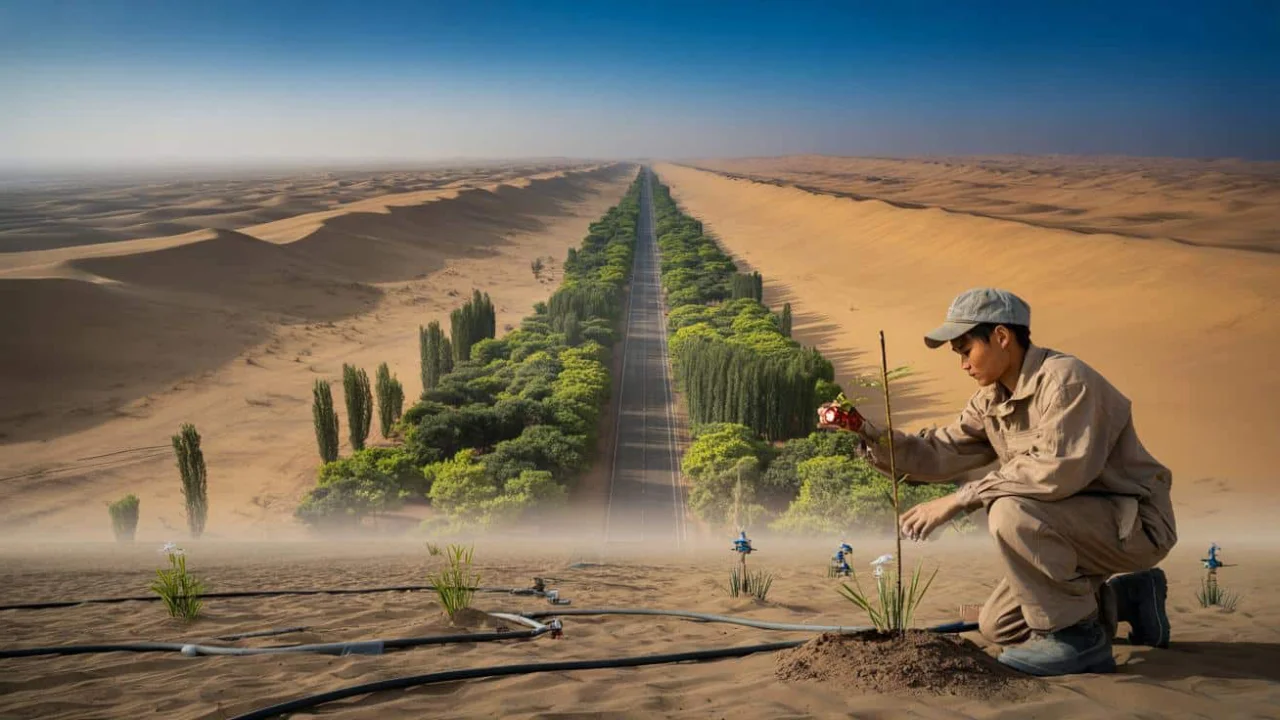
Mei Zhang still remembers the day her grandmother’s house disappeared under a wall of sand. She was seven, watching from the window as yellow dunes crept closer to their village on the edge of the Taklamakan Desert. “My grandmother cried that morning,” Mei recalls, now 34 and working as an environmental engineer. “She said the desert was hungry and would eat everything.”
Today, Mei drives past that same spot on her way to work. Where sand once swallowed homes, rows of poplar trees now sway in the wind. Her grandmother’s old house is gone, but not because of the desert. It’s because the entire area transformed into something nobody thought possible—a green corridor cutting through what was once called the “Sea of Death.”
The Taklamakan Desert, covering 337,000 square kilometers in western China, has become the unlikely star of the world’s most ambitious reforestation project. After decades of planting billions of trees, something extraordinary happened: the desert stopped expanding and started absorbing carbon dioxide instead of just releasing it.
From “No Return” to Carbon Capture Champion
The Taklamakan’s nickname wasn’t just dramatic flair. For centuries, travelers who entered this desert often never came back. Dust storms could bury caravans, and shifting sands made navigation nearly impossible.
“We used to lose 3,000 square kilometers of farmland every year to desert expansion,” explains Dr. Wang Tao, a desertification expert at the Chinese Academy of Sciences. “Communities were abandoning their homes. Something had to change.”
The Taklamakan desert reforestation project began in the 1990s with a radical approach: instead of just blocking sand with barriers, China decided to plant a living wall around the desert’s edges. The strategy involved three key elements:
- Creating protective forest belts along major roads and settlements
- Using drought-resistant native species like tamarisk and saxaoul
- Installing precision irrigation systems to conserve water
- Training local communities to maintain the new forests
The results exceeded everyone’s expectations. Satellite data now shows that areas of Taklamakan desert reforestation have stabilized sand movement by up to 85%. More surprisingly, these new forests are capturing about 1.3 million tons of CO2 annually.
The Science Behind Desert Trees That Drink CO2
Most people think deserts only produce carbon dioxide. But when you plant the right trees in the right way, something magical happens. The new vegetation doesn’t just survive—it thrives and starts actively pulling carbon from the atmosphere.
| Tree Species | CO2 Absorption Rate | Survival Rate |
| Desert Poplar | 22 kg/year per tree | 87% |
| Tamarisk | 15 kg/year per tree | 92% |
| Sea Buckthorn | 18 kg/year per tree | 78% |
| Saxaoul Shrub | 8 kg/year per shrub | 94% |
The key breakthrough came from understanding desert soil chemistry. “People assumed desert soil was dead, but it’s actually full of nutrients,” notes Professor Li Ming from Beijing Forestry University. “The organic matter from tree roots and fallen leaves creates a carbon-rich layer that stores CO2 for decades.”
China’s approach combined traditional knowledge with modern technology. Farmers knew which plants survived desert conditions, while scientists used satellite monitoring to track exactly where trees would have the biggest impact.
The irrigation system is particularly clever. Instead of flooding the area, engineers installed drip lines that deliver tiny amounts of water directly to root zones. This uses 70% less water than traditional methods while keeping trees healthy enough to grow rapidly.
Real People, Real Changes in Desert Communities
The environmental impact is impressive, but the human stories make it real. Chen Wei, a farmer near Korla, watched his apple orchards slowly disappear under sand for fifteen years. “Every spring, I’d find another row of trees buried,” he says. “I was ready to give up.”
Then the reforestation teams arrived. They planted protective forest belts upwind from Chen’s farm. Within five years, the sandstorms that used to destroy his crops became rare events. His apple harvest doubled, and he started growing vegetables he never thought possible in the desert climate.
The economic effects ripple outward. Tourism has exploded along the Tarim Desert Highway, where travelers stop to photograph the green corridors cutting through golden dunes. Local communities now earn money as forest guardians, maintaining the trees and monitoring irrigation systems.
More importantly, young people are staying in desert communities instead of migrating to cities. “My daughter is studying environmental science because she wants to expand what we’ve done here,” Chen explains. “She sees a future in the desert now.”
What This Means for Fighting Climate Change
The Taklamakan desert reforestation success has caught international attention. If similar projects worked in other deserts, they could absorb millions of tons of CO2 while creating jobs and protecting communities from sandstorms.
The project proves that deserts aren’t wastelands—they’re opportunities. With the right approach, even the harshest landscapes can become part of the solution to climate change.
“What we’ve learned here could be applied to deserts in Africa, Australia, or the American Southwest,” says Dr. Wang. “The techniques aren’t complicated, but they require patience and community involvement.”
Countries are already visiting to study China’s methods. Morocco has adapted the irrigation techniques for their Sahara border regions. Australia is testing similar tree species in the Outback.
The transformation of the Taklamakan proves that humans can reverse environmental damage on a massive scale. It just takes the right combination of science, persistence, and local knowledge—plus a willingness to think differently about what’s possible.
FAQs
How many trees has China planted in the Taklamakan Desert?
China has planted over 66 billion trees nationwide since 1978, with millions specifically in Taklamakan desert reforestation projects along roads and settlement borders.
How much CO2 does the Taklamakan Desert forest absorb?
Current estimates suggest the reforested areas absorb approximately 1.3 million tons of CO2 annually, with capacity increasing as trees mature.
What types of trees survive in the Taklamakan Desert?
Desert poplars, tamarisk, sea buckthorn, and saxaoul shrubs perform best due to their salt tolerance and deep root systems.
How do they water trees in the desert?
Engineers use precision drip irrigation systems that deliver small amounts of water directly to root zones, using 70% less water than traditional methods.
Can this reforestation method work in other deserts?
Yes, countries like Morocco and Australia are adapting these techniques for their desert regions, focusing on native drought-resistant species and efficient irrigation.
How long does it take for desert trees to start absorbing significant CO2?
Most desert trees begin meaningful carbon absorption within 3-5 years of planting, reaching peak absorption rates after 10-15 years of growth.


