
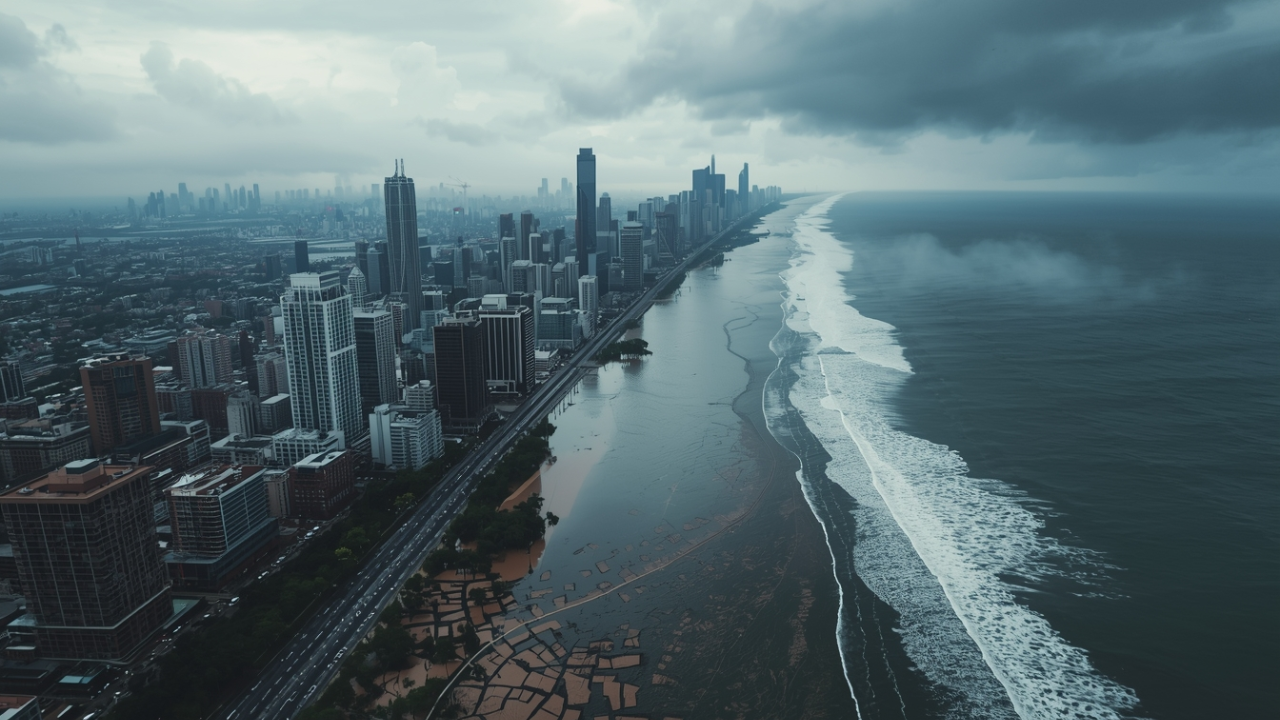
Whole megacities are quietly slipping downward, millimetre by millimetre, while seas are rising in the opposite direction.
The process feels invisible in daily life. Streets look the same. Buildings still stand. But beneath the surface, land is compacting, aquifers are emptying and foundations are slowly descending. Over decades, that tiny annual drop accumulates into something far more dramatic — neighbourhoods falling below sea level, drainage systems failing and coastlines being redrawn within a single human lifetime.
New scientific research on subsidence — the gradual sinking of land — suggests that for some of the world’s largest cities, retreat may ultimately prove more realistic than resistance.
What Scientists Are Seeing Beneath Our Feet
A recent study published in Nature Sustainability examined 48 major coastal cities that show measurable signs of subsidence. Together, these cities represent roughly one-fifth of the global urban population — meaning hundreds of millions of people are living on land that is slowly dropping.
Subsidence itself is not new. Land naturally rises and falls due to tectonic shifts, sediment compaction and geological adjustments. What has changed is the speed — and the cause.
Modern cities intensify natural processes through:
- Excessive groundwater pumping
- Oil and gas extraction
- Heavy construction and high-rise development
- Rapid urban expansion on soft coastal soils
In several megacities, land is sinking faster than local sea levels are rising. That combination transforms climate change from a distant risk into an immediate urban emergency.
Using satellite radar technology that tracks ground movement over decades, researchers found annual sinking rates of several millimetres per year. At first glance, the numbers sound small. But over 30 or 40 years, those millimetres become tens of centimetres — enough to overwhelm flood defences and reshape risk maps entirely.
Six Cities on the Front Line
Among the 48 cities studied, several stand out for both the speed of subsidence and the number of people exposed.
- Jakarta – sinking by up to 26 mm per year
- Ahmedabad – up to 23 mm per year
- Istanbul – up to 19 mm per year
- Houston – up to 17 mm per year
- Lagos – up to 17 mm per year
- Manila – up to 17 mm per year
To visualize this, imagine placing a coin under your house each year. Over time, entire districts end up lower than surrounding waters during high tides or storms.
And unlike dramatic disasters, this process is gradual — which makes it politically easier to ignore, but far harder to reverse.
Jakarta: The Capital That Chose to Move
Jakarta has become the global symbol of subsidence.
Built on soft coastal sediments and criss-crossed by rivers, the city has relied heavily on groundwater extraction for decades. As aquifers emptied, the ground compacted. Some districts have dropped several metres.
Floods that were once occasional are now frequent. Sea walls have been raised repeatedly, only to be overtaken by the combined force of sinking land and rising water.
Indonesia has responded with a radical solution: building a new capital roughly 1,000 kilometres away on the island of Borneo. Officially framed as a strategy to reduce congestion and promote balanced development, the deeper driver is elevation. Parts of Jakarta are simply becoming too low — and too costly — to defend forever.
Ahmedabad and Istanbul: Growth on Fragile Foundations
Ahmedabad, one of India’s fastest-growing cities, sits on alluvial soils that compress when groundwater is pumped out. Rapid urbanisation and rising industrial demand have intensified extraction.
The sinking is uneven. Some neighbourhoods drop faster than others. Roads crack. Pipelines warp. Drainage systems lose their slope, causing water to stagnate where it once flowed away.
In Istanbul, the pressures differ but the trend is similar. Massive infrastructure projects, transportation corridors and relentless expansion place added stress on complex geology. While sinking rates are lower than Jakarta’s, acceleration in some development zones raises concern.
In both cities, urban ambition is colliding with geological limits.
Houston, Lagos and Manila: Resource Pressure Meets Coastal Risk
In Houston, decades of oil and gas extraction — combined with groundwater pumping — have contributed to measurable subsidence. Industrial growth and suburban expansion amplified the effect.
Lagos faces another variation of the problem. Rapid population growth has pushed development onto wetlands and coastal flats. Sand mining for construction destabilises the ground, while natural buffers disappear. Millions now live in areas highly exposed to future flooding.
Meanwhile, Manila contends with soft delta sediments, heavy groundwater use and frequent typhoons. Even a few additional centimetres of relative sea-level rise have real consequences for communities built on marginal land.
Across continents, the pattern is consistent: subsidence magnifies climate risks at the local level.
Europe Is Not Immune — Just Slower
European cities generally experience lower sinking rates, thanks to stricter groundwater regulations and different urban histories. But lower does not mean safe.
Cities such as Venice and Rotterdam already rely on sophisticated flood barriers and pump systems. Parts of France’s Atlantic coast are also confronting more frequent tidal flooding.
Engineering solutions can buy time. They cannot stop land from sinking.
Why “Inevitable” Is Entering the Conversation
Scientists use the word cautiously, but the arithmetic is difficult to ignore.
If land sinks at 15 mm per year while sea level rises at 4 mm per year, residents experience nearly 20 mm of relative water rise annually. Over 50 years, that approaches one metre.
At that scale:
- Sea walls must be repeatedly elevated
- Insurance costs soar
- Low-income communities face displacement first
- Infrastructure retrofits become financially overwhelming
The issue is not a single catastrophic flood. It is the cumulative narrowing of safe, affordable, dry land.
At some point, retreat becomes cheaper than defence.
Can the Sinking Be Slowed?
Subsidence is not entirely irreversible. Some cities have successfully reduced sinking by regulating groundwater extraction.
Key strategies include:
- Limiting groundwater pumping
- Switching to surface water supplies
- Protecting wetlands and natural sediment buffers
- Designing lighter infrastructure
- Redirecting development to higher ground
- Planning phased relocation for high-risk zones
These measures require long-term planning and upfront investment — both politically difficult in fast-growing cities. Yet delay locks in greater exposure.
The Human Questions Behind the Data
Urban risk models project tens of millions of residents living in regularly flooded zones by 2070 under business-as-usual scenarios.
For families, the questions are personal:
- Will property values collapse?
- Will insurance remain available?
- Will children grow up behind higher and higher walls?
- Or will relocation become unavoidable?
Subsidence transforms climate change from an abstract global statistic into a visible shift in daily life.
A Slow Disappearance, Not a Sudden One
Sinking cities will not vanish overnight.
Instead, they may experience:
- Increasing tidal flooding
- Infrastructure failure
- Saltwater intrusion into drinking supplies
- Gradual population decline from the lowest districts
The threat is incremental but relentless.
The real danger lies in complacency. Millimetres feel trivial — until they accumulate into metres.
For some megacities, the decision may eventually be less about fighting water and more about choosing when and how to move.
Not because the cities collapse in a single dramatic event — but because the mathematics of gravity, geology and sea-level rise quietly narrow the options until staying no longer makes sense.


