
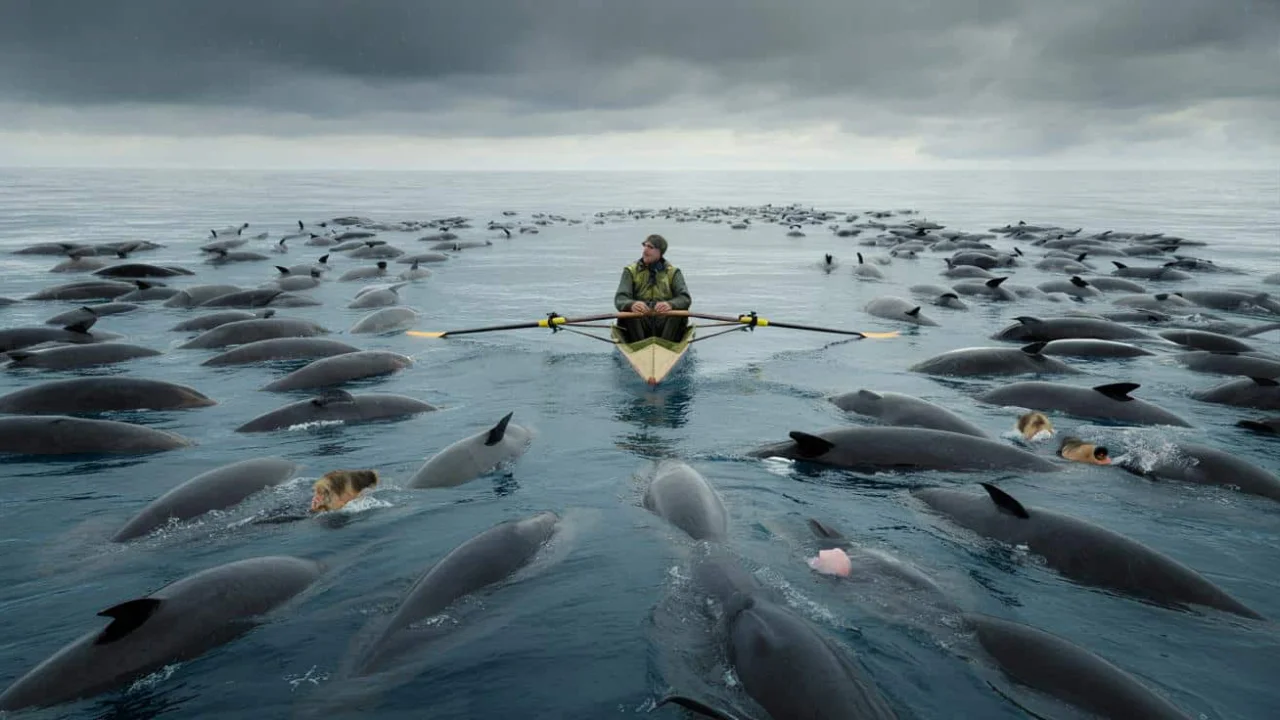
Picture this: you’re sitting at your office desk, dealing with Monday morning emails, when your phone buzzes with a video from a friend. The footage shows dark shapes moving through crystal-clear water, dozens of them, surrounding a tiny boat in the middle of nowhere. Your first thought? “This can’t be real.”
But for Tom Waddington, a British ski instructor turned ocean rower, this wasn’t a viral video or a nature documentary. This was his reality, happening 2,000 nautical miles from the nearest shore, when nearly a thousand pilot whales decided to investigate his solitary journey across the North Atlantic.
What started as another grueling day of rowing suddenly transformed into one of the most extraordinary whale encounters ever recorded by a solo adventurer.
When the Ocean Goes Silent, Magic Happens
Waddington was several weeks into his epic voyage from Newfoundland, Canada, to Penzance on England’s southwest coast. The morning had been miserable—rain, choppy seas, and the kind of weather that makes you question every life choice that led you to a seven-meter boat in the middle of nowhere.
Then everything changed. The wind dropped to almost nothing. The waves settled into an eerie calm. And the water around his modest rowing boat began to ripple from below.
“At first, I thought it might be dolphins,” Waddington later recalled. “You see them fairly often on long ocean crossings. But within minutes, I knew this was something completely different.”
Dark, rounded heads began breaking the surface. Then more. Then dozens more. What he initially mistook for a small pod quickly revealed itself as something extraordinary—close to 1,000 pilot whales moving as a single, breathing mass around his tiny vessel.
The animals weren’t just passing by. They seemed genuinely curious about this strange intruder in their territory. Some glided alongside his boat, others surfaced just meters away, and several even rolled onto their sides, bringing their large, intelligent eyes close to his hull as if conducting their own inspection.
The Science Behind This Incredible Whale Encounter
Back on land, Waddington’s support team analyzed the satellite footage he managed to transmit. Marine biologists identified his visitors as long-finned pilot whales (Globicephala melas), and the encounter revealed fascinating insights about these remarkable creatures.
Here’s what makes this whale encounter so special:
- Social superpods: Pilot whales are among the most social marine mammals, often traveling in groups of 20-100 individuals
- Family bonds: Multiple family units can merge into massive congregations of several hundred or even thousand whales
- Curious nature: These intelligent animals frequently investigate unfamiliar objects in their environment
- Deep-sea dwellers: They typically inhabit deep ocean waters, making coastal sightings relatively rare
“Pilot whales are incredibly intelligent and social animals,” explains Dr. Sarah Mitchell, a marine mammal researcher at the Pacific Marine Institute. “When they encounter something unusual like a solo rower, their natural curiosity kicks in. They’re not aggressive—they’re investigating.”
| Pilot Whale Facts | Details |
|---|---|
| Scientific Name | Globicephala melas |
| Length | Up to 7 meters (23 feet) |
| Weight | 1.5-3.5 tonnes |
| Family | Delphinidae (dolphin family) |
| Typical Group Size | 20-100 individuals |
| Lifespan | 35-60 years |
Despite belonging to the dolphin family, pilot whales’ stocky bodies and rounded heads often lead people to mistake them for small whales. Their distinctive bulbous foreheads house sophisticated echolocation systems that help them navigate and hunt in deep ocean waters.
What This Means for Ocean Conservation
This incredible whale encounter offers more than just spectacular footage—it provides valuable insights into pilot whale behavior and highlights the importance of protecting our oceans’ most intelligent inhabitants.
Pilot whales face numerous threats in today’s oceans. Climate change affects their food sources, while shipping traffic disrupts their communication and navigation. Perhaps most tragically, their strong family bonds sometimes lead to mass strandings when one whale gets into trouble and the others refuse to leave.
“Events like Tom’s encounter remind us that we share the oceans with incredibly intelligent, social beings,” notes marine conservationist Dr. James Rodriguez. “These whales showed curiosity rather than fear, which suggests healthy whale populations in that area.”
The encounter also demonstrates how solo ocean adventurers can become valuable citizen scientists. Waddington’s footage provides researchers with rare glimpses of natural pilot whale behavior in their deep-sea habitat—data that would be nearly impossible to collect otherwise.
For the thousands of people following Waddington’s journey online, the whale encounter became a powerful reminder of the ocean’s wonder and fragility. Social media exploded with shares and comments as viewers experienced the magic secondhand.
The Ripple Effects of Going Viral
Waddington’s whale encounter quickly captured global attention, but the impact extends far beyond viral video fame. Educational organizations are using his footage to teach about marine life, while conservation groups leverage the public’s fascination to raise awareness about ocean protection.
“When people see something this extraordinary, it creates an emotional connection to marine conservation,” explains wildlife filmmaker and ocean advocate Lisa Chen. “Tom’s experience shows that the ocean is still full of wonder—if we protect it.”
The encounter also highlights the unique perspective that solo ocean adventurers bring to marine research. Unlike large research vessels, a single person in a small boat presents minimal threat to marine life, often resulting in more natural behavioral observations.
For Waddington himself, the experience transformed a grueling physical challenge into something transcendent. After hours of repetitive rowing through challenging conditions, suddenly finding himself surrounded by nearly a thousand intelligent, curious creatures reminded him why he chose to cross the ocean in the first place.
As he continues his journey toward England’s coast, Waddington carries with him not just the memory of an extraordinary whale encounter, but also the responsibility of sharing what the ocean taught him during those magical hours when he wasn’t alone after all.
FAQs
Are pilot whales dangerous to small boats?
No, pilot whales are generally harmless to boats and humans. They’re curious and intelligent animals that may investigate unusual objects but pose no threat to small vessels.
Why do pilot whales travel in such large groups?
Pilot whales are highly social animals with strong family bonds. Large groups form when multiple family units merge together, providing protection and social interaction.
How rare is an encounter like Tom Waddington’s?
Extremely rare. While pilot whale sightings occur regularly in certain areas, encountering nearly 1,000 individuals in open ocean is exceptionally uncommon.
Can pilot whales actually pilot ships?
No, despite their name, pilot whales don’t guide ships. They’re called “pilot whales” because they often follow a lead whale, appearing to “pilot” their group.
What should you do if surrounded by whales while at sea?
Remain calm, avoid sudden movements, and don’t attempt to touch the animals. Most whales are simply curious and will move on naturally.
Do pilot whales typically live in the North Atlantic?
Yes, long-finned pilot whales are common in the North Atlantic’s cooler waters, though they prefer deeper offshore areas rather than coastal regions.


