
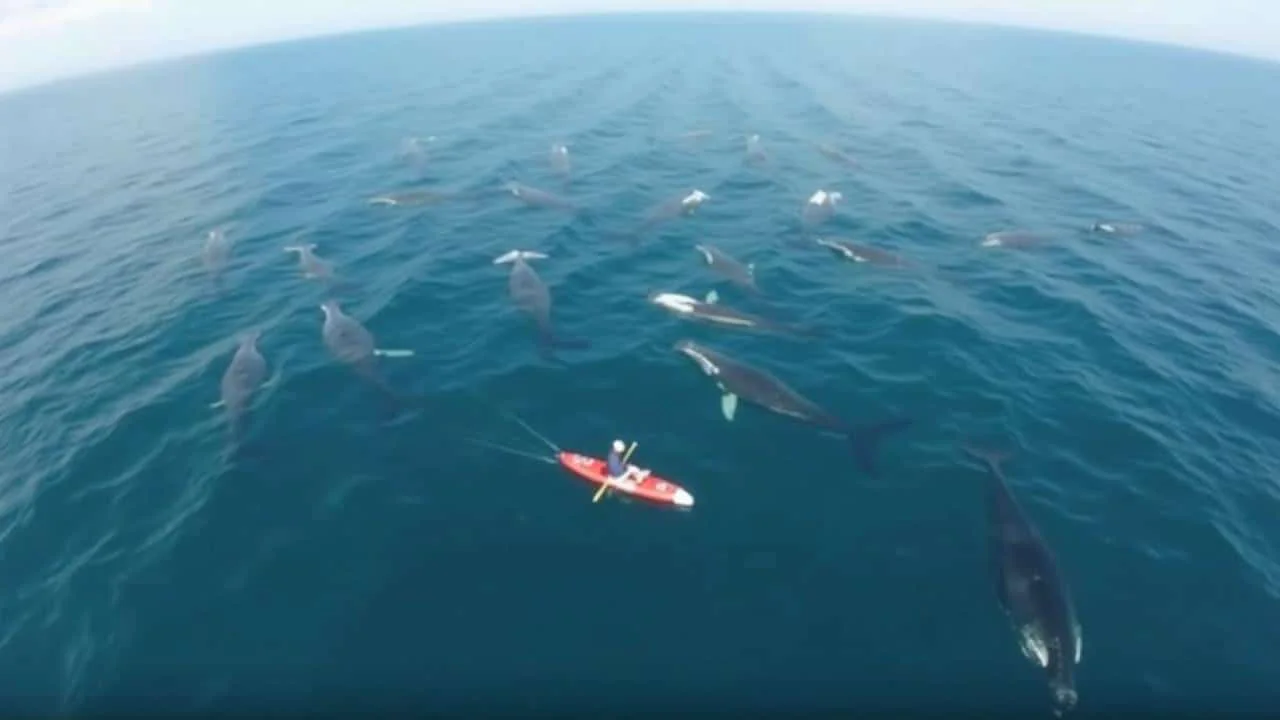
Sarah had been rowing competitively for twelve years when she first saw the viral video. Sitting in her kitchen with her morning coffee, she watched the footage three times before setting down her phone with shaking hands. “That could have been me,” she whispered to her husband. As someone who trained in open water regularly, she knew exactly how vulnerable that tiny boat looked surrounded by dozens of massive whales.
The image haunted her for days. Not because it was terrifying, but because it was beautiful and terrifying at the same time. Every rower dreams of those perfect moments on the water when you feel truly connected to nature. But this? This was something else entirely.
That’s the power of the whale rower encounter that’s currently breaking the internet. It forces you to confront the thin line between adventure and disaster, between being blessed by nature and being completely at its mercy.
When the Ocean Becomes a Highway of Giants
The footage shows what marine biologists estimate to be between 50 and 100 whales moving through the water like a slow-motion stampede. The solitary rower, completely dwarfed by the massive creatures, continues stroking through their midst with what appears to be remarkable calm.
“I’ve studied whale behavior for twenty years, and I’ve never seen anything quite like this,” explains Dr. Marine Rodriguez, a cetacean researcher at the Pacific Marine Institute. “The sheer number of animals in such close proximity to a small watercraft is extraordinary.”
The video quality suggests it was filmed from a drone or helicopter, capturing the full scope of the encounter from above. What makes the footage so compelling is its raw, unedited nature. No dramatic music, no narrator explaining what’s happening. Just the stark reality of one human navigating through a sea of giants.
The whales appear to be moving in a coordinated fashion, likely following a migration route or responding to a rich feeding area. Their movements are deliberate and unhurried, which probably saved the rower from disaster.
Breaking Down the Viral Phenomenon
Within hours of appearing online, the whale rower encounter had racked up millions of views across multiple platforms. But the numbers only tell part of the story. The real impact lies in how viewers responded to what they saw.
| Platform | Initial Views (24 hours) | Dominant Reaction |
|---|---|---|
| TikTok | 2.3 million | Awe and amazement |
| Twitter/X | 1.8 million | Safety concerns |
| 1.5 million | Mixed wonder and worry | |
| YouTube | 900,000 | Educational discussions |
The comment sections revealed fascinating cultural divides. Younger viewers tended to focus on the magical aspects of the encounter, calling it “once in a lifetime” and “absolutely incredible.” Older viewers and those with maritime experience were more likely to emphasize the dangerous elements.
Key factors that made this whale rower encounter go viral include:
- The dramatic scale difference between human and whales
- The peaceful yet tension-filled atmosphere
- The mystery surrounding the rower’s identity and current safety
- The debate it sparked about wildlife interaction ethics
- The high-quality aerial footage that captured every detail
“What we’re seeing is a perfect storm of factors that create viral content,” notes social media analyst Jake Chen. “It’s beautiful, it’s dangerous, it raises questions, and it makes people feel something strong enough to share.”
The Safety Debate That’s Dividing the Internet
Marine safety regulations exist for good reasons, and this encounter has reignited discussions about how close is too close when it comes to whale interactions. Most countries maintain strict guidelines requiring boats to stay at least 100 meters away from whales, with some jurisdictions pushing that distance to 300 meters for certain species.
The rower in the viral video appears to be well within those restricted zones, though it’s unclear whether they intentionally sought out the whales or simply found themselves in the wrong place at the right time.
“A single tail slap from an adult humpback whale can generate forces equivalent to being hit by a small car,” explains Captain Maria Santos, a commercial fishing veteran with thirty years of ocean experience. “That little rowing shell wouldn’t stand a chance if even one of those animals felt threatened or startled.”
The potential dangers include:
- Accidental collision from whale movement
- Boat damage from tail strikes or breaching
- Getting caught in feeding behavior
- Separation from safety equipment or rescue vessels
- Hypothermia if thrown into cold water
However, whale behavior experts point out that the animals in the video appear calm and undisturbed by the human presence. Their slow, steady movements suggest they weren’t feeling threatened, which likely prevented a dangerous situation from escalating.
What This Means for Ocean Recreation and Wildlife Protection
The whale rower encounter has sparked broader conversations about how humans interact with marine wildlife. Tourism operators, recreational boaters, and conservation groups are all weighing in on what lessons can be learned from this extraordinary moment.
For the rowing community, the video serves as both inspiration and cautionary tale. Many competitive rowers train in open ocean conditions, but few have protocols for handling large marine animal encounters.
“We’re definitely going to be updating our safety briefings after seeing this,” admits rowing coach Tom Bradley, whose athletes regularly train in coastal waters. “Most of our emergency procedures focus on weather and equipment failure, not wildlife encounters of this magnitude.”
The incident also highlights the need for better education about whale migration patterns and seasonal feeding areas. If recreational users knew when and where large concentrations of marine mammals were likely to appear, they could make more informed decisions about their activities.
Conservation groups see the viral nature of the encounter as an opportunity to educate the public about whale behavior and the importance of maintaining respectful distances from marine life.
“When people see footage like this, they often focus on the spectacle rather than the science,” says wildlife protection advocate Dr. Lisa Park. “We need to use this moment to teach people about whale conservation and responsible ocean recreation.”
The long-term impact of this whale rower encounter may extend beyond social media virality. It’s already being used in marine safety courses and wildlife protection seminars as an example of both the majesty and unpredictability of ocean encounters.
FAQs
How dangerous was this whale rower encounter really?
Extremely dangerous, despite appearing peaceful. A single whale movement could have easily destroyed the small boat and injured or killed the rower.
Did the rower break any laws by being so close to the whales?
It depends on the location and whether the encounter was intentional. Most jurisdictions require minimum distances of 100-300 meters from whales.
Why didn’t the whales attack or seem bothered by the boat?
Whales are generally not aggressive toward humans and the small size of the rowing shell likely didn’t register as a threat to the animals.
Has the identity of the rower been revealed?
No, the rower’s identity remains unknown, though marine authorities in several countries are investigating the footage.
Could this encounter have been predicted or avoided?
Possibly, if the rower had access to whale migration tracking data or local marine wildlife alerts before heading out on the water.
What should someone do if they find themselves in a similar situation?
Remain calm, avoid sudden movements, slowly move away from the animals if possible, and contact marine rescue services immediately.


