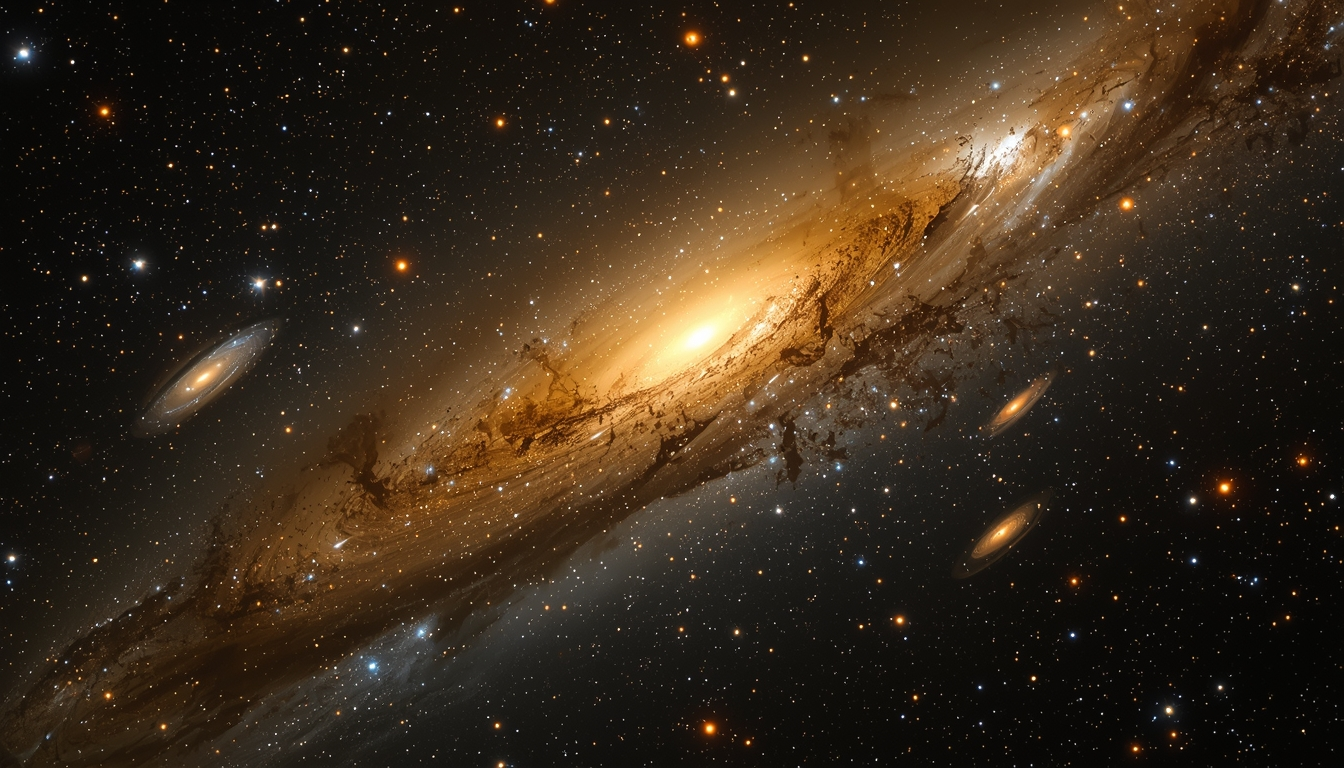
From planets to stars to entire galaxies, rotation is a fundamental feature of the cosmos. Astronomers have long assumed that, on the largest scales, the Universe has no preferred direction — that galaxies should spin clockwise and counterclockwise in roughly equal numbers.
New observations from the James Webb Space Telescope are now challenging that assumption.
A Surprising Pattern in the Early Universe
The James Webb Space Telescope (JWST) was designed to peer deeper into cosmic history than any instrument before it, capturing light from galaxies formed just a few hundred million years after the Big Bang.
While analyzing these distant systems, researchers from Kansas State University identified an unexpected trend. In a study published in Monthly Notices of the Royal Astronomical Society, computer scientist Lior Shamir and his team reported that roughly two-thirds of the observed early galaxies appear to rotate in the same direction — predominantly clockwise.
If confirmed, this imbalance would contradict the long-standing expectation of cosmic symmetry.
Under current cosmological models, galaxy orientations should be random when averaged across vast distances. Instead, JWST data seem to reveal a directional bias embedded in the young Universe itself.
Could the Universe Have Been Born Spinning?
One explanation is radical: perhaps the Universe itself had an initial angular momentum — a primordial spin inherited at birth.
Such a scenario would have profound implications. A rotating Universe could subtly influence large-scale structure formation and even affect patterns in cosmic background radiation. Some speculative models, including those proposing that our Universe formed inside a massive black hole, allow for this possibility.
“If the Universe was indeed born spinning,” Shamir noted, “it would suggest that our current cosmological theories are incomplete.”
However, no clear evidence of such large-scale rotation has yet been detected in measurements of cosmic background radiation — a key pillar of modern cosmology.
Or Is It an Observational Illusion?
A more conservative explanation involves perspective.
Earth, along with the Milky Way, moves through space while orbiting the galactic center. Some researchers have proposed that this motion could introduce subtle brightness differences between galaxies spinning in opposite directions. If galaxies rotating one way appear slightly brighter from our vantage point, they may be overrepresented in observational data.
Astronomers previously believed this effect would be too small to significantly skew results. But JWST’s unprecedented sensitivity may now be exposing biases that went unnoticed before.
If so, recalibrating deep-Universe distance measurements could become necessary. Such corrections might even help clarify lingering cosmological tensions — including discrepancies in measurements of the Universe’s expansion rate and puzzling observations of apparently “overmature” galaxies in the early cosmos.
A Challenge to Cosmic Assumptions
At this stage, the findings raise more questions than answers. Are we observing a genuine large-scale asymmetry written into the fabric of the Universe? Or are we confronting the limits of our observational frame?
Either way, the discovery underscores the transformative power of the James Webb Space Telescope. By looking further back in time than ever before, it is not just refining our understanding of cosmic origins — it is testing the very assumptions on which modern cosmology rests.
If the imbalance proves real, it could signal that the Universe holds a structural secret we have only just begun to uncover.