The Universe is no stranger to stellar outbursts. But a recent explosion observed just outside our galaxy has left astronomers stunned. What initially appeared to be a familiar type of event — a nova — has revealed characteristics unlike anything previously recorded in or near the Milky Way.
Nova vs. Supernova: A Crucial Distinction
To understand the scale of the discovery, it helps to clarify the difference between two types of stellar explosions.
A supernova marks the catastrophic death of a massive star. It releases an extraordinary amount of energy and typically occurs only once in a star’s lifetime.
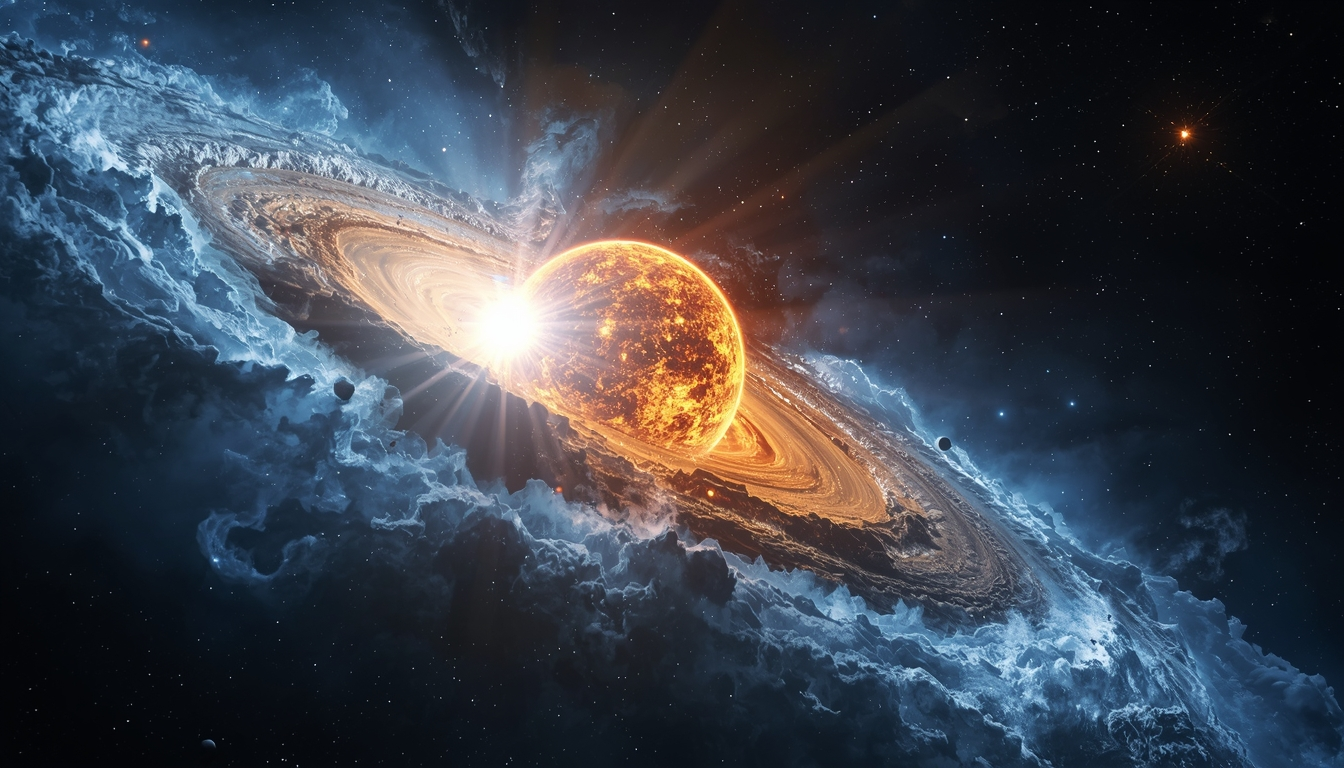
A nova, by contrast, is less destructive but still dramatic. It occurs in a binary system where a white dwarf — the dense remnant of a dead star — siphons matter from a companion star. When enough material accumulates on its surface, a thermonuclear explosion ignites.
Unlike supernovae, novae can recur. These events, known as recurrent novae, erupt at intervals ranging from a year to several decades. Only about a dozen have been documented in the Milky Way.
A Recurrent Nova in the Large Magellanic Cloud
The object at the center of this discovery is LMC 1968-12a, located in the Large Magellanic Cloud, a satellite galaxy of the Milky Way.
First identified in 1968, this system consists of a white dwarf and a red subgiant star significantly larger than the Sun. Since 1990, astronomers have observed eruptions approximately every four years, making it a predictable target for study.
When the nova erupted again in 2024, researchers were ready.
For the first time, scientists captured near-infrared spectroscopic data of an extragalactic recurrent nova. Observations were conducted using the Magellan Baade Telescope at the Carnegie Institution for Science and the Gemini South Telescope, part of the International Gemini Observatory.
What they found was extraordinary.
A Spectral Signature Never Seen Before
Shortly after the eruption, the nova’s brightness began to fade. But spectroscopic instruments continued to detect an unusually intense signal from ionized silicon.
In particular, astronomers observed silicon atoms stripped of nine of their fourteen electrons — a level of ionization that requires immense energy. This could only be achieved through extreme radiation or highly energetic collisions within the ejected material.
At its peak, the near-infrared emission from ionized silicon alone was measured at approximately 95 times the Sun’s total energy output across all wavelengths.
“This is unprecedented,” said astronomer Tom Geballe of NOIRLab.
Even more surprising was what researchers did not detect. Typical novae in the Milky Way show spectral signatures from sulfur, phosphorus, calcium, and aluminum. In LMC 1968-12a, those elements were absent. Silicon dominated the spectrum almost entirely.
A Nova Shaped by Its Environment
Astronomers estimate that the expelled gas may have reached temperatures exceeding 3 million degrees Celsius — making this one of the hottest novae ever recorded.
Why so extreme?
The answer likely lies in the chemical composition of the Large Magellanic Cloud. Compared to the Milky Way, it contains fewer heavy elements — what astronomers refer to as lower “metallicity.”
In metal-rich environments, heavy elements trap heat on a white dwarf’s surface, triggering more frequent but less violent eruptions. In metal-poor systems like the Large Magellanic Cloud, more material must accumulate before ignition occurs. The result: rarer, but far more powerful explosions.
In this case, the large red subgiant companion further amplified the violence. As the nova’s ejected material slammed into the companion star’s outer atmosphere, intense shockwaves likely drove temperatures even higher.
A Breakthrough in Astrophysics
Until now, the link between low-metallicity environments and more extreme nova explosions had been largely theoretical. This eruption provides direct observational evidence supporting that model.
Far from being a routine stellar flare, the explosion of LMC 1968-12a offers new insight into how chemical composition shapes cosmic events. It also highlights how neighboring galaxies can host phenomena that behave very differently from those in our own.
In a Universe filled with explosive endings, this one stands apart — not for its size alone, but for the clues it reveals about how stars live, erupt, and interact with their environments beyond the Milky Way.